Stucco on your house should look like one wall, not a wall with scars. We fix the cracks, loose patches and water damage, then match the texture so the repair disappears under paint.
Qualified MasonsVerified ProfessionalsFree EstimatesOn Time
What stucco repair involves
Stucco is a cement finish troweled over block, or over a framed wall with lath and a water barrier behind it. It's tough, but it's rigid, and houses move. Settling, water sneaking in at a window or under a downspout, and a hard knock from a mower or a ladder all show up as cracks, hollow spots or stains.
You need us when a crack is wide enough to slip a nickel into, when a patch sounds hollow under your knuckles, or when a stain keeps coming back in the same place. We start with a free estimate. We'll tell you straight whether it's a quick patch or something failing behind the surface. Homeowners in Atlanta call us for both.
Signs you need stucco repair
Cracks wider than a hairlineIf you can slide the edge of a nickel into it, the wall is moving or water has been working behind it. We don't just caulk those.
Hollow sound when tappedKnock with your knuckles. A dull, drummy sound means the stucco has let go of what's behind it, even if it looks fine.
Stains under windows or below rooflinesBrown or dark streaks mean water is getting in and running down inside the wall. The stain is the symptom, and the leak is the problem.
Bulges or soft spotsIf the wall gives under your thumb or bellies out, the backing is probably wet or rotted and the stucco is just hiding it.
What we handle
Hairline and wider crack repairHairlines get cleaned, filled with a flexible patching material and painted. Wider cracks we grind open into a V-shaped groove so the patch has something to grip.
Patching loose or hollow areasWe tap out the whole bad area, cut back to solid stucco and rebuild it in coats. The edges get cut square so we don't leave a thin feathered patch that cracks again.
Repair around windows and doorsCorners of openings crack first because stress gathers there. We cut out the failed stucco, check the flashing and sealant, and rebuild so water runs out and not in.
Re-coating a wall to a matching textureWhen patches would outnumber good wall, we put a new finish coat over the whole face. It takes a steady hand to keep one texture, dash or sand or lace, across every foot of it.
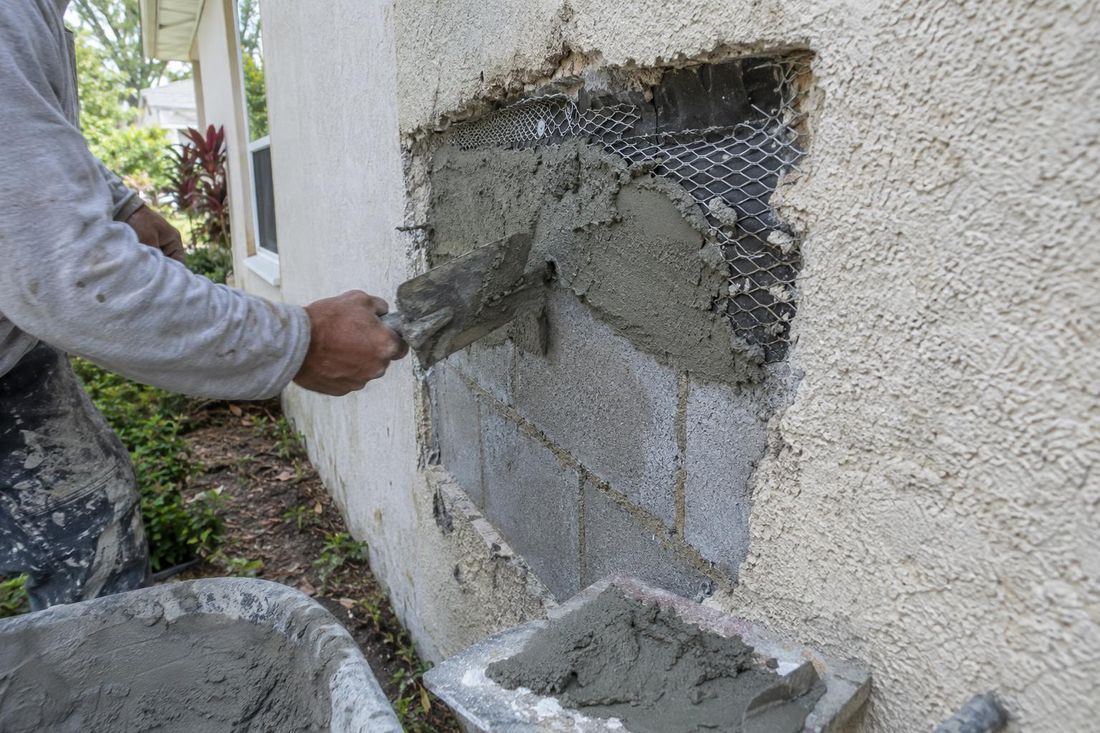
Applying stucco patch over wire lath A person in a long-sleeved gray shirt uses a trowel to press gray stucco mortar onto metal wire mesh in an opening cut into a textured stucco wall. Concrete block shows below the mesh, and a mortar tub and a wheelbarrow of mix sit in the foreground.
How we do it
Loose stucco is cut back to sound edges. We find those edges by tapping, then cut with a grinder and a cold chisel until what's left is tight to the wall. On block, new stucco bonds directly to the masonry, so we wet the block down and get to work. On framing, the lath and water barrier behind are repaired first. Torn paper or rusted lath gets replaced, and new barrier laps over old like shingles so water sheds outward.
Stucco goes on in coats. On lath that's usually a scratch coat raked so the next layer grips, a brown coat to bring it flush, and then the finish coat. We let each one firm up before the next. The texture is matched by hand, and we try it on a small spot first so you can see it before we do the whole patch.
How a job with us goes
Free estimate and tap test for hollow areas
We walk the whole house, not just the crack you pointed at. We tap the walls, look at roof edges and downspouts, and tell you what we find.
Loose material removed
We cut back to sound stucco with a grinder and chisel. It's dusty, so we mask windows and tarp the ground. It also shows us what's really behind the wall.
Backing repaired
On framed walls we fix the lath, water barrier and flashing before any stucco goes on. Skip this step and the patch fails, because the water is still getting in.
Coats applied and textured
We apply the coats one at a time and let each set up. Then we match the texture with a trowel, brush or float, whatever your wall calls for.
Cure time before painting
New stucco has to cure and dry before paint goes on, or the paint can peel. We tell you when the wall is ready.
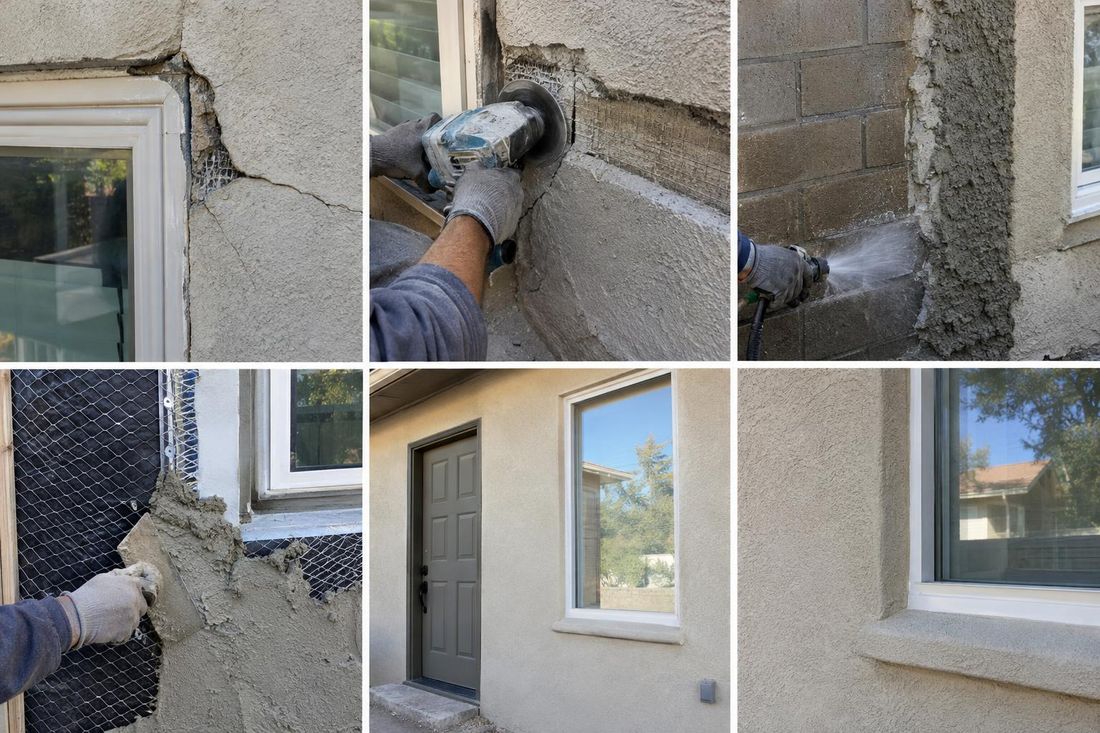
Stucco crack repair process collage Six panels show a stucco wall with a cracked corner by a window, a grinder cutting along the crack, and a hose rinsing a block wall beside a stucco edge. Further panels show a worker troweling stucco over wire mesh and black paper, then smooth finished stucco around a door and windows.
What drives the cost
The price follows the work behind the surface more than the crack you can see. Size and number of patches matter, since every separate patch means setup, mixing and blending. What we find behind the stucco matters most. A dry, solid block wall is simple, while a framed wall with wet backing is not. Texture matching takes time, and a heavy dash or lace finish is harder to blend than a smooth one. Height adds cost because it means scaffolding or a lift. A few small cracks at ground level cost far less than a gable end full of hollow spots. We'll explain the number in plain words at the free estimate.
How long it takes
Most repairs take one to three days of actual work, depending on how many patches there are and how much has to be rebuilt behind the stucco. Each coat has to firm up before the next goes on, so we don't rush it. Then comes a cure period before paint. Weather matters too. Hot sun or hard rain on fresh stucco causes trouble, and we may move a day to protect the work. We'll give you a real schedule when we do the estimate.
Local expertise: residential stucco repair in Atlanta
Atlanta gets about 49.7 inches of rain a year. Late winter, early spring and July are the wettest stretches, and fall, especially October, is the driest.
What it means for your job
Mortar, stucco and sealers need dry time. Fall is the easiest season for repointing and sealing, and summer work is planned around afternoon storms.
Overnight freezes can be expected on about 40 days a year in Atlanta.
What it means for your job
Water that soaks into brick, stone and mortar and then freezes is what pops faces off brick and opens joints. Keeping water out matters more here than in places that rarely freeze, and winter mortar work has to be protected overnight.
Rotted wood behind stucco on framed walls must be repaired before the patch. If we open a wall and find soft sheathing or damaged studs, we'll show you, and that repair has to happen first because a patch over rot is wasted money. Painting is usually separate. We also can't fix a leak whose source is somewhere else, like a failed roof edge or a bad gutter, so those need attention too. And new stucco won't match an old wall's color on its own. We match the texture, which is why we suggest painting the full wall.
Hairline cracks are common and are sealed and painted. Wide cracks or bulges mean something behind has failed. We'll look at which one you've got.
Will the patch show?
A good texture match plus painting the full wall hides it. Fresh stucco is a different shade from old until the paint goes on.
Can I just caulk the crack myself?
For a true hairline, a paintable flexible filler can hold. Wider cracks keep moving and open back up, and caulk can trap water behind the wall. Tap around the crack first.
Why is there a stain under my window?
Water is probably getting in at the sill, the window edge or the flashing. We trace it before we patch, because stucco over a live leak fails again.
Do I need to move anything?
We need clear access to the wall. Trim shrubs back, move grills and furniture away, and close your windows. Dust happens.