A crack in a commercial wall usually means the wall has nowhere to move. We fix the crack and give the wall a way to move, so it doesn't split open again next to our patch.
Qualified MasonsVerified ProfessionalsFree EstimatesOn Time
What masonry crack repair involves
Commercial masonry cracks for a few repeat reasons. The wall never got movement joints, or the steel behind the brick is rusting, or part of the building has settled. Block and brick shrink and shift with the temperature, and a long wall with no control joints will pick its own spots to break. Patching the crack alone treats the symptom.
You need this when cracks line up along a long wall, start at a lintel or shelf angle, or keep widening. Property managers call us after a tenant spots a gap or a piece of brick drops. General contractors call when a warranty walk turns up cracking. We work out the cause first, then repair to fit it. Call us for a free estimate in Atlanta.
Signs you need masonry crack repair
Cracks lined up at regular spacingThat usually means the wall wants movement joints and was never given any. Long block walls split in the same spots again and again.
Rust stains or a bulge at a lintel or shelf angleThe steel behind the brick is rusting, and rust takes up more room than steel. It pushes the masonry apart and the cracks keep growing.
Stepped or diagonal cracks near a corner or slabPart of the building may have settled. We want to know if it has stopped before we patch anything.
Sealant split or pulled loose at a jointThe joint is working harder than it was built to, or the wall needs another joint nearby.
What we handle
Cracks from missing control or expansion jointsLong block and brick walls need joints cut in where they want to move. We lay out the spacing, cut them in and seal them.
Cracks at lintels, shelf angles and cornersRusting steel is the usual cause. We open the masonry, clean or replace the steel, and rebuild what we took out.
Settlement cracks in block wallsThese step along the mortar joints or run straight through the block. We find out if the movement has stopped, then stitch or rebuild.
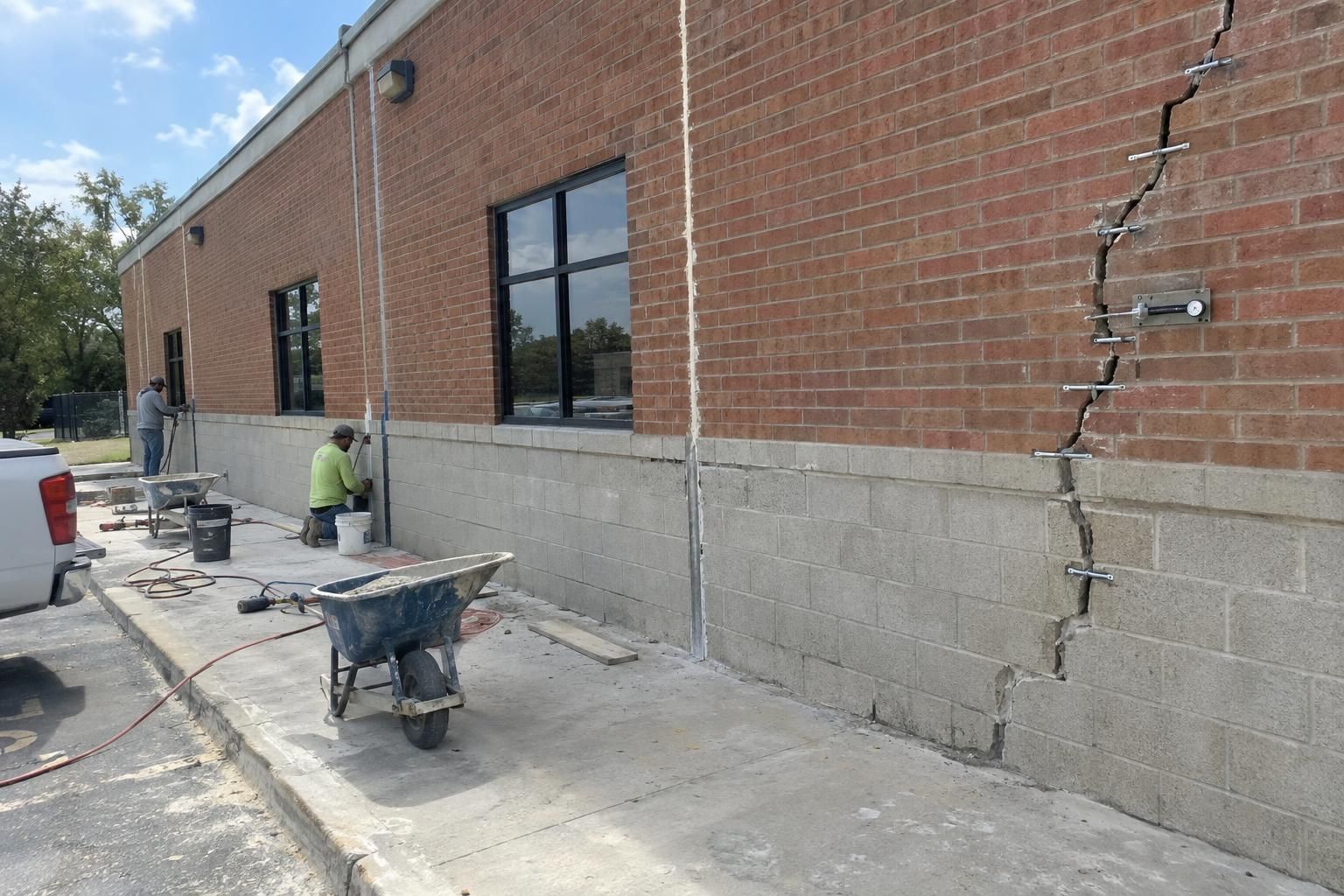
Crack monitoring before repairWhen the cause isn't clear, we mount gauges across the crack and read them over time. It takes patience up front, but it keeps you from repairing a crack that's still moving.
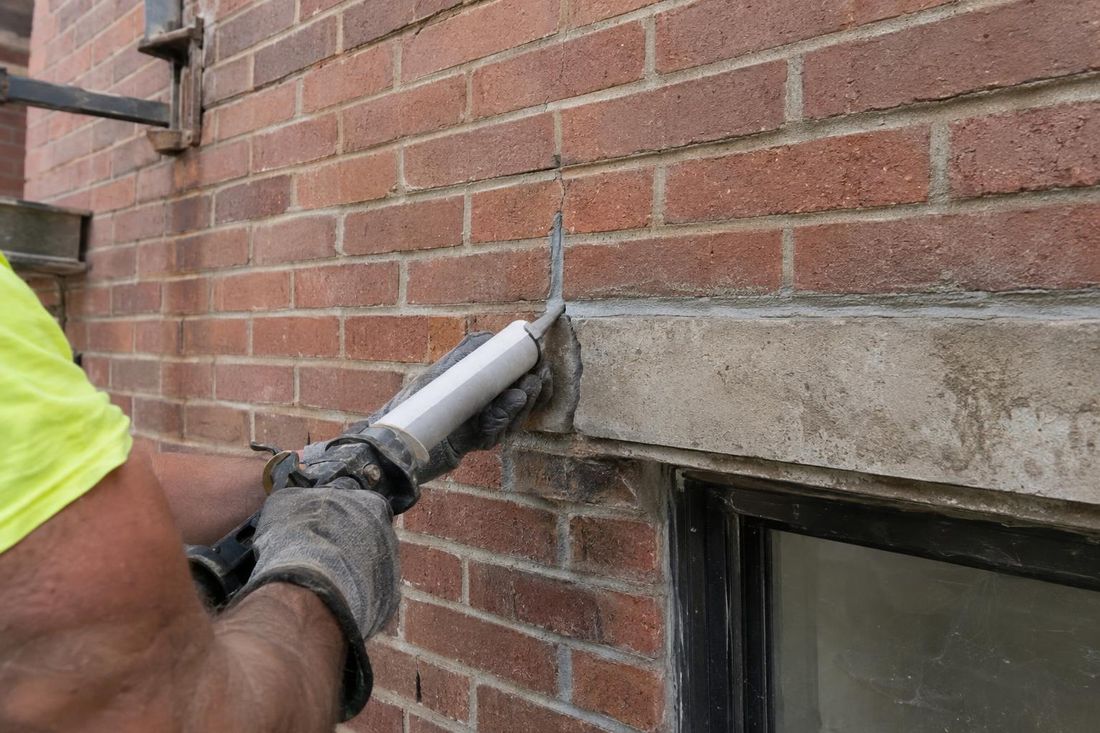
Caulking a crack in brick wall A gloved worker uses a caulking gun to apply sealant into a vertical crack in the mortar joint of a red brick wall, just above a concrete window lintel. A black window frame is visible at the lower right.
How we do it
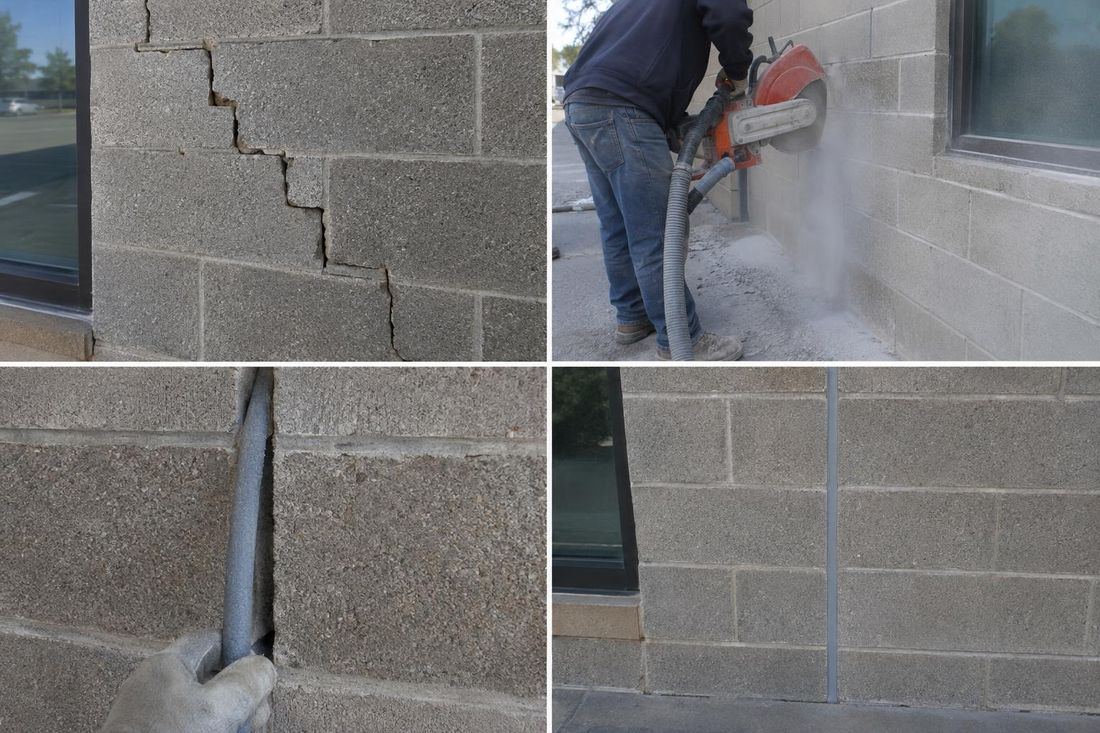
For new movement joints, we saw-cut the wall with a diamond blade where it needs to move, blow out the dust, and push in backer rod. Then we fill the joint with a flexible sealant. The backer rod keeps the sealant from sticking on three sides, so it can stretch and shrink with the wall. Mortar can't do that job, which is why a mortar-filled crack opens again.
Structural cracks get stitched with stainless steel bars. We cut slots across the crack along the mortar joints, set the bars in epoxy or grout, and repoint over them. Where the damage is bigger, we rebuild the wall to an engineer's detail. Gauges can be mounted across a crack to learn whether it is still moving. We check them on a schedule and write the readings down, so the decision to repair rests on numbers and not a guess.
How a job with us goes
Survey and crack mapping
We walk the whole building and mark every crack on a drawing with its width, direction and length. We read the pattern first, because cracks in a neat row tell a different story than one lonely crack.
Monitoring or engineer review
If the cause isn't clear, we mount gauges and watch. If steel or settlement is involved, we bring in an engineer before we cut anything.
Access and protection
We set up lifts or scaffolding and cover doors, walks and windows below. We also plan the work so your tenants or customers can still get in.
Repairs and new joints
We saw-cut joints, stitch cracks and rebuild damaged masonry. The wall has to be able to move before we close the crack, so the joints come first.
Sealants and finish restoration
We seal the joints, repoint and clean up. We match mortar and sealant color as close as we can, then walk the job with you.
Cutting and sealing cracked block wall A four-panel collage shows a stepped crack in a concrete block wall, a worker cutting a vertical joint in the wall with a dust-vacuum saw, a gray backer rod being pressed into the cut joint, and the finished wall with a narrow vertical control joint line.
What drives the cost
Price follows the work, and the biggest driver is usually the linear feet of crack. New joints add up by how many we cut and how tall the wall is. Stitching adds slots, bars and grout for every crack we treat. Access matters more than people expect, since a lift or scaffold on a tall wall can take a real share of the budget. Engineering adds a fee when a crack needs a stamped detail, and monitoring adds visits. We give free estimates, and we'll tell you which items are firm and which depend on what we find once the wall is opened up.
How long it takes
Most repairs run from a few days to a few weeks, depending on how much wall there is and how we get at it. Weather can slow mortar and sealant work. If we monitor first, that adds months, because a crack needs time to show you how it moves through the seasons. But it beats repairing a crack that's still moving and paying to do the job twice.
Local expertise: commercial masonry crack repair in Atlanta
The red clay of the Georgia Piedmont is typified by the Cecil soil series: very deep, well drained soil on ridges and side slopes, with a red subsoil that averages 35 to 60 percent clay.
What it means for your job
Clay holds water against a wall and does not recover well once it is compacted, so drainage behind a retaining wall and a properly built base under pavers and footings matter more here than the surface material.
Atlanta gets about 49.7 inches of rain a year. Late winter, early spring and July are the wettest stretches, and fall, especially October, is the driest.
What it means for your job
Mortar, stucco and sealers need dry time. Fall is the easiest season for repointing and sealing, and summer work is planned around afternoon storms.
Overnight freezes can be expected on about 40 days a year in Atlanta.
What it means for your job
Water that soaks into brick, stone and mortar and then freezes is what pops faces off brick and opens joints. Keeping water out matters more here than in places that rarely freeze, and winter mortar work has to be protected overnight.
Structural causes need an engineer, and we won't guess at those. If a lintel has sagged or a foundation is still settling, we bring one in and build to the detail. Repair without addressing movement will crack again, so we won't just fill a crack that needs a joint. Fixing a failed footing, bad drainage or a roof leak that's feeding the damage falls outside masonry, though we'll point it out when we see it. Sealant also ages and will need replacing down the road. You'll get an honest read with your free estimate, even if it's not the answer you wanted.