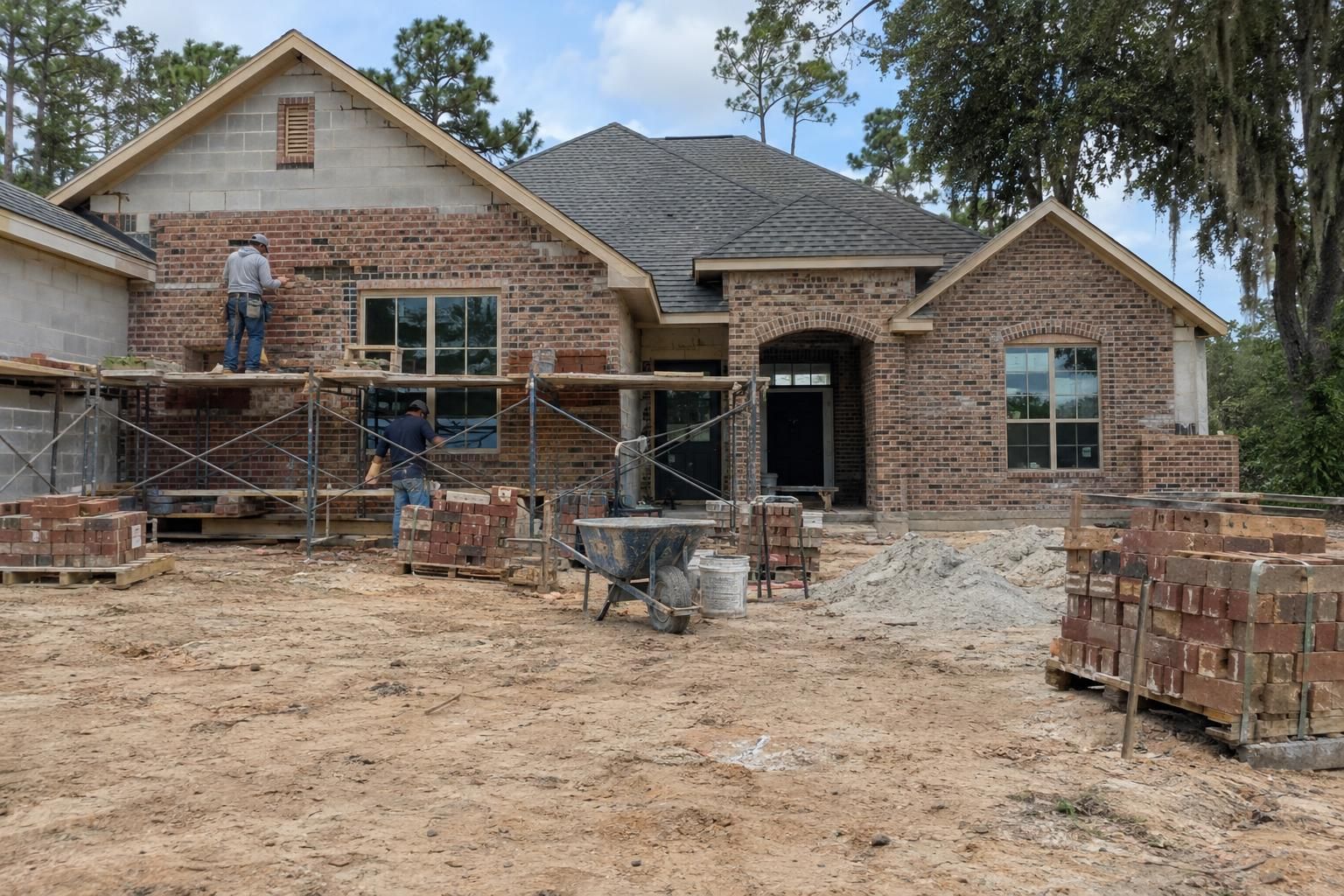
Brick veneer gives your house the look of a brick house without the brick holding anything up. It's one layer of brick over a framed wall, laid by hand by our masons.
Qualified MasonsVerified ProfessionalsFree EstimatesOn Time
What brick veneer installation involves
Here's how it works. Your walls stay wood-framed and sheathed like they are now. We add a single layer of brick that stands off the wall with a small air gap behind it. The frame still carries the house. The brick carries only itself, down to a footing or ledge, and sheds the weather before it reaches your sheathing. Thin brick gives you the same look as a surface, set on the wall much like tile.
Most homeowners call us when they're tired of painting or re-siding, when an addition needs to match the brick next door, or when a fireplace wall or kitchen backsplash wants some real weight. Not sure which kind your house can take? We'll check the foundation and the wall first, then tell you straight. Estimates are free for homes in Atlanta.
Signs you need brick veneer installation
Paint that won't stay putYou're scraping and repainting siding every few years and you're sick of it. Brick has no paint film to peel, and the color runs through the clay.
An addition that doesn't matchThe new room is sided and the old house is brick. Veneer lets us carry brick across the new wall so the seam disappears.
A tired fireplace or accent wallDated tile, painted drywall, or a surround that looks flat. Thin brick goes up in a few days and gives the room some heft.
Damaged or faded sidingCracked vinyl, soft boards, or panels that have faded unevenly. If the sheathing underneath is sound once the siding's off, we can often brick right over it.
What we handle
Full-thickness veneer on exterior wallsReal full-size brick laid on a footing or steel ledge and tied back to the framing. It's what most people picture when they say brick house.
Thin brick, outside or inReal brick cut thin and adhered to a prepared wall. It's our answer when your house has no ledge for full brick, and it works well on interior walls.
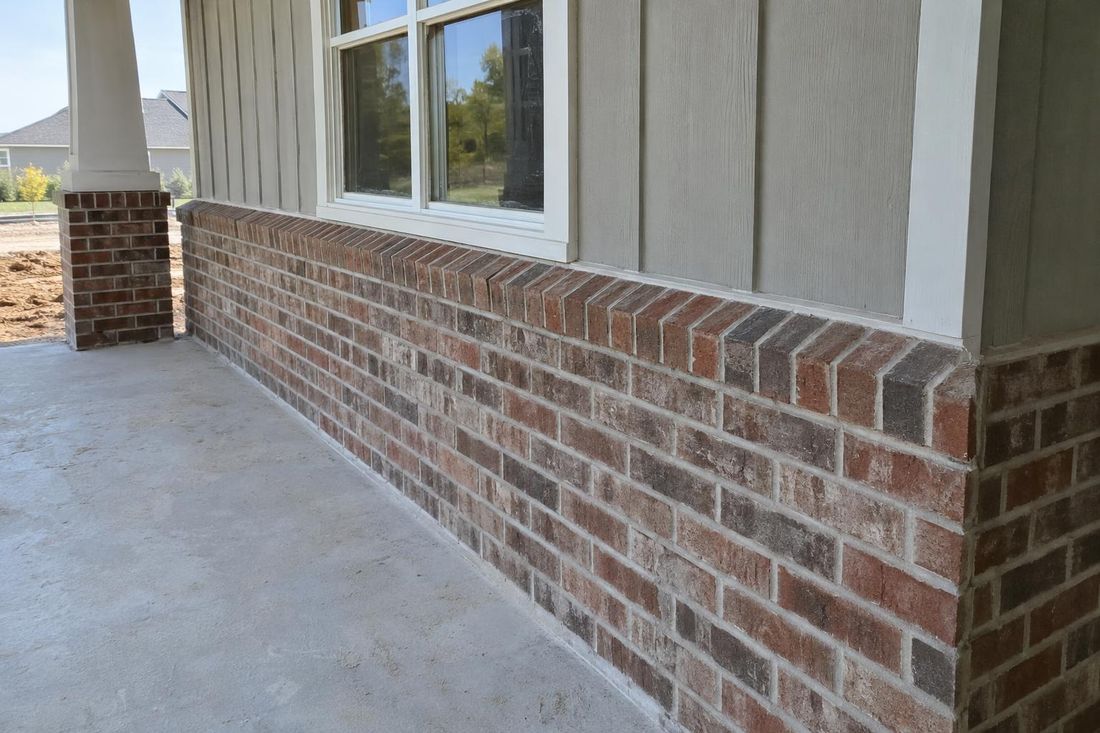
Brick wainscotBrick on the lower part of a wall, often a few feet high. We cap it with a sloped sill so water runs off, which looks good on a front porch or a garage wall.
Interior accent walls and fireplace surroundsThin brick around a fireplace, behind a stove, or on one wall in a kitchen or entry. We keep the clearances the fireplace or stove maker calls for.
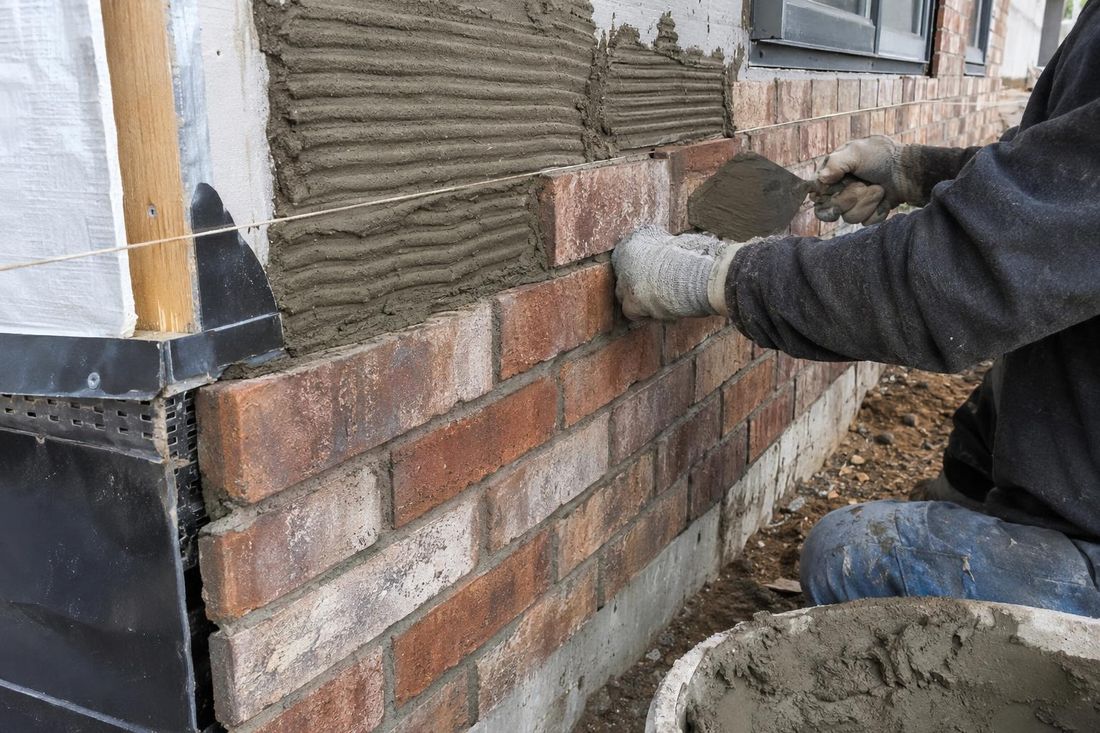
Mortar-set thin brick veneer installation A worker in gloves presses a brick into a ribbed layer of mortar on an exterior wall, using a trowel and a guide string for alignment. Finished brick courses sit below on a concrete foundation, with a metal flashing strip and a mortar bucket also in view.
How we do it
Full brick sits on a footing or a steel ledge, which is angle iron bolted to the foundation. It's tied to the framing with corrugated metal ties nailed into the studs. Behind the brick we leave an air gap of about an inch over a moisture barrier. Flashing at the bottom catches any water that gets in, and weep holes along the base let it back out. Skip those details and the water stays in your wall. We don't skip them.
Thin brick is adhered to a prepared wall like tile and then grouted with mortar. Over wood framing we hang a moisture barrier and metal lath, then lay a scratch coat of mortar for the brick to grip. On concrete or block we clean the surface first so the bond holds. We set each piece with a notched trowel and fill the joints with a grout bag.
How a job with us goes
Free estimate and brick selection
We walk your house, check the foundation first, and measure the walls. Then we hold brick samples against your trim and roof in daylight, since color looks different outside.
Wall preparation
We add a ledge if full brick needs one, hang a moisture barrier, and fasten ties to the studs. Thin brick gets metal lath instead. A good wall behind the brick is half the job.
Brick installed
Our masons lay full brick course by course, checking level and plumb as we go, and keep the air gap clear of mortar so the weep holes can drain. Thin brick is set row by row with a notched trowel.
Joints filled and tooled
We fill the joints, then tool them with a jointer once the mortar is thumbprint hard. Tooling packs the surface tight and sheds water, which is why we don't skip it.
Cleaning
We brush the brick down and wash off mortar haze with a mild cleaner, then rinse the wall and pick up the site. Harsh acid can stain brick, so we go easy.
Brick veneer on porch wall base A residential porch wall shows a finished red and gray brick veneer base with a sloped rowlock brick sill course beneath a white-framed window and tan vertical siding. A matching brick-clad column base and an unfinished concrete porch floor are also visible.
What drives the cost
The biggest driver is wall area, because every square foot needs brick, mortar and hands to lay it. Full brick costs more than thin brick, mostly in labor. If your foundation needs a steel ledge added, that's extra work before we lay a single brick. Lots of windows, doors, corners and gable peaks slow us down, since each one means more cutting. The brick itself matters too, from a plain common brick to a handmade one. Height and access play a part, like whether we need scaffolding. We'll walk the house with you and put it all in your free estimate.
How long it takes
An accent wall takes a few days. A whole exterior takes one to several weeks, depending on how big the house is and how many corners and openings we're working around. Weather matters too. Mortar doesn't cure well in a hard freeze or a downpour, so we may pause for a day. We'll give you a realistic window when we do your estimate, and we'll tell you if it shifts.
Local expertise: residential brick veneer installation in Atlanta
Atlanta gets about 49.7 inches of rain a year. Late winter, early spring and July are the wettest stretches, and fall, especially October, is the driest.
What it means for your job
Mortar, stucco and sealers need dry time. Fall is the easiest season for repointing and sealing, and summer work is planned around afternoon storms.
Overnight freezes can be expected on about 40 days a year in Atlanta.
What it means for your job
Water that soaks into brick, stone and mortar and then freezes is what pops faces off brick and opens joints. Keeping water out matters more here than in places that rarely freeze, and winter mortar work has to be protected overnight.
Full brick needs something to sit on. Houses built without a brick ledge usually get thin brick instead, unless you're open to adding a footing or steel ledge. Siding removal and trim work may be a separate trade, and we'll tell you up front if your job needs one. We don't repair rotted sheathing or framing, so if we find soft wood behind your siding, it has to be fixed first. And we won't lay brick on a wall that isn't sound enough to hold ties or lath.