Commercial Water damage and spalling repair in Atlanta
Water in a commercial wall rarely tells you where it came in. We start by finding the entry point, because treating the whole wall is how money gets spent twice.
Qualified MasonsVerified ProfessionalsFree EstimatesOn Time
What water damage and spalling repair involves
Water damage and spalling repair is what we do when a masonry building starts showing the effects of moisture. You'll see stained ceilings, brick faces popping off, or rust bleeding out of the joints. The water usually gets in at a few spots, like a failed flashing, a cracked coping joint, or a weep hole packed with mortar. Then it travels, so the leak inside is often far from the leak outside.
You need us when sealing and patching haven't held, when a tenant keeps calling about the same wall, or when an inspection finds loose brick over a sidewalk. We test, we open the wall where the test points, and we fix what's actually broken. Want to know how bad it is? Call us for a free estimate in Atlanta.
Signs you need water damage and spalling repair
Stains at the top of interior walls or on ceilingsWater is getting past the wall and running along a shelf angle, a lintel or the roof edge before it drops. The stain is rarely right under the leak.
Brick faces flaking or popping offThat's spalling. Water got into the brick and stayed, and it pushed the face off. Look first below copings, near parapets and above openings.
Rust stains or cracks running from lintels and shelf anglesThe steel is rusting and swelling, and that cracks the brick around it. We'd rather catch this early.
White powder or damp patches on the wallThat's efflorescence, and it means water is moving through and carrying salt out. Open joints and weeps that don't drain are common causes.
What we handle
Leak investigation and water testingWe trace stains back, then spray the suspect areas section by section. That proves where water enters before anyone pays for repairs.
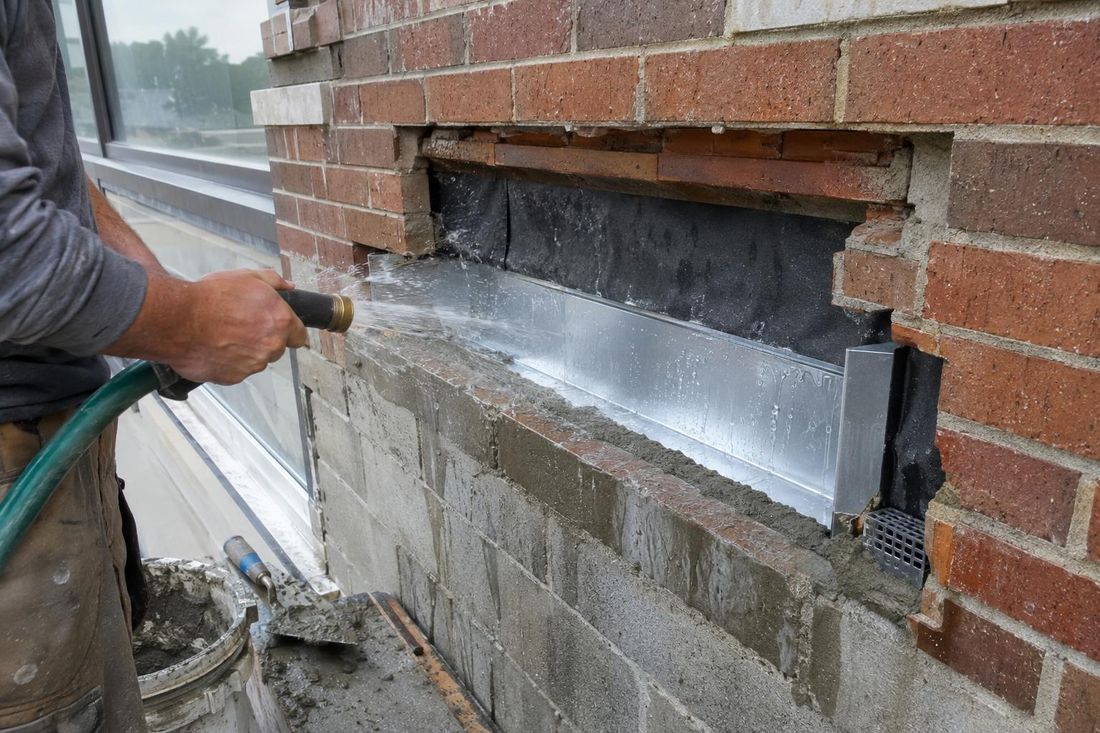
Flashing and weep repairWe open the wall at a failed through-wall flashing and rebuild it. Then we clear or add weeps so the cavity can drain.
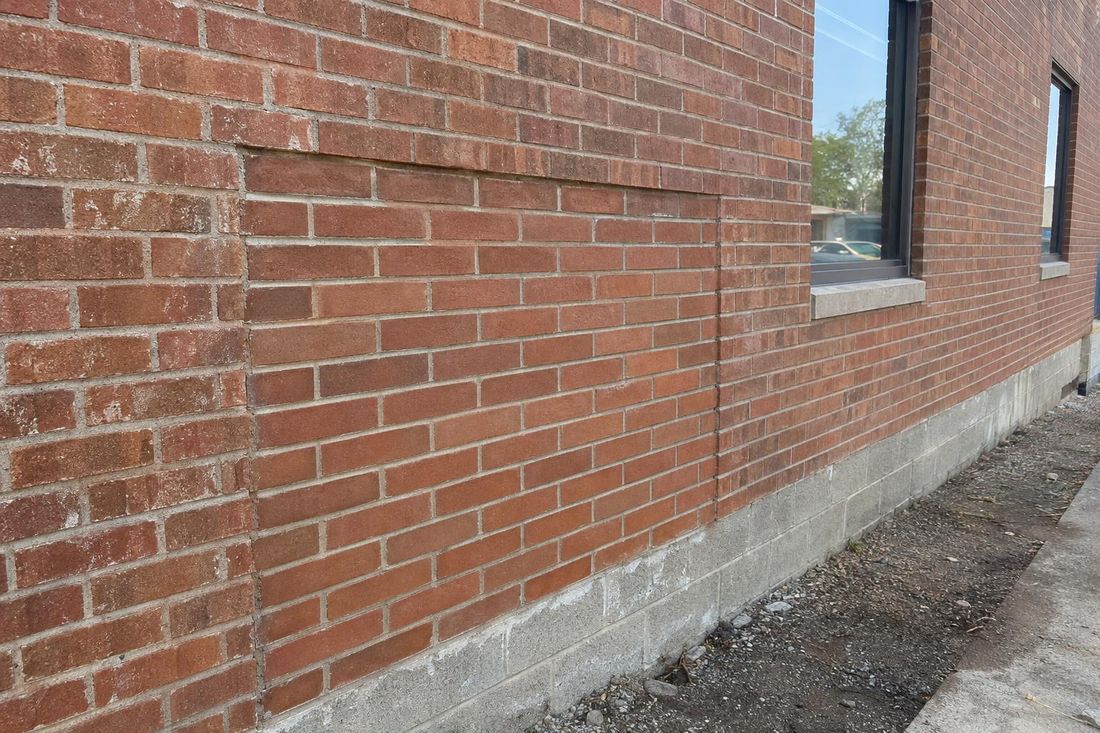
Spalled brick and block replacementWe cut out the damaged units and lay matching ones, bonded into the surrounding wall.
Coping, parapet and sealant repairThe tops of walls take the worst of the weather. We reset or reseal copings, repoint parapet joints and replace failed sealant.
Lintel and shelf angle repairWhen rusting steel is cracking the brick, we take out the brick, deal with the steel and rebuild the masonry.
Wetting masonry during flashing installation A worker sprays water from a hose onto a concrete block ledge where a metal flashing pan sits beneath an opening cut into a red brick wall. Dark water-resistant membrane lines the opening, and a mortar bucket and trowel rest below.
How we do it
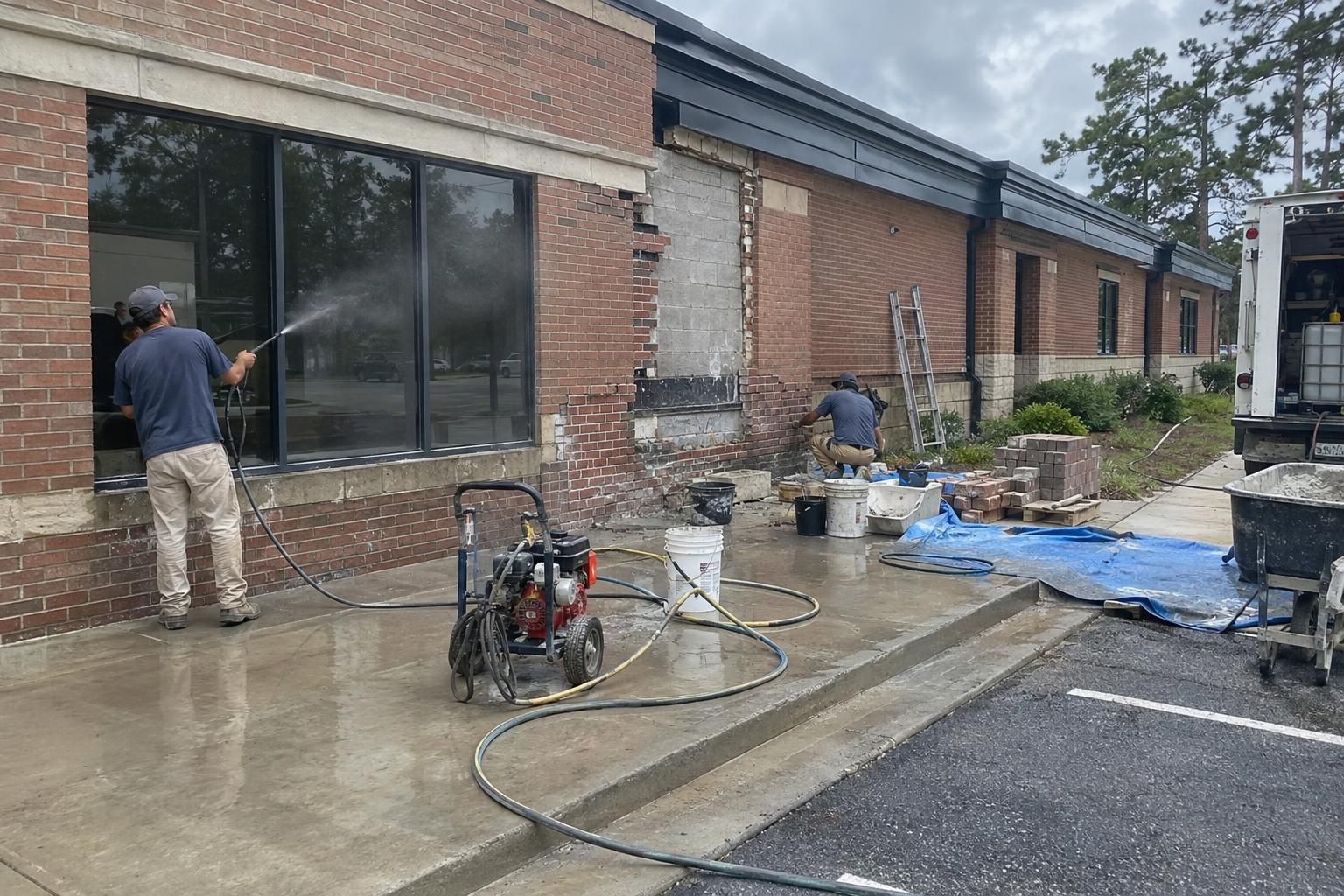
Spray testing isolates where water enters. We run a hose with a spray bar across one section of wall at a time, starting low and working up, while someone inside watches for moisture. The first section that leaks tells us where to look. Sometimes we also pull a few bricks or a sealant bead to see the flashing behind.
Common fixes are rebuilding failed through-wall flashing, clearing blocked weeps, resealing joints and copings, and replacing damaged units. We cut old mortar out with a grinder and repoint with mortar matched to the wall, because mortar harder than the brick pushes the damage into the brick. Once the entry points are fixed and the wall has dried, we apply a breathable water repellent where suitable. We don't use it to cover open joints.
How a job with us goes
Leak history and survey
We ask where it leaks, after what kind of weather, and who has already tried to fix it. Then we walk the building, inside and out, looking at copings, flashing lines, lintels and sealant. The stain pattern usually narrows things fast.
Water testing
We spray one section at a time, bottom to top, and watch from inside. That shows which spot actually leaks, not which one we suspect. We note every result.
Opening up
Where testing points to flashing or steel, we take out a few units and look. It beats guessing, and it shows how far the damage runs.
Targeted repairs
We fix only what the testing and the open wall showed us. We work in the order that stops water first.
Retest and report
We spray the repaired areas again to see if they hold. Then we give you a written report of what we found and what we fixed.
Brick wall with replaced section A red brick wall on a commercial building has a rectangular patch of newer, more uniform bricks set into the older, more weathered brickwork, with visible seams marking the patch edges. A concrete block base runs along the bottom of the wall, and windows are visible on the right.
What drives the cost
Investigation time comes first. One stain on one wall is a short visit, and a whole building with several leaks takes longer. Access matters too, since work from a lift or scaffold costs more than work from the ground. Then there's the extent of flashing work, because rebuilding flashing means taking out the masonry above it and putting it back. The last piece is the number of units we replace and whether rusted steel is involved. We won't know most of that until we test, so our free estimate often begins with a look and a plan.
How long it takes
Investigation takes a day or two. Repairs range from days to weeks, depending on how much flashing has to be rebuilt and how many units need replacing. Weather matters, because we can't test or lay mortar well in the rain, and new mortar needs time to cure before we retest. If the building is occupied, we plan around your tenants, and that can stretch the schedule a little. We'll give you a realistic window once we've seen what's behind the wall.
Local expertise: commercial water damage and spalling repair in Atlanta
Atlanta gets about 49.7 inches of rain a year. Late winter, early spring and July are the wettest stretches, and fall, especially October, is the driest.
What it means for your job
Mortar, stucco and sealers need dry time. Fall is the easiest season for repointing and sealing, and summer work is planned around afternoon storms.
Overnight freezes can be expected on about 40 days a year in Atlanta.
What it means for your job
Water that soaks into brick, stone and mortar and then freezes is what pops faces off brick and opens joints. Keeping water out matters more here than in places that rarely freeze, and winter mortar work has to be protected overnight.
Leaks from roofing, windows or mechanical units are other trades. Testing shows which it is, and we'll tell you straight if the water isn't coming through the masonry. If a wall is bowing or a lintel has failed badly, we'll tell you to bring in an engineer before we touch it. A water repellent won't stop leaks through open joints or bad flashing, so those get fixed first. A soaked wall also needs time to dry before we can judge the results. Interior damage like drywall, paint and ceiling tile isn't part of our work.
We have sealed the wall twice and it still leaks. Why?
Sealer can't bridge a failed flashing, an open joint or a cracked coping. Testing finds the real entry point, and then we fix that.
Is white staining on our brick a problem?
It shows water is moving through the wall and is worth investigating. The salt isn't the damage, but wherever it comes from, water is coming too.
Our leak only shows up in wind-driven rain. Can you still find it?
Often, yes. A spray bar can copy rain hitting from the side. We start with the side of the building that takes the weather.
Can you work while tenants are in the building?
Usually. Most of our work is outside, but testing needs someone inside watching for water, so we coordinate with your manager. We schedule the noisy cutting with you.
Do you have to take down the whole wall?
No. We open only where testing points, like a few units at a flashing line or around a rusted lintel, and then we rebuild to match.