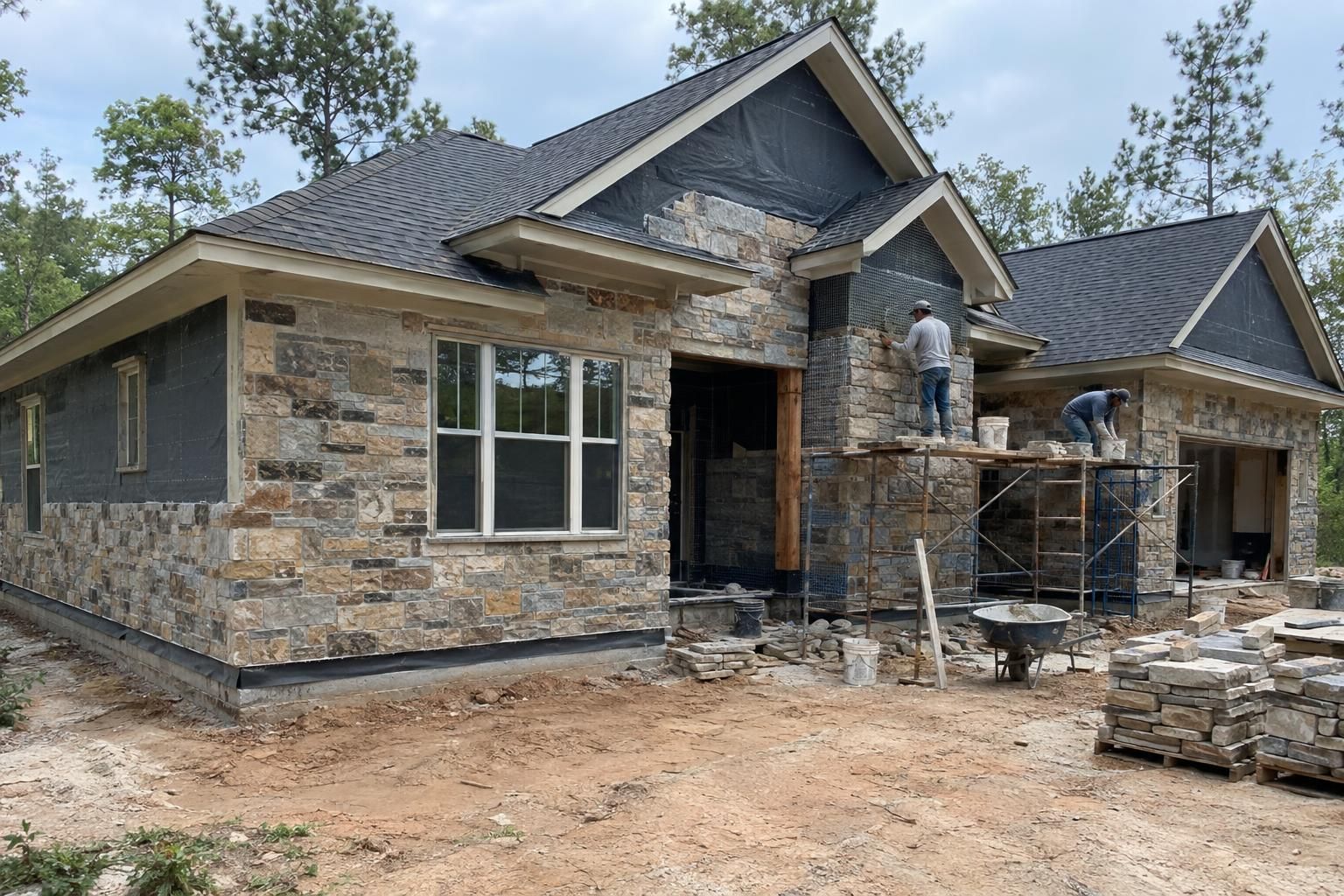
Stone veneer gives your house the look of a stone wall without the weight of one. We build what's hidden behind it as carefully as what you'll see from the street.
Qualified MasonsVerified ProfessionalsFree EstimatesOn Time
What stone veneer installation involves
Stone veneer is a thin layer of natural or manufactured stone fixed to a wall. On a house it dresses up an entry, columns, the lower walls or a fireplace. It keeps working because the wall behind it is built to shed water.
Most people call us when an entry looks flat, when a bare concrete foundation shows more than they'd like, or when a fireplace face is stuck in another decade. We come out, look at the wall you have, and tell you straight whether stone can go there and what has to happen first. Not sure which stone? We'll bring samples and hold them against your siding. Estimates are free, so call us here in Atlanta.
Signs you need stone veneer installation
Your entry looks flatA plain stoop or door surround with nothing to catch the eye is the classic reason people call us. Stone on the surround or the columns gives the front some weight.
Bare foundation showingA strip of gray concrete between the ground and your siding looks unfinished. Stone skirting covers it and gives the house a base to sit on.
Fireplace face looks datedTired tile, old brick or a flat painted surface can be covered in stone once we check the clearances around the firebox.
Old veneer is stained or looseDark streaks, a hollow sound when we tap, or stones lifting at the bottom usually mean water got behind it. We'd want to open it up and look.
What we handle
Natural thin stoneReal stone sawn thin, so it's far lighter than a full stone wall. It holds its color, and cut edges look like stone all the way through.
Manufactured (cast) stoneCast in molds and colored, it weighs less and costs less. It suits big areas like a long run of skirting.
Stacked ledgestone panelsNarrow stone pieces pre-assembled into panels, which go up faster and give a tight, linear look. We like them on fireplaces.
Stone on columns, skirting, entries and fireplacesThese are the everyday house jobs, and corners and trim pieces matter as much as the flat stone. We lay each one out to suit the structure under it.
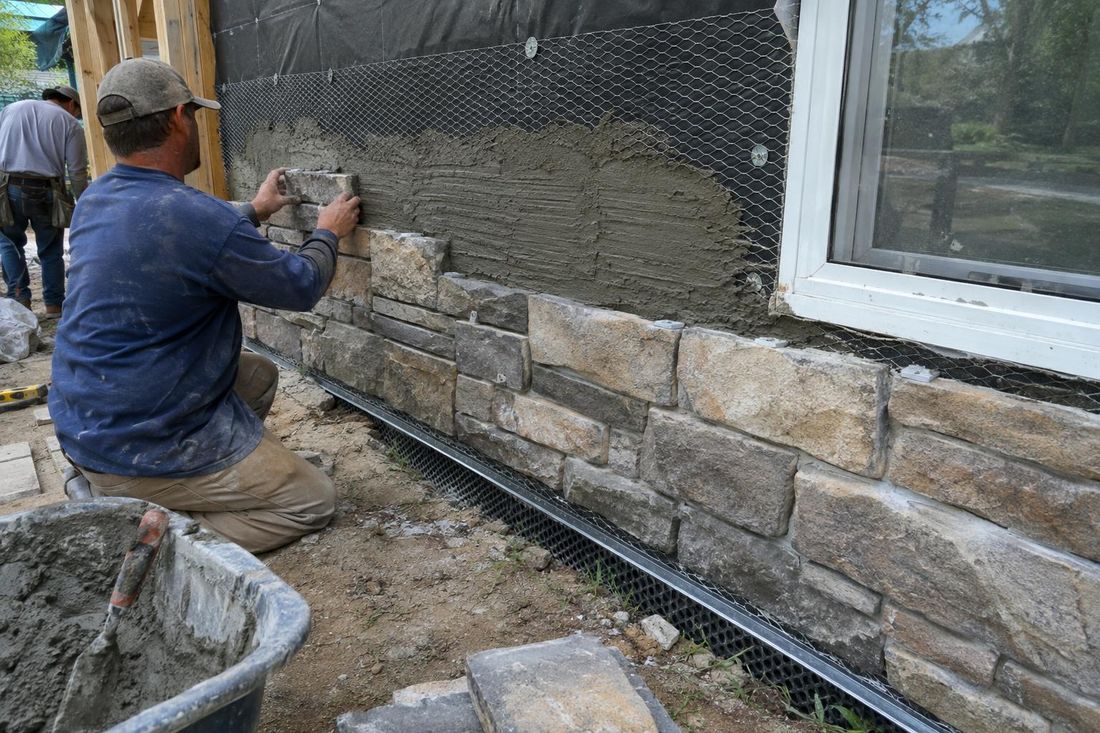
Mason setting stone veneer on wall A worker in a cap kneels and presses a stone piece into a fresh layer of mortar spread over metal lath and weather barrier on a house wall. Finished courses of stone sit above a black drainage strip at the base, and a mortar tub with a trowel is in the foreground.
How we do it
Over wood framing, the wall gets two layers of water barrier, lapped shingle-style so water runs down and out, never in. Then comes metal lath, fastened into the framing and not just the sheathing, and a mortar scratch coat that we rake so the setting mortar has something to grab. Windows and doors get flashing before any of that goes on, because that's where water likes to sneak in.
At the bottom we leave a drainage gap and a weep screed so water that does get behind the stone has a way out. We keep stone off the ground and off roofing, with a clear gap at roof lines. Over clean, unpainted brick or block we skip the lath and set stone on a mortar bed. Stone gets cut with a wet saw so corners come out tight.
How a job with us goes
Free estimate and stone selection
We walk your house, check the wall behind where the stone will go, and note windows, grade and roof lines. Then you pick your stone from samples, because it looks different on the wall than it does on a showroom table.
Barrier, lath and scratch coat
We flash the openings, hang both layers of barrier, fasten the lath and trowel on the scratch coat. This is the part nobody sees later, and it's the part that keeps the wall dry.
Stone laid out and set
We lay the stone out on the ground first and mix colors and sizes so there are no blotches. Then our masons set it from the top down on a mortar bed.
Joints grouted or left dry-stacked
Some stone looks best with a filled joint and some with tight dry-stack. We follow the look you chose and work the joints before the mortar skins over.
Cleaning
We brush off mortar smears while they're still easy to remove and wash the stone down. Then we walk the job with you.
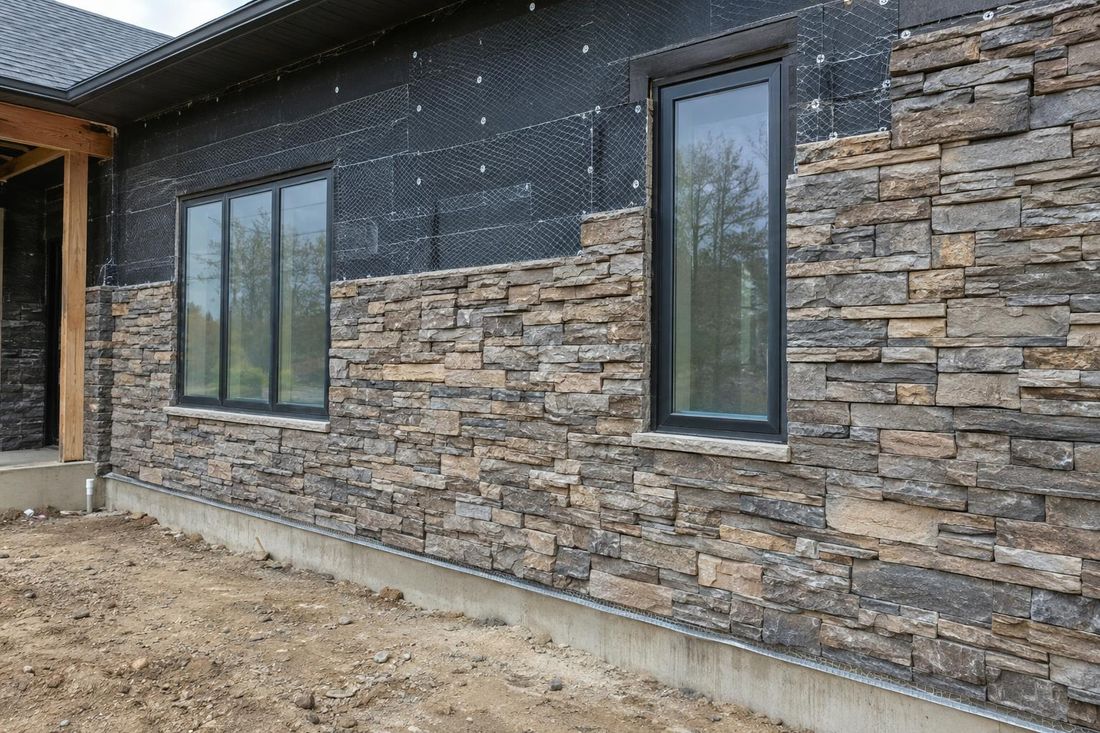
Partially installed stone veneer exterior wall A house exterior wall is partly covered with stacked stone veneer in gray and tan tones, applied over black weather-resistant barrier and wire lath. The upper wall is still exposed, and the veneer is built up around black-framed windows above a concrete foundation.
What drives the cost
Price comes down to a handful of things. Area is the big one, since more square footage means more stone and more hours. Natural stone costs more than manufactured, and corners and trim pieces take longer to cut and set than flat wall. Wall preparation matters too. A clean sheathed wall is quick, while a wall with old siding to strip or damaged framing to fix adds work before any stone goes up. Height counts as well, because scaffolding and carrying stone up take time. We price after we've seen the wall, which is why the estimate is free.
How long it takes
An entry or set of columns takes a few days. A full front elevation takes one to two weeks. Those numbers move with the weather, since we don't want to set stone in a downpour, and with how much prep the wall needs. Stone selection and ordering come before we start, so we'll tell you when your stone is in and give you a start date then.
Local expertise: residential stone veneer installation in Atlanta
Atlanta gets about 49.7 inches of rain a year. Late winter, early spring and July are the wettest stretches, and fall, especially October, is the driest.
What it means for your job
Mortar, stucco and sealers need dry time. Fall is the easiest season for repointing and sealing, and summer work is planned around afternoon storms.
Overnight freezes can be expected on about 40 days a year in Atlanta.
What it means for your job
Water that soaks into brick, stone and mortar and then freezes is what pops faces off brick and opens joints. Keeping water out matters more here than in places that rarely freeze, and winter mortar work has to be protected overnight.
Most stone veneer failures are water behind the stone, not the stone itself, so the hidden layers matter most. Stone cannot go directly over siding or paint. Vinyl, wood and painted surfaces have to come off or be covered with the proper layers first. We won't set stone over rotted sheathing or a wall that's moving. That gets fixed first. Stone also can't touch the soil or sit on a roof, so some designs need adjusting. On fireplaces, we follow the clearances for your firebox.