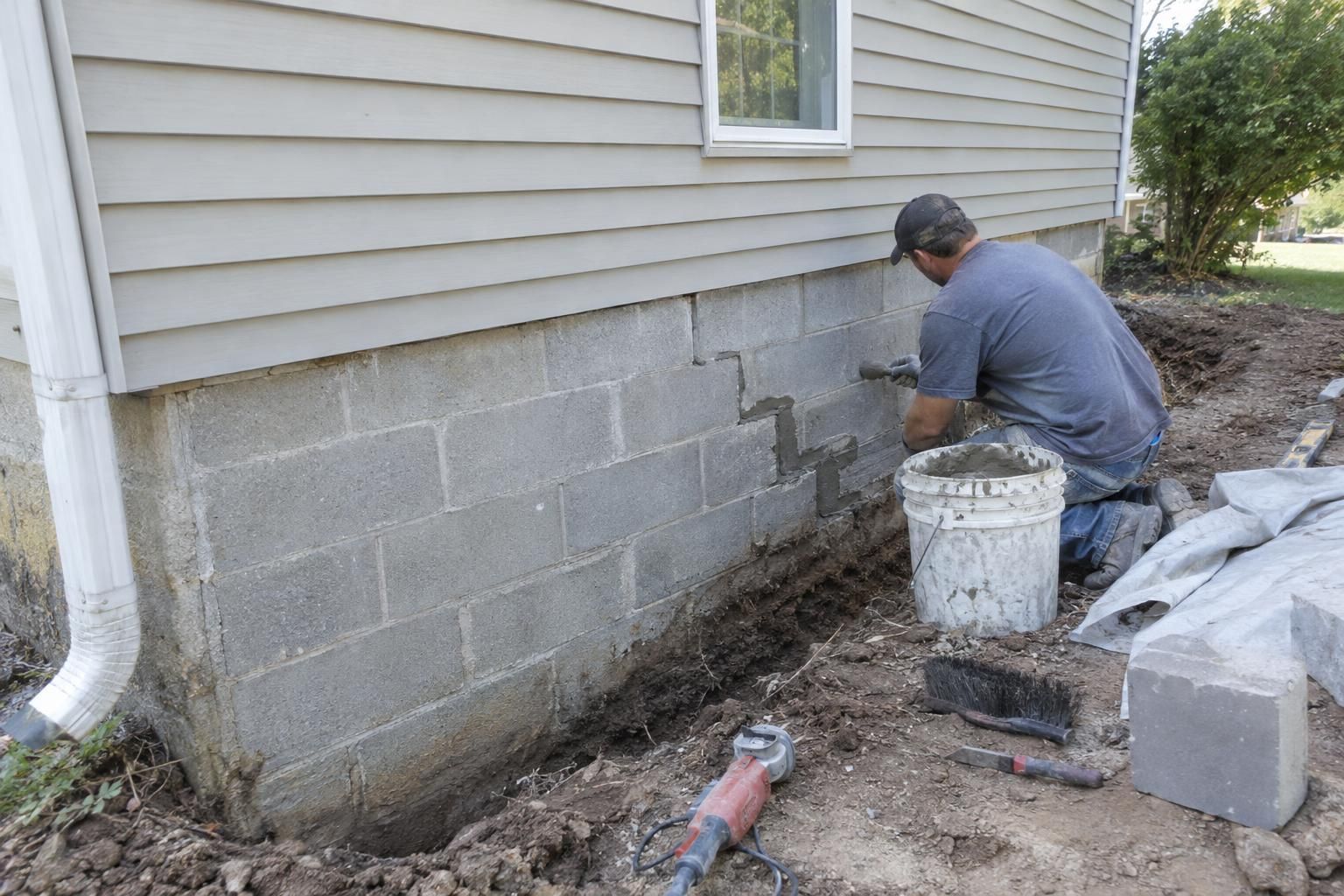
Cracked block under your house can usually be fixed without tearing the place apart. We repair stem walls and crawl space walls in Atlanta, and we start by working out why the wall moved.
Qualified MasonsVerified ProfessionalsFree EstimatesOn Time
What block foundation repair involves
Block foundation repair means fixing the concrete block that holds your house up off the ground. That might be a stair-step crack, a crumbling section, a wall leaning inward, or block gone soft around a vent. We cut out bad mortar, replace broken block, and add steel and grout in the cells where a wall needs more strength.
You need it when a crack gets wider, when upstairs doors start to stick, or when you see white powder and flaking on the block. You also need it when you can see daylight through a crawl space wall. Small cracks are cheap to deal with early. But water finds them every time it rains, and a wall that has pushed in won't push back out on its own. Not sure which you've got? We'll come look, and the estimate is free.
Signs you need block foundation repair
Stair-step cracksThese climb the wall along the mortar joints and mean one part of the wall moved more than the next. Thin ones that haven't changed are common. Wide ones, or ones where one side sticks out past the other, need a look.
Inward bowLay a straight board against the wall. If there's a gap in the middle, or a crack runs level along one joint, soil and water are pushing the wall in.
White powder and flakingThat's salt left behind as water moves through the block. It tells us moisture is getting in, and the face of the block will flake off over time.
Cracks at ventsOpenings weaken a wall, so cracks often start at the corners of crawl space vents. If one of those is growing, don't wait on it.
What we handle
Stair-step crack repairWe grind out the cracked joints and repoint them, and we replace any block that split clean through. We also look at why it cracked before we close it up.
Rebuilding damaged sections of stem wallWhen block is crumbling or pushed out, we take that section down and lay it back up with new block. The house sits on temporary support the whole time.
Filling and reinforcing hollow cellsA hollow wall with no steel in it can be strengthened. We add rebar and fill the cells with grout so the wall can stand up to soil pressure.
Repairing block at vents and openingsBlock around vents, access doors and pipe openings tends to crack first. We rebuild the corners, set a new lintel where the old one failed, and close up the gaps.
Parging and coating foundation blockOnce the wall is sound, we coat the face with a masonry parge so water has a harder time getting in. It's finishing work, but it matters.
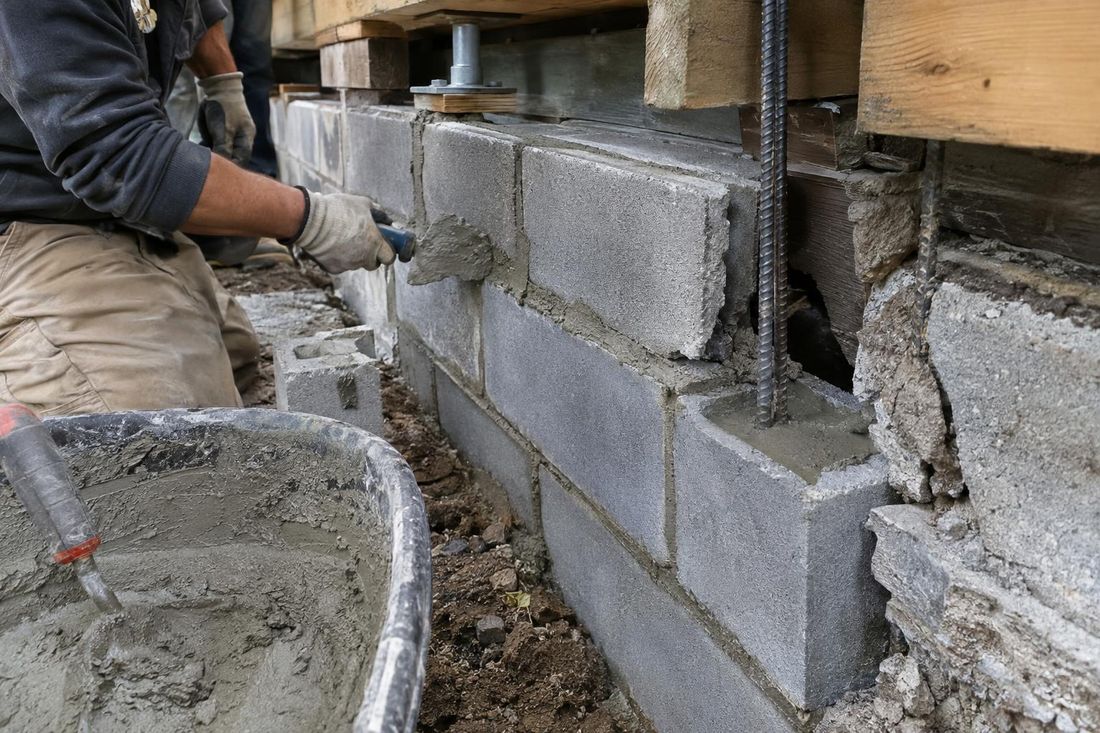
Mason laying concrete block foundation wall A worker in gloves uses a trowel to apply mortar to a course of gray concrete blocks, with a vertical steel rebar rising from a filled block cell. Wooden beams and a jack post support the structure above, and a wheelbarrow of wet mortar sits in the foreground beside an older stone foundation.
How we do it
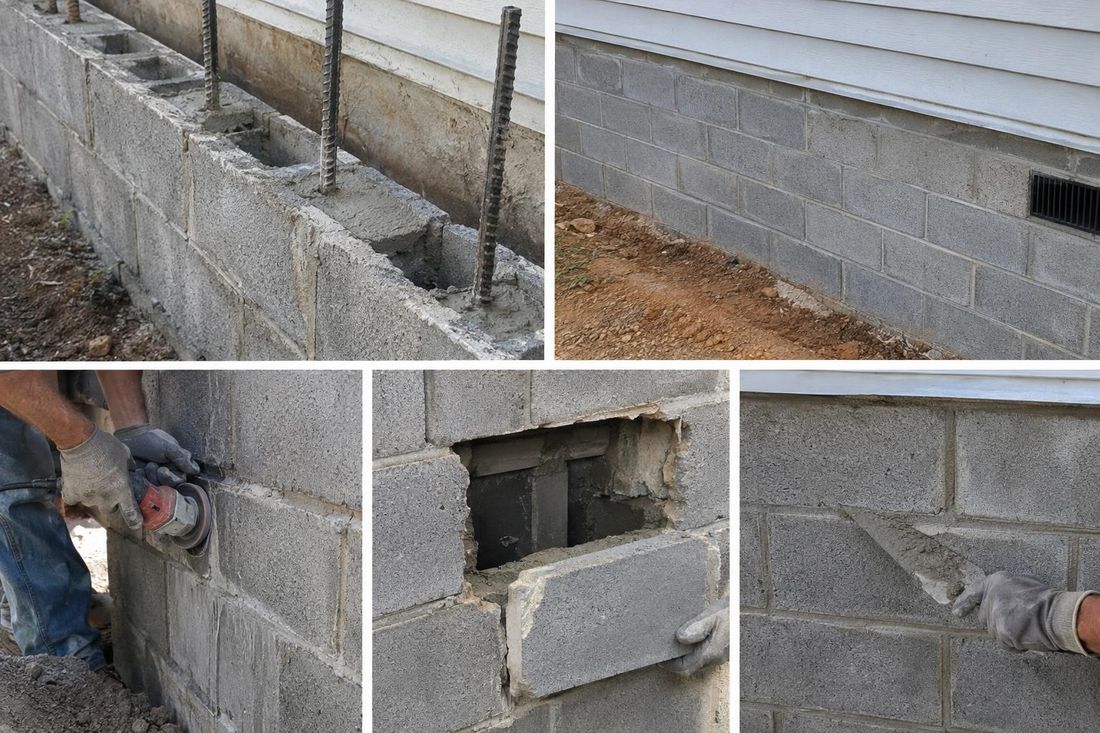
For cracked joints, we cut out the old mortar with a grinder, about three-quarters of an inch deep, brush out the dust, and repoint with mortar matched to the wall. Broken or flaking block is cut out and replaced one unit at a time, tied into the courses around it. Mortar that crumbles in your fingers comes out. Mortar that's still sound can stay.
Weak sections can be strengthened by adding steel and grout to the cells. We open a cell, set rebar, and fill it with grout in lifts so it packs without voids. The house is supported while any section is rebuilt, on steel posts and cribbing, before we take out a single block. Nothing should hang on a wall we've opened up, so we take that part slowly.
How a job with us goes
Free estimate and cause check
We get under the house with a flashlight and a level and look at the cracks, the soil outside, and where the gutters drain. Fixing block without finding the cause is how cracks come back.
Temporary support where needed
If a section is coming down, we support the framing above it with posts and beams first. There's no sense rebuilding a wall that's carrying a house we haven't held up.
Block repaired or rebuilt
We cut out bad joints, replace broken block, and add rebar and grout where the wall needs it. Everything is laid plumb and tied into the wall beside it.
Joints finished and surface coated
We tool the joints so they shed water, then parge or coat the face once the mortar has set up. That coat slows moisture and covers our patches.
Drainage corrections recommended
We tell you what we saw outside, like gutters dumping at the foundation, soil sloping toward the wall, or short downspouts. Some fixes are as simple as an extension.
Concrete block foundation wall repair steps A collage of five photos shows a concrete block foundation wall: rebar sticking out of mortar-filled block cores, a worker cutting into the blocks with an angle grinder, a section of block removed and held beside an open gap, and a gloved hand troweling mortar onto the block face. It also shows a finished gray block wall beneath white siding with a foundation vent.
What drives the cost
Price follows how much wall we're fixing. Repointing a few cracks costs far less than rebuilding a long section. Whether the house must be shored matters too, since posts, beams and jacks add time. Access under the house is a big one. A crawl space where we're on our bellies passing block down a hatch takes longer than a wall we can walk up to. Reinforcing adds steel and grout, and the number of cells we fill counts. Coating the wall adds some as well. We give you the number at the free estimate, after we've seen the wall, because no two foundations are the same.
How long it takes
Repointing cracks is a day. Rebuilding a section takes several days, because the house has to be supported first, the block laid, and the mortar and grout given time to set before the load goes back on. Weather and tight access can stretch that. We put the coating on after the mortar has cured enough to take it. We'll give you a realistic window at the estimate, and we'll tell you straight if something changes once the wall is open.
Local expertise: residential block foundation repair in Atlanta
The red clay of the Georgia Piedmont is typified by the Cecil soil series: very deep, well drained soil on ridges and side slopes, with a red subsoil that averages 35 to 60 percent clay.
What it means for your job
Clay holds water against a wall and does not recover well once it is compacted, so drainage behind a retaining wall and a properly built base under pavers and footings matter more here than the surface material.
Atlanta gets about 49.7 inches of rain a year. Late winter, early spring and July are the wettest stretches, and fall, especially October, is the driest.
What it means for your job
Mortar, stucco and sealers need dry time. Fall is the easiest season for repointing and sealing, and summer work is planned around afternoon storms.
Overnight freezes can be expected on about 40 days a year in Atlanta.
What it means for your job
Water that soaks into brick, stone and mortar and then freezes is what pops faces off brick and opens joints. Keeping water out matters more here than in places that rarely freeze, and winter mortar work has to be protected overnight.
We're masons, and we repair the wall. If the ground under the footing is still moving, a foundation specialist or engineer is needed for underpinning. Patching block over a footing that's still sinking just buys you a new crack. Drainage corrections are our recommendations, and if water keeps pushing on the wall, the repair can crack again. So we can't promise a crack will never return. Rotted framing or damaged plumbing under the house is outside block work. If we find any of that, we'll tell you and point you to the right person.
Thin, stable cracks are common. Wide, growing or offset cracks mean movement and should be assessed. Mark the ends of a crack with a pencil and date it, and you'll know soon enough which kind you have.
Who do I call, a mason or a foundation company?
A mason for damaged block. A foundation company or engineer if the house is sinking.
Do we have to move out while you work?
Usually not. Most of the work is outside or down in the crawl space. We'll tell you ahead of time if we need to clear a hatch or move anything.
What does white powder on the block mean?
It's salt left behind by water passing through the wall. It's not the wall failing by itself, but it tells us moisture is getting in, and we'll look for where.