Commercial Masonry caulking and expansion joints in Atlanta
Sealant is the part of a masonry wall that's meant to wear out, and brick is the part that isn't. Replacing the sealant on time is how we keep water out of your building.
Qualified MasonsVerified ProfessionalsFree EstimatesOn Time
What masonry caulking and expansion joints involves
Masonry moves. It swells in the heat, shrinks in the cold, and the whole building flexes and settles underneath it. Soft joints at expansion joints, control joints, window and door frames, and under copings give that movement somewhere to go. Those joints are filled with flexible sealant over a foam backer rod, and the sealant takes a beating from sun, water and every cycle of stretching.
Eventually it hardens, cracks or lets go of the brick. Then water gets behind the wall and into the frames, the insulation and sometimes the ceiling below. If you manage a building in Atlanta and you can slip a pencil into a joint, it's time to call us. We cut the old sealant out, put new in, and give free estimates.
Signs you need masonry caulking and expansion joints
Cracked sealantSplits across the face of the bead mean it has lost its stretch. It can't follow the wall anymore, so the next cold snap tears it further.
Hard and brittlePress a fingernail into the bead. If it feels like old rubber and doesn't spring back, it has done its job and then some.
Pulling away from one sideA gap along the brick or the window frame means the bond let go. Water will find that gap quickly.
Gaps you can see intoIf you can see backer rod or a dark void, the joint is open. We also look for stains or damp spots below a joint, because water often leaves a trail before anyone spots the cause.
What we handle
Expansion and control joint replacementWe cut out the failed sealant along the full length of the joint and rebuild it with new backer rod and sealant sized for the movement that joint sees. On a big wall, the long straight runs add up fast.
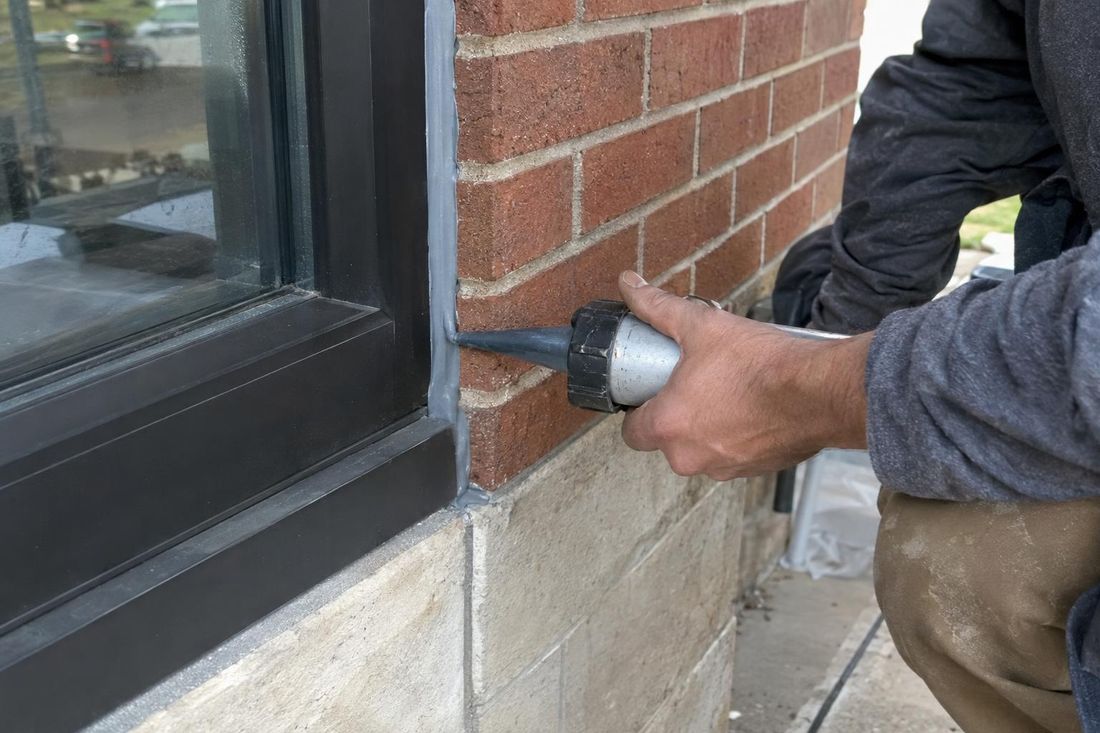
Window and door perimeter sealantThe joint between the frame and the brick sees sun and water all day. We redo it around storefronts, punched windows and doorframes, and we take care not to scar the frame.
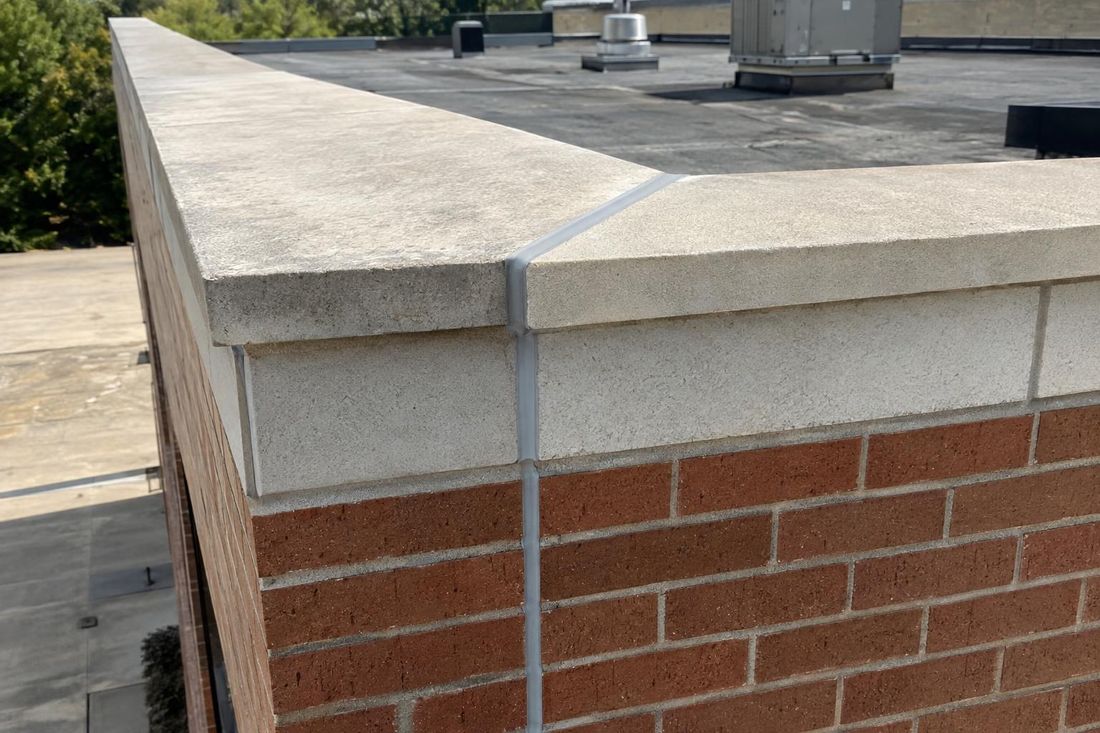
Coping and parapet jointsThe top of a wall gets the worst weather and the most standing water. We reseal the joints between coping stones or caps so rain stays on top where it belongs.
Cutting new movement joints in cracked wallsSometimes a wall cracks because it never had a place to move. We saw-cut a joint where the movement wants to happen and seal it. If a crack looks structural, we'll tell you and suggest an engineer.
Caulking joint between window and brick A person's hand holds a metal caulking gun with a tapered nozzle, applying gray sealant along the vertical joint where a dark-framed window meets a red brick wall. The sealant bead is visible running down the joint toward the stone base below.
How we do it
We cut the old sealant out completely. A sharp utility knife and a hooked blade do most of it, and where it's stubborn we reach for an oscillating tool, careful not to nick the brick edge. Then we clean both faces of the joint with a wire brush and a vacuum, wipe nonporous surfaces like aluminum with solvent, and prime where the sealant maker calls for it. Dust is the enemy of adhesion.
Next we push in closed-cell foam backer rod to the right depth, sized a little large so it stays put. The rod sets the depth and keeps the sealant from bonding to the back of the joint. Then we gun in new silicone or urethane and tool it so it bonds to the two sides only. A joint stuck to three surfaces can't stretch, and it tears. Silicone holds up well in strong sun. Urethane can be painted. We pick by joint and surface.
How a job with us goes
Joint survey and linear footage
We walk the building and measure every joint, noting the width, the height and what's on each side. Footage drives your estimate, so we count it carefully.
Product and color selection, adhesion test
We match the sealant to the job and to your brick or frame color. Then we test a sample on your actual surfaces, because a sealant that won't stick to your material is the wrong one.
Removal and preparation
We cut out all the old sealant, clean and prime the joint, and set the backer rod. This is the slow part, and it's the part that decides how long the work lasts.
New sealant
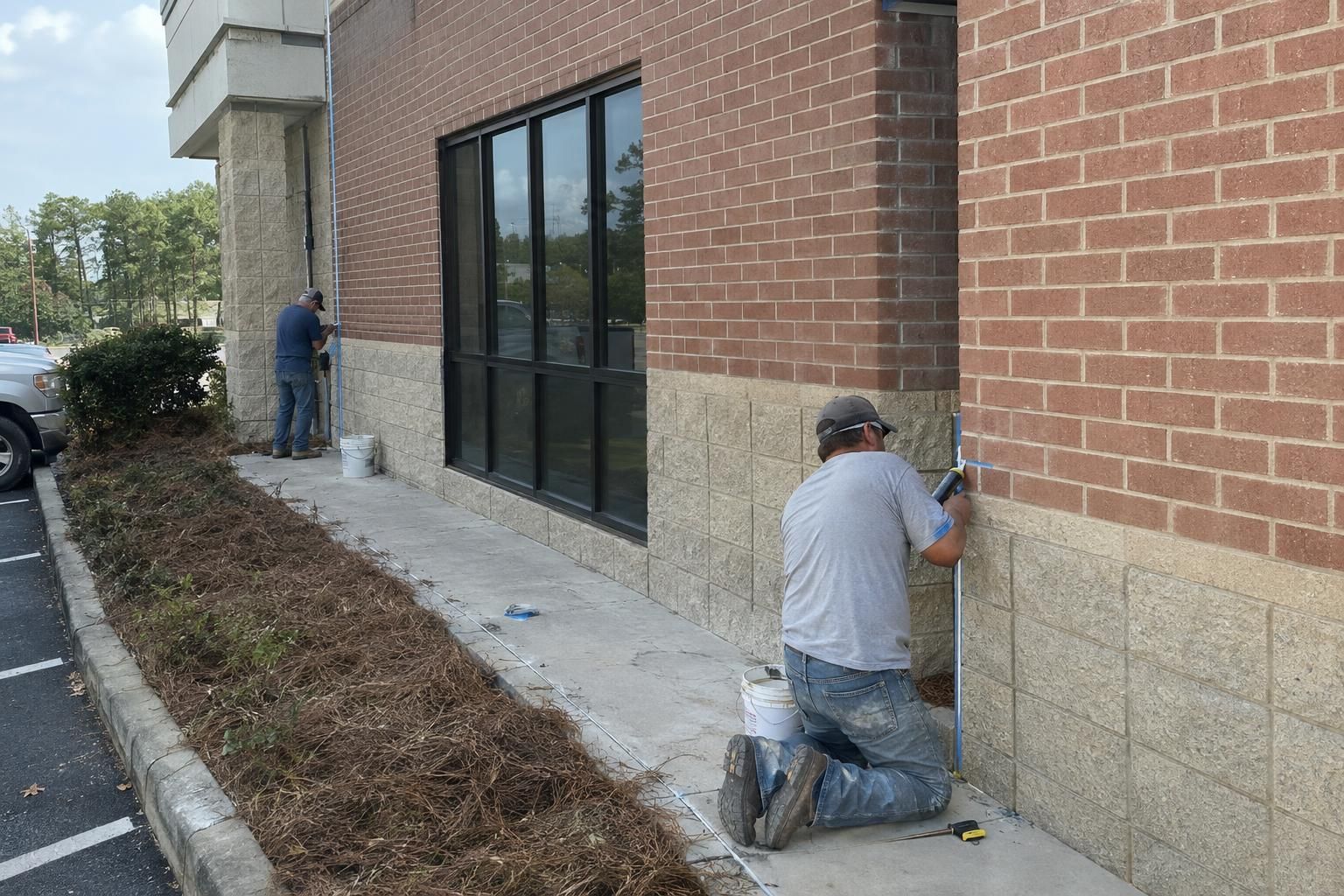
We gun the sealant in, tool it firm against both sides, and pull the masking tape before it skins over. Neat lines are nice, but the tooling is what makes the bond.
Inspection
We walk every joint again looking for voids, pinholes and edges that didn't wet out. Anything we find, we fix before we pack up.
Sealed expansion joint at parapet corner A vertical gray sealant-filled joint runs down the corner of a brick wall and continues across the precast stone coping at the top of a commercial flat-roof parapet. The sealant line separates the masonry sections at the corner, with a rooftop unit and vent visible behind it.
What drives the cost
Mostly it comes down to linear feet. A short run of joint costs less than a long one, and wide joints take more rod and sealant than narrow ones. Height and access matter too, since a joint at the ground is quicker than one we reach by lift or scaffold. The sealant type changes the price, and so does how much old material has to come out and how hard it's stuck. Joints packed with layers of old caulk take longer than a single clean bead. We don't guess at any of this. We measure, and the estimate is free.
How long it takes
Days to weeks, depending on the size of the building. A small storefront can be done in a few days. A tall building with a lot of joint takes longer, mostly because of access. Weather plays a part too. Joints have to be dry, and some sealants need a minimum temperature to cure well, so a wet week can push things back. We'll give you a schedule once we've measured the job, and we'll tell you early if the weather changes it.
Local expertise: commercial masonry caulking and expansion joints in Atlanta
Atlanta gets about 49.7 inches of rain a year. Late winter, early spring and July are the wettest stretches, and fall, especially October, is the driest.
What it means for your job
Mortar, stucco and sealers need dry time. Fall is the easiest season for repointing and sealing, and summer work is planned around afternoon storms.
Overnight freezes can be expected on about 40 days a year in Atlanta.
What it means for your job
Water that soaks into brick, stone and mortar and then freezes is what pops faces off brick and opens joints. Keeping water out matters more here than in places that rarely freeze, and winter mortar work has to be protected overnight.
New sealant over old fails quickly, so we don't do it. Full removal is the only method that lasts, and we quote the work that way. Joints also have to be dry when we seal them, so if it's raining or the brick is soaked, we wait. Sealant can't fix a wall that's moving because of a structural problem. If the brick is spalling or the mortar is crumbling, that's repointing, which is a separate job. And no sealant lasts forever, so plan on checking the joints now and then.
Masonry caulking and expansion joints questions
How long does sealant last?
Commonly ten to twenty years, depending on the product and how much sun the wall gets. The faces that take the most sun usually age first, so don't be surprised if one side of the building needs work before the others.
How do I know it has failed?
Cracking, hardening, pulling away from one side, or gaps you can see into. Stains or damp spots below a joint are another clue.
Can you just caulk over the old sealant?
No. New sealant over old fails quickly. We cut the old out first, every time.
Do you use silicone or urethane?
Both. We choose after testing adhesion on your wall. Some stone can stain from the wrong silicone, which is another reason we test first.
Can you work in rain or cold?
Not in the rain, since the joints have to be dry. Cold matters too, because some sealants need a minimum temperature, so we check the product label before we start.