Qualified MasonsVerified ProfessionalsFree EstimatesOn Time
What emergency masonry repair involves
Emergency masonry repair is what we do when a wall, chimney or porch column has been damaged and can't be left alone. On the first visit we look at what's loose, what's carrying weight and what could come down next. Then we shore it up, pull off the loose pieces and cover any opening so rain stays out.
You need this after a vehicle hits your garage wall, a limb takes the top off your chimney, or a column starts leaning and the porch roof sags above it. Brick looks tough, but one cracked course can hide a lot of trouble behind it. If you're in Atlanta and can't tell whether it's urgent, call us. We'd rather look at something that turns out fine than have you wait on something that isn't. Our estimates are free.
Signs you need emergency masonry repair
Leaning or bowed wallIf you can sight along a wall and see it curve or tilt, it has shifted. Keep clear of it and call us.
Stair-step cracksCracks that run diagonally along the mortar joints and are wider at one end mean the wall is moving, not just aging.
Brick or chunks of mortar on the groundSomething let go, and what's above it may not be far behind. Look up before you pick anything up.
A gap that wasn't there beforeA chimney pulling away from the house or a column sitting off its base is no longer tied in. Don't lean on it, and don't lean a ladder against it.
What we handle
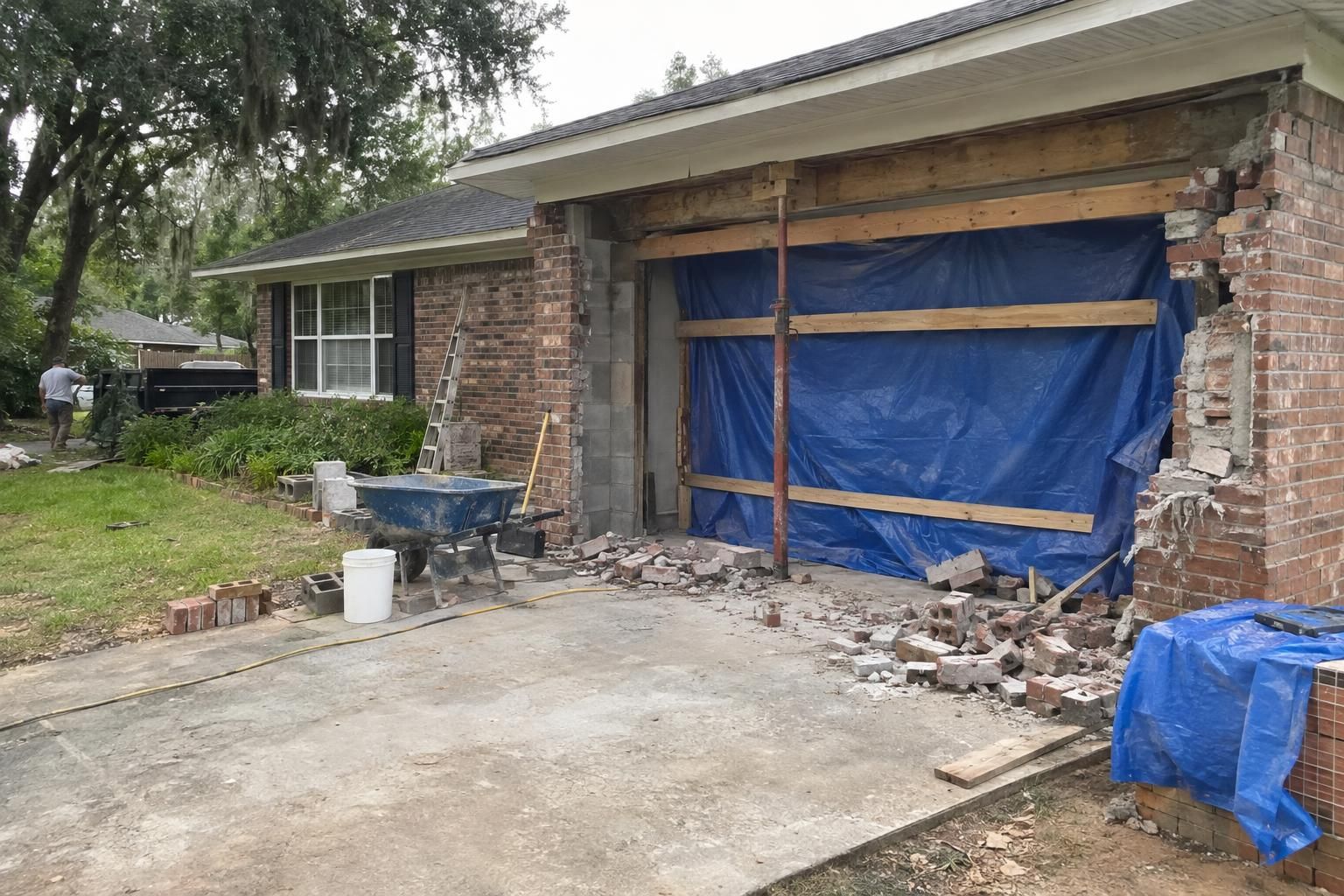
Vehicle impact to a wall or garageA car or truck can knock out a section of wall and crack the lintel above it. We shore the opening first, then rebuild the wall and set a sound lintel.
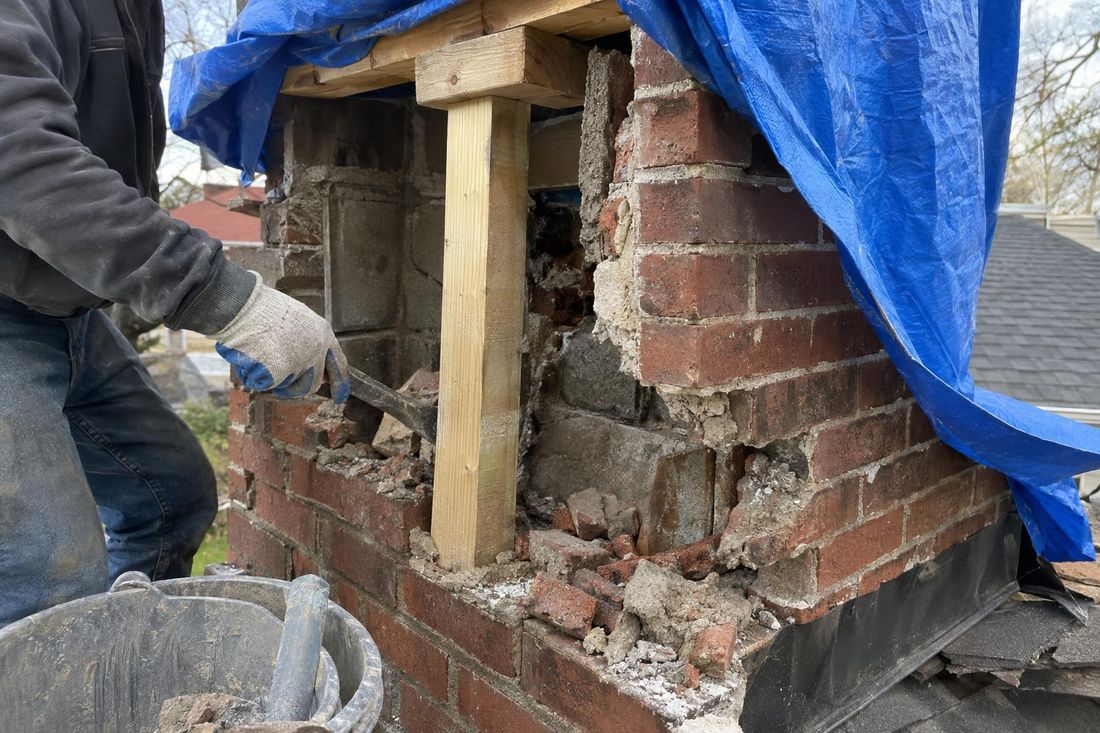
Tree or storm damage to a chimney or wallLimbs and wind-thrown trees often snap a chimney at the roofline or push a wall out of plumb. We take the loose masonry down and check how it meets the roof before we rebuild.
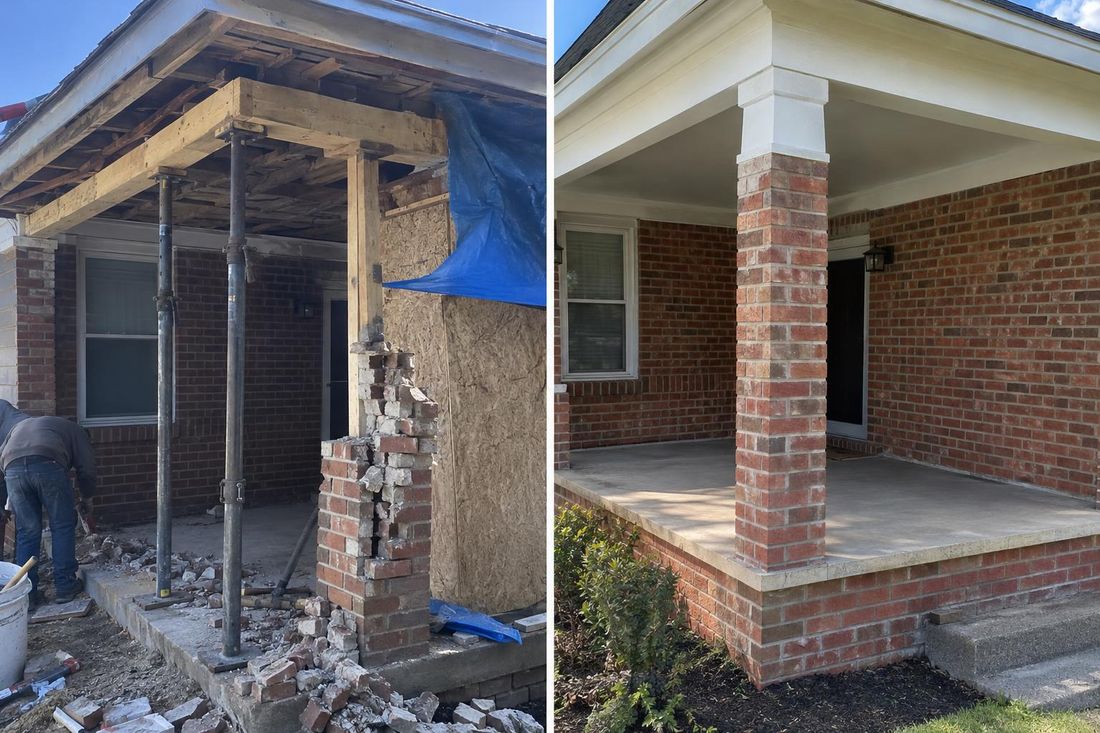
Collapsed or leaning porch columnOnce a column shifts, the porch roof it holds is on borrowed time. We hold up the beam with temporary posts, then repair or rebuild the column.
Fallen brick or stoneSometimes only a patch of veneer or a stone cap lets go. We find out why, because brick rarely falls for no reason.
Partially dismantled brick chimney under tarp A gloved worker uses a chisel on a damaged red brick chimney that is partly taken apart, with loose bricks and mortar debris on the ledge. A wooden post supports a timber beam above the opening, a blue tarp covers the top, and a bucket sits in the foreground.
How we do it
Safety work comes first. We take off loose brick, block and stone by hand, usually with a hammer and chisel, so we don't shake what's still standing. Then we shore the structure with adjustable steel posts and timber. We cover open walls and roofs with heavy poly or plywood so the weather can't make things worse.
Permanent repair starts once your insurer has seen the damage. We match brick or block as closely as we can for size, color and texture. We mix mortar to suit the old work, because mortar harder than your brick will crack it later. New masonry gets tied into the wall behind it with metal ties, and a cracked lintel gets replaced. Then we tool the joints to match what's around them. A perfect color match isn't always possible with older brick, and we'll tell you that up front.
How a job with us goes
Urgent visit
We come out and look at the damage from a safe distance, then up close. We check what's loose and what's carrying load so we know what to do first.
Make safe
We pull the loose material, shore whatever needs holding and cover the openings. That stops the damage from getting worse, whether it's gravity or rain doing it.
Photos and written scope
We photograph everything before we move it, then write up what the repair involves. Your insurer needs both, and you'll want them too.
Matching materials
We take samples to the supplier and hunt for brick or block that fits. Why bother? Because a mismatch on a front wall shows from the street.
Permanent repair
We rebuild course by course and tie the new work into sound masonry. Then we tool the joints to match, clean up and walk you through what we did.
Brick porch column rebuilt, before and after The left side shows a partly demolished brick porch column with temporary steel posts holding up the roof framing, rubble on the ground, and a worker bending over nearby. The right side shows a finished porch with a rebuilt red brick column, white column cap, and a concrete porch floor.
What drives the cost
Price follows how much came down and how hard it is to hold up what's left. A patch of veneer costs far less than the corner of a house. A chimney rebuilt from the roofline up means roof work and more time. Shoring takes materials and labor even though it disappears behind the finished wall. Calling us at night or on a weekend costs more than a weekday visit. Matching matters too. Common brick is easy to find, and old or handmade brick can take a long search. Your insurance may cover part of it, and we'll give you a free written estimate your adjuster can read.
How long it takes
We do the make-safe work on the first visit, so the damage stops getting worse that day. The rebuild comes later, and it waits on two things. One is insurance approval and the other is materials. Special-order brick can take a while to arrive, and we can't hurry an adjuster. Once both are in hand we get to work, though freezing weather or heavy rain can push us back, since fresh mortar doesn't like either.
Local expertise: residential emergency masonry repair in Atlanta
Atlanta gets about 49.7 inches of rain a year. Late winter, early spring and July are the wettest stretches, and fall, especially October, is the driest.
What it means for your job
Mortar, stucco and sealers need dry time. Fall is the easiest season for repointing and sealing, and summer work is planned around afternoon storms.
Overnight freezes can be expected on about 40 days a year in Atlanta.
What it means for your job
Water that soaks into brick, stone and mortar and then freezes is what pops faces off brick and opens joints. Keeping water out matters more here than in places that rarely freeze, and winter mortar work has to be protected overnight.
If the building might collapse, you smell gas or wires are down, call 911 and stay out. Don't call us first. We can't tell you what your insurer will pay, and our make-safe work is temporary, not the repair. Response time depends on how many emergencies we're already handling, and a big storm brings plenty at once. If the damage looks structural, we may ask for an engineer's opinion before we rebuild, and we'll wait for it.
Sudden damage from vehicles, trees and storms often is covered. We take photos and write up the scope for your claim, but your policy decides, so ask your agent.
Is my house safe to stay in?
Keep away from the damaged area until a mason or engineer has looked at it. If the damage is at one end, the rest may be fine, but we'd want to see it first.
Can I clean up the fallen brick myself?
Please wait. That pile may be holding up what's above it, and the photos help your claim. Keep kids and pets away from it too.
Should I put a tarp on it?
Cover a low opening if you can reach it from the ground. Never climb up or stand under a leaning wall. We'll cover it properly when we get there.
Will the new brick match?
We get as close as we can on size, color and texture, and we'll show you samples before we lay anything. Old brick is the hardest, and we'll be honest if it won't be perfect.