Qualified MasonsVerified ProfessionalsFree EstimatesOn Time
What natural stone walls involves
A natural stone wall is built from full stones, either stacked dry or set in mortar. It isn't a thin veneer, and it isn't a pattern stamped into concrete. At a home it edges beds, lines a driveway or frames an entry, and the stone you see is the stone doing the work.
You usually need one when something in the yard wants a clear edge. Maybe the mulch keeps washing onto the walk. Maybe the driveway shoulder crumbles into the lawn every spring. Or maybe the front walk just looks bare. We'll walk the property with you, watch where the water goes, and figure out where the wall will be seen from. Then we give you a free estimate for your home in Atlanta. No pressure, and no sales pitch dressed up as advice.
Signs you need natural stone walls
Mulch and soil wash onto your walkEvery hard rain pushes the edge of the bed a little further out. A low wall holds the line and slows the water down.
Your driveway edge is breaking upGravel or asphalt that crumbles at the shoulder needs something solid beside it. Stone takes tire nudges better than a row of landscape timbers ever will.
An old wall is leaning, bulging or missing stonesThat usually means water got behind it or the base was never right. Sometimes we can rebuild it with its own stone, and we'll tell you straight if it's past saving.
Your entry looks unfinishedA drive or front walk with nothing on either side of it feels like a sentence with no period. Walls and piers give it a frame.
What we handle
Dry-stacked stone wallsNo mortar, just the weight and fit of each stone. They're the right call for garden beds and borders because they drain freely and tolerate ground movement.
Mortared stone wallsSet on a concrete footing with the joints raked back so the stone stands proud. They look more formal and can be thinner than a dry-stack wall.
Stone-faced block wallsA block core does the heavy lifting and we face it in real stone. We reach for this when a wall gets tall and solid stone would be a lot of weight to carry.
Entry walls and piersShort wings and square piers at the drive or front walk, topped with a cap stone wide enough for a light or a mailbox. We size them to the house, not the other way around.
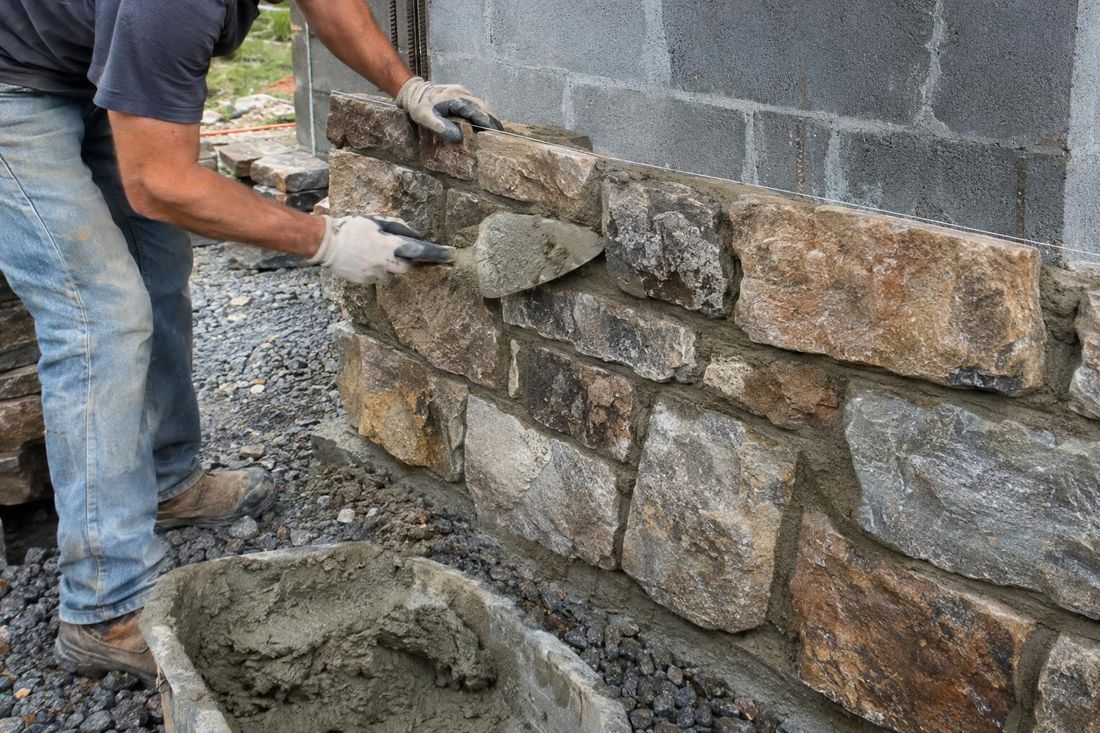
Mason laying natural stone wall A worker in gloves uses a trowel to apply mortar while setting irregular natural stones in a course along a concrete block wall. A tub of wet mortar sits on the gravel in the foreground, and a string line guides the height of the stonework.
How we do it
Dry-stack walls sit on compacted gravel. We dig out the topsoil, lay crushed stone and run a plate compactor over it until it stops settling. Then the wall leans slightly back into the slope or the yard, held by the weight and fit of the stone. The biggest stones go low, joints get staggered, and long tie stones run back into the wall so the face can't peel away. We backfill behind with clean gravel so water has somewhere to go.
Mortared walls need a concrete footing, poured below the frost line and often with rebar in it. Without that, the wall will move and the mortar will crack. Taller walls are usually a block core faced in stone, with metal ties holding the face to the block. For the stone itself we work with fieldstone, ledge stone and flat stone for caps, and we pick it by color and shape, not just by the pallet.
How a job with us goes
Free estimate and stone choice
We come out, measure, and look at drainage, access and what's already around the wall. Then we talk stone, because the stone sets the look and a good chunk of the price.
Layout
We stake the line and string it, and often spray-paint it on the ground. Walk it with us, because it's much cheaper to move a stake than a wall.
Base or footing prepared
We dig, compact and level a gravel base for dry-stack or form and pour a footing for mortar. This is the part nobody sees, and it's the part that decides whether the wall is still straight in ten years.
Stone sorted, shaped and laid
We sort the pile by size first, then set each stone, turning it until it sits without rocking. We trim with a hammer and chisel only where we have to.
Cap stones set
Caps lock the top courses together and shed water. We set them last, check the line again, and sweep the site clean.
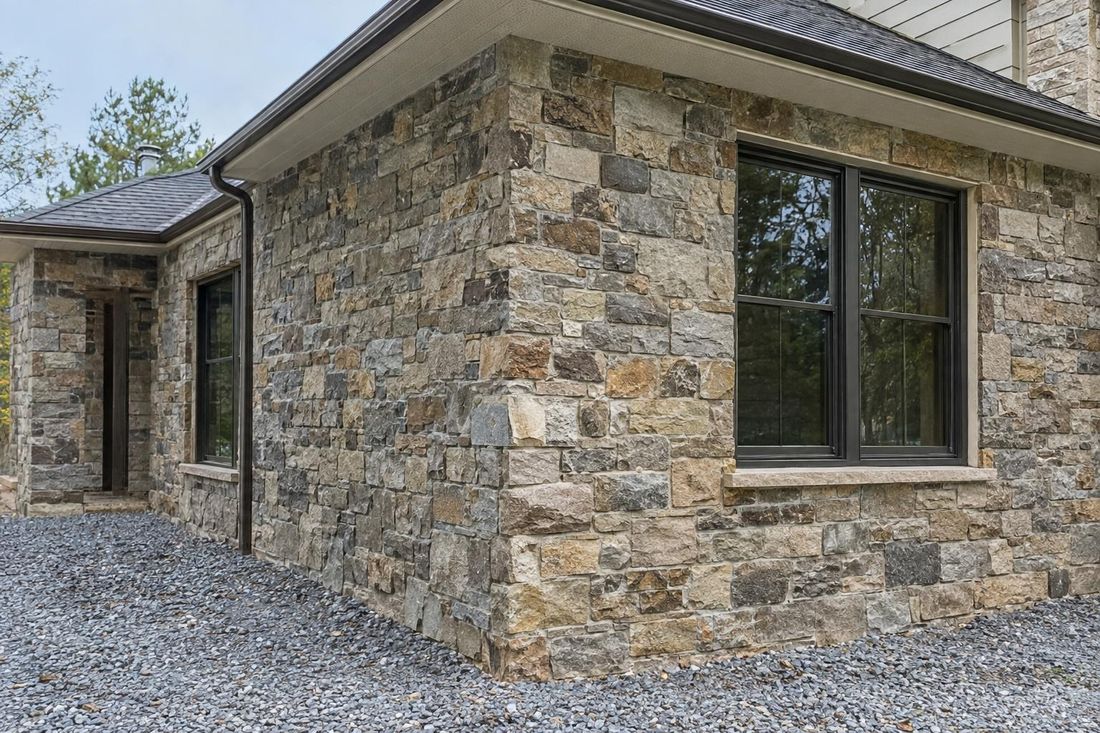
Natural stone veneer house exterior The corner of a house is clad in natural stone in mixed gray, tan and rust tones, laid in a irregular pattern with a stone window sill beneath a dark-framed window. A covered entry sits to the left, and the house is surrounded by gray gravel.
What drives the cost
Length and height set the baseline, since a wall is mostly stone and labor per square foot of face. Type of stone matters a lot, and so does how far it travels, because stone is heavy and freight adds up fast. Dry-stack and mortared walls price differently, and a mortared wall needs a footing. How much shaping the stone needs counts too, since rough fieldstone takes more hands and more time than tidy ledge stone. Access plays in as well. If we can drive close, that's one thing. If every stone goes by wheelbarrow, that's another. We'll walk you through all of it at the estimate.
How long it takes
Stonework is slow by nature: plan on about a week for a modest garden wall. Footings add days because concrete has to set before we load it with stone. Rain can push things, and so can a late stone delivery. We'd rather tell you that up front than promise a date and rush the wall. When we walk the site we'll give you our best read on timing for your job.
Local expertise: residential natural stone walls in Atlanta
The red clay of the Georgia Piedmont is typified by the Cecil soil series: very deep, well drained soil on ridges and side slopes, with a red subsoil that averages 35 to 60 percent clay.
What it means for your job
Clay holds water against a wall and does not recover well once it is compacted, so drainage behind a retaining wall and a properly built base under pavers and footings matter more here than the surface material.
Atlanta gets about 49.7 inches of rain a year. Late winter, early spring and July are the wettest stretches, and fall, especially October, is the driest.
What it means for your job
Mortar, stucco and sealers need dry time. Fall is the easiest season for repointing and sealing, and summer work is planned around afternoon storms.
Overnight freezes can be expected on about 40 days a year in Atlanta.
What it means for your job
Water that soaks into brick, stone and mortar and then freezes is what pops faces off brick and opens joints. Keeping water out matters more here than in places that rarely freeze, and winter mortar work has to be protected overnight.
In Fulton County, a retaining wall over 4 feet high needs its own permit unless it was already shown and permitted on a land disturbance permit, and each wall takes a separate permit form and fee.
What it means for your job
A site with several walls means several permits. Budget the time and fees for each one before the masonry starts.
A wall holding back soil is a retaining wall and is designed differently. If your wall has to hold a slope, tell us early, because height, drainage and sometimes an engineer's drawing come into it. Ask your local building office whether a permit applies. Stone varies, so no two walls match exactly, and a new wall beside an old one will weather into it over time. We can't fix a bigger water problem in the yard with a wall alone. And we don't build on soft fill or frozen ground, because the wall will pay for it later.
Dry-stack drains freely and tolerates ground movement. Mortared walls are more formal and can be thinner.
Can you match stone already on my property?
Usually, if the quarry or a similar stone is still available.
Will my wall crack when the ground freezes?
A dry-stack wall flexes with the ground, so it usually rides it out. A mortared wall on a proper footing below the frost line should hold, though hairline joints can show up over time.
Can you rebuild my old wall with its own stone?
Often, yes. We pull it down, sort the good stone and rebuild on a proper base. Some stone is too broken to reuse, and we'll show you which.
Do I need a permit?
It depends on the height and on whether the wall holds back soil. We'll tell you what to ask your local building office when we see the plan.