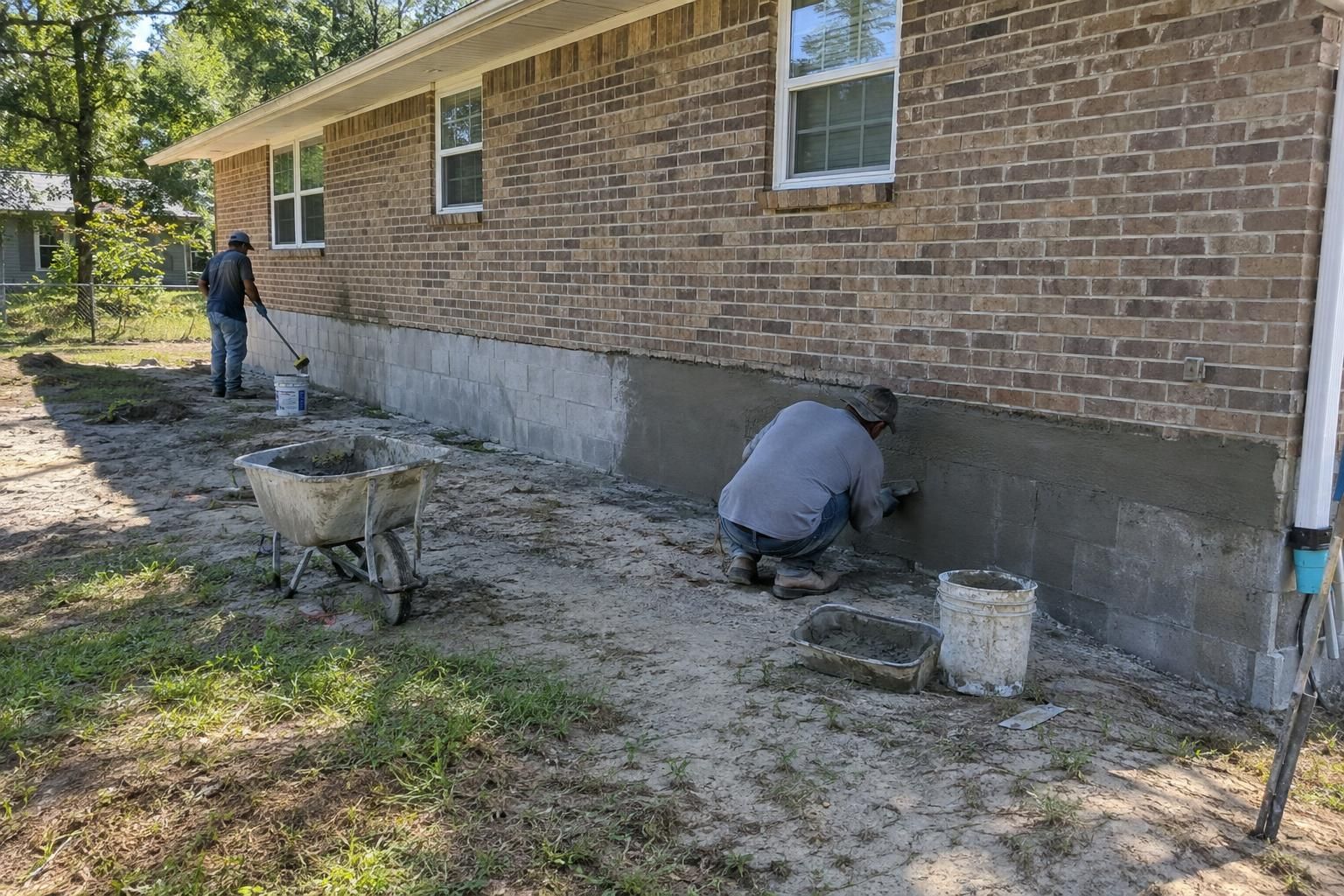
Qualified MasonsVerified ProfessionalsFree EstimatesOn Time
What parging involves
Parging is a thin coat of cement mortar troweled over block or brick. On a house it covers the exposed foundation between the ground and the siding. It also smooths rough block walls that were never meant to be looked at up close. Think of it as the skin on the wall. It evens out the face, hides the joints and gives paint or coating something good to hold.
You need us when that skin starts to flake, crack or sound hollow when we tap it with a trowel handle. You also need us when you've got bare block you're tired of looking at, or when you plan to paint or waterproof and the wall is too rough to take it. Not sure which one you've got? We'll come look.
Signs you need parging
Flaking or sanding surfaceThe top layer is letting go, often because moisture is working behind it. Pick at it with a screwdriver and see how much comes off.
Hollow sound when tappedThe parge has lost its bond to the block underneath. It looks fine until a freeze pushes it off in sheets.
Cracks that wander across the wallHairline ones are usually shrinkage. Wide ones, or ones that step along the mortar joints, tell us the wall behind may be moving.
Bare, rough block above gradeNothing is failing yet, but it's hard to paint, it collects dirt and it looks unfinished next to the siding.
What we handle
Parging an exposed block foundationThis is the classic job. We cover the band of block between grade and siding so the foundation reads as one clean surface instead of a stack of units.
Repairing cracked or flaking pargeWe cut back to solid parge and square up the edges. Then we patch so the repair doesn't show as a ring. Sometimes that's a few patches and sometimes it's the whole wall.
Smoothing block walls and stem wallsRough block at a garage, a crawlspace entry or a stem wall gets an even face with a float or trowel finish.
Parging before paint or waterproof coatingCoatings copy whatever is under them. We give you a tight, even surface first, and you or your painter can coat it once it cures.
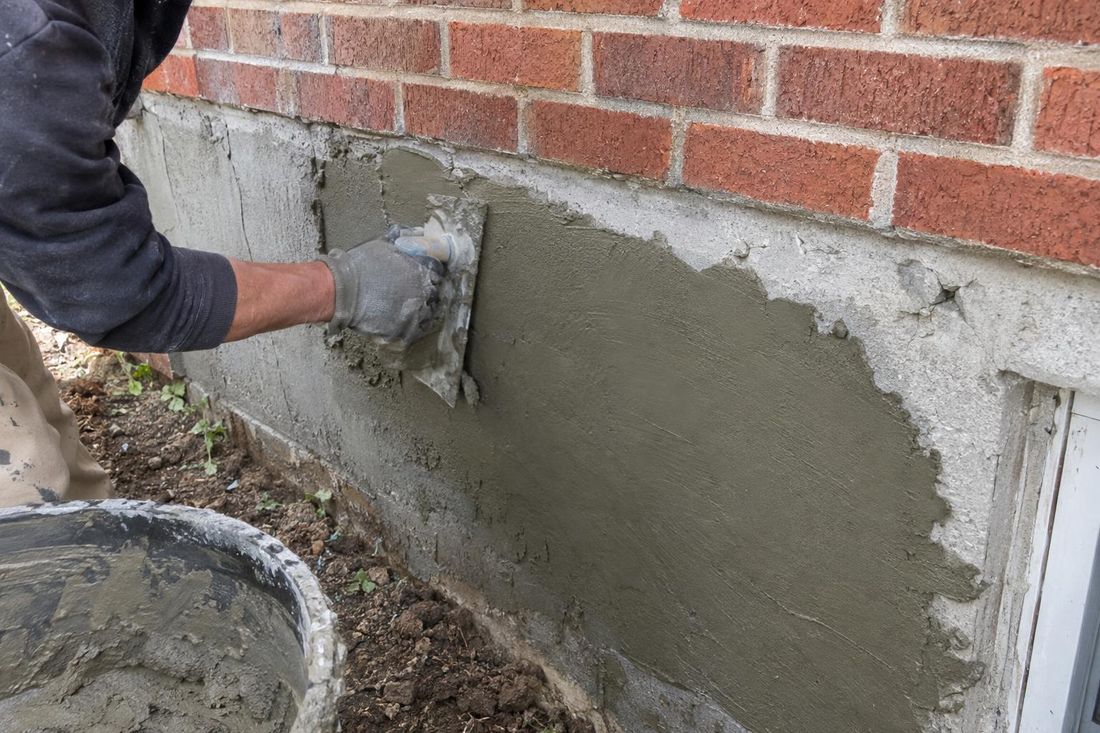
Troweling cement parging onto foundation wall A gloved hand uses a hawk-style trowel to spread gray cement mortar over a concrete foundation wall just below a red brick wall. The fresh coating covers part of the rough concrete, and a bucket of mortar sits in the foreground.
How we do it
We start with a wire brush and a stiff broom, and a pressure washer when the wall needs one. Loose parge, flaking paint and powdery salts come off. Then we dampen the wall so the block doesn't suck the water out of the mortar too fast. Damp is what we want, not dripping. If the old surface is slick or painted, we apply a bonding agent first.
The mortar is cement and sand, mixed stiff enough to stay put on a vertical wall. We trowel it on in one or two thin coats, because thick coats slump and crack. When we do two, we scratch the first so the second has something to grab. The finish is smooth with a steel trowel or brushed with a stiff brush, and we match it to what's already on your house. Then we keep it damp while it cures.
How a job with us goes
Free estimate
We walk the wall, tap it and look at where the water goes. Gutters, grade and downspouts matter as much as the mortar does. Then we tell you what we'd do and why.
Surface cleaned and prepared
We brush, wash and cut out everything loose, then dampen the wall. Parge only holds as well as what's under it, so we don't hurry this part.
Parge coat applied and finished
We trowel the mortar on in thin coats and work one section at a time so the edges blend. Then we finish it smooth or brushed to match what you have.
Kept damp while curing
We mist the wall and shade it if the sun is hot or the wind is up. Parge that dries too fast turns weak and chalky.
Walk-through and cleanup
We look it over with you and clean up our mess. If you plan to paint, we tell you how long to wait.
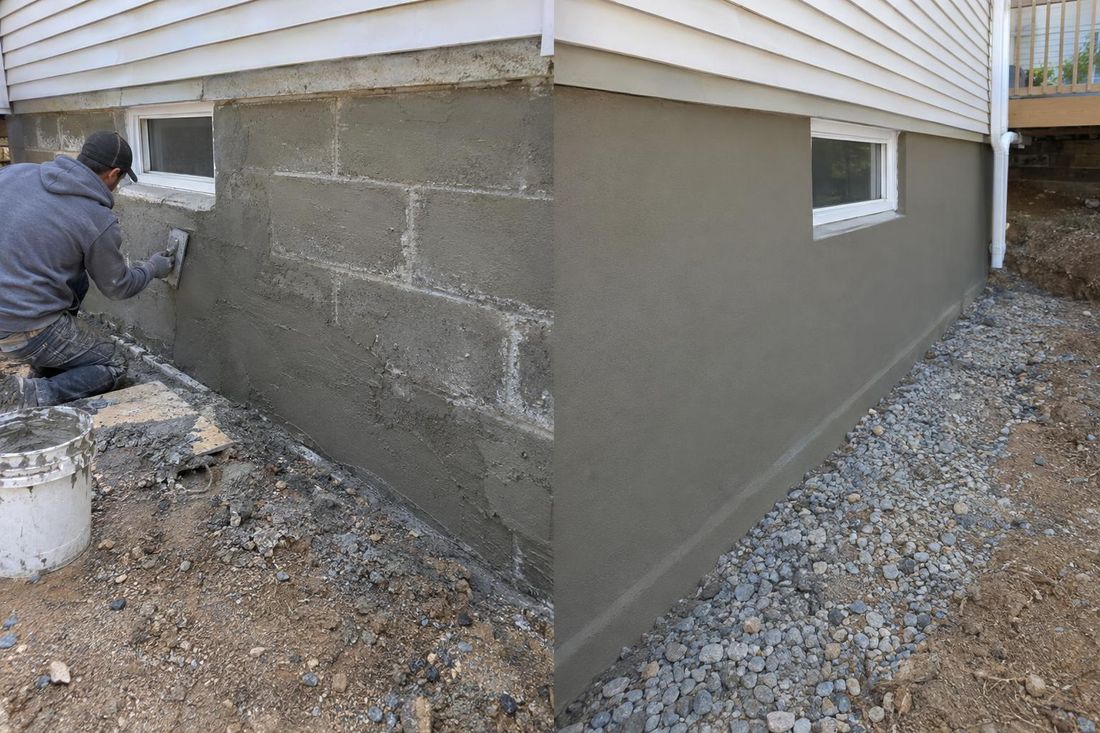
Parging a concrete block foundation wall A before-and-after view of a house foundation: on the left a worker troweling cement coating onto a bare concrete block wall, and on the right the same kind of wall covered in a smooth gray cement finish. Gravel lies along the base of the finished wall.
What drives the cost
Three things move the price most. The first is wall area. The second is how much old parge has to come off, and that's usually the biggest swing, since chipping out failed coating takes longer than putting new on. The third is the finish, because a smooth trowel finish takes more time than a brushed one. Access counts too. Shrubs, window wells and a steep grade all slow the work. So does a wall that needs a bonding agent or two coats. We'd rather see it than guess, which is why the estimate is free.
How long it takes
Usually one to two days. A few patches can be done in an afternoon, and a whole foundation wall takes longer. The mortar keeps curing after we leave, so hold off on paint or coating until we say it's ready. Rain, frost or hard sun can move our schedule, because parge doesn't cure well in any of them. We'll tell you plainly if the weather has to move us.
Local expertise: residential parging in Atlanta
Atlanta gets about 49.7 inches of rain a year. Late winter, early spring and July are the wettest stretches, and fall, especially October, is the driest.
What it means for your job
Mortar, stucco and sealers need dry time. Fall is the easiest season for repointing and sealing, and summer work is planned around afternoon storms.
Overnight freezes can be expected on about 40 days a year in Atlanta.
What it means for your job
Water that soaks into brick, stone and mortar and then freezes is what pops faces off brick and opens joints. Keeping water out matters more here than in places that rarely freeze, and winter mortar work has to be protected overnight.
Parging is a finish, not waterproofing or a structural repair. It will crack again if the wall behind is moving, and we won't pretend otherwise. If water is getting in from bad grade or a downspout dumping at the footing, the parge will fail again until that's fixed. We can tell you what we see, but we don't do the regrading or gutter work. We also don't parge over frozen block or in the rain. Mortar needs the right conditions to bond.