Your old brick house was built soft on purpose, and it needs repairs that stay soft too. We fix it with lime mortar and matching brick so the wall keeps standing the way it was meant to.
Qualified MasonsVerified ProfessionalsFree EstimatesOn Time
What historic brick restoration involves
Historic brick restoration means repairing a home with the same kind of materials that built it. Old brick was fired soft and laid in lime mortar that was meant to be the weaker part of the wall. The mortar wears away and gets replaced, and the brick stays. Modern hard mortar flips that around. The brick takes the stress, and its face breaks off.
You need us when the joints are washed out, when an old patch of gray cement is cracking the brick beside it, or when you just bought a house with some years on it and want to know what you've got. We'll come look, tell you plainly what we see, and give you a free estimate.
Signs you need historic brick restoration
Brick faces flaking offThe hard outer skin of the brick is spalling, often because a harder mortar beside it is forcing the brick to carry all the movement. It won't heal itself, and each winter takes a little more.
Gray ridges between the bricksThat's usually an earlier cement repair, and it doesn't flex like the old joints do. Check the brick edges next to it for chips and cracks.
Sandy jointsIf you can scratch the mortar out with a house key, or sand piles up at the foot of the wall, that joint has done its job and needs repointing.
White powder or damp spotsSalts are coming out of the brick as water moves through the wall. Something is holding that water in, and we want to find out what.
What we handle
Lime mortar repointingWe rake out the failed joints and fill them with lime mortar matched to the original. It's the most common job we do, and the one that saves the most brick.
Replacing brick with salvaged or matched historic brickWhen a brick is too far gone, we set in salvaged brick of the same size, color and softness. If salvage won't match, we look for a new brick that's close and hold it up against your wall before we commit.
Removing earlier hard-cement repairsWe cut out cement patches and joints without chewing up the brick edges, then repoint in lime. It's slow work, and it's often where a job starts.
Chimney, pier and foundation restorationChimneys, porch piers and brick foundations take the worst weather and water. We rebuild loose courses and repoint in lime so the masonry can dry out the way it was meant to.
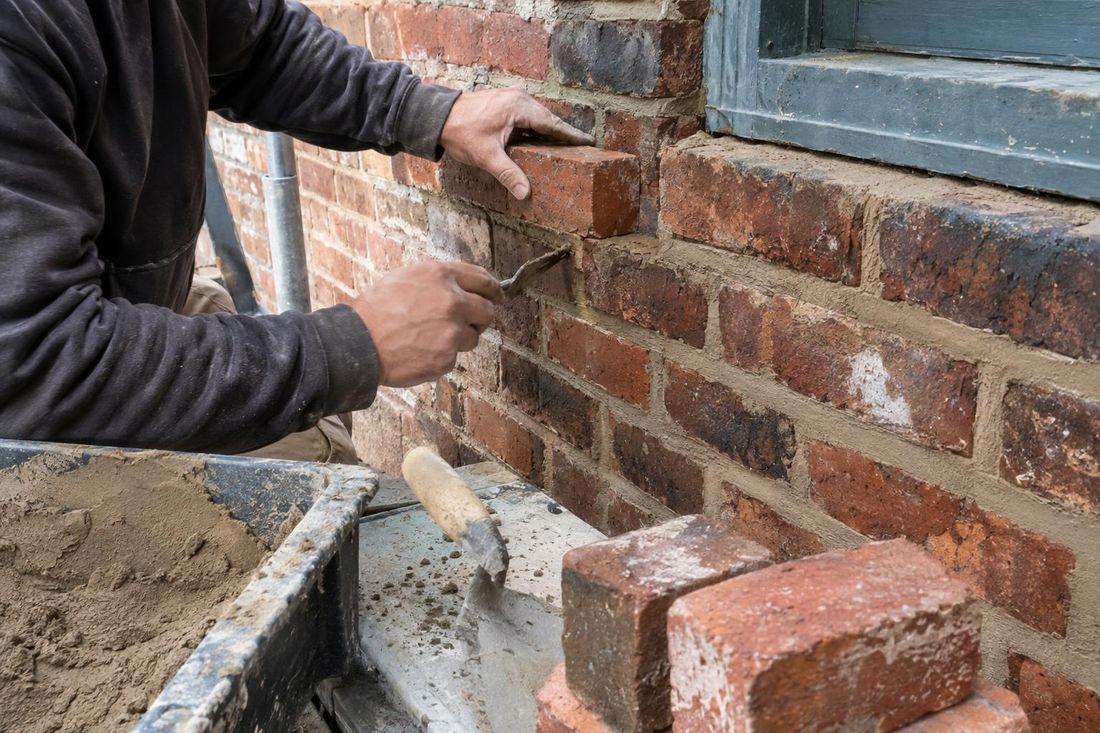
Mason repointing old red brick wall A person in a dark sweatshirt uses a small pointing tool to apply mortar between weathered red bricks, while holding a loose brick against the wall. A mortar tub, a trowel on a board, and a stack of reclaimed bricks sit in the foreground below a window sill.
How we do it
We match the mortar to your wall before we mix a batch for it. That means checking softness, color, sand and joint profile. Lime is the binder, and we pick the sand for grain size and color, because sand does most of the color work in an old joint. The new mortar should always be softer than the brick it holds. Then we match the profile, whether flush, concave or struck, because the shape of a joint changes how water runs off the wall.
Joints get raked out by hand with narrow chisels where the brick is soft or the joint is tight. Where the brick can take it, we use careful tools to speed things up, but we keep the blade off the brick edge. Cleaning is the gentlest method that works. We start with water and a soft bristle brush and only go further if the dirt won't budge. No sandblasting, and no harsh acid washes.
How a job with us goes
Free estimate and assessment
We come out and look at the brick, the mortar and any old repairs, then tell you what we find. We want to know what your wall is made of before we say what it needs.
Samples approved
We make mortar samples and pick replacement brick for you to look at. Lime mortar lightens as it dries, so we judge color on cured samples, and nothing goes on the wall until you're happy with the match.
Careful removal
We take out failed mortar and hard-cement patches joint by joint, by hand or with careful tools. Going slow here protects the brick edges, and those edges are the one thing you can't put back.
Repointing and brick replacement
We set any replacement brick first, then pack the joints in layers and tool them to the original profile. Packing in layers keeps the mortar from pulling away from the brick as it sets.
Slow, damp curing
Lime mortar cures with moisture, so we mist the joints and shade them where we need to over the following days. Let it dry too fast and it turns weak and powdery.
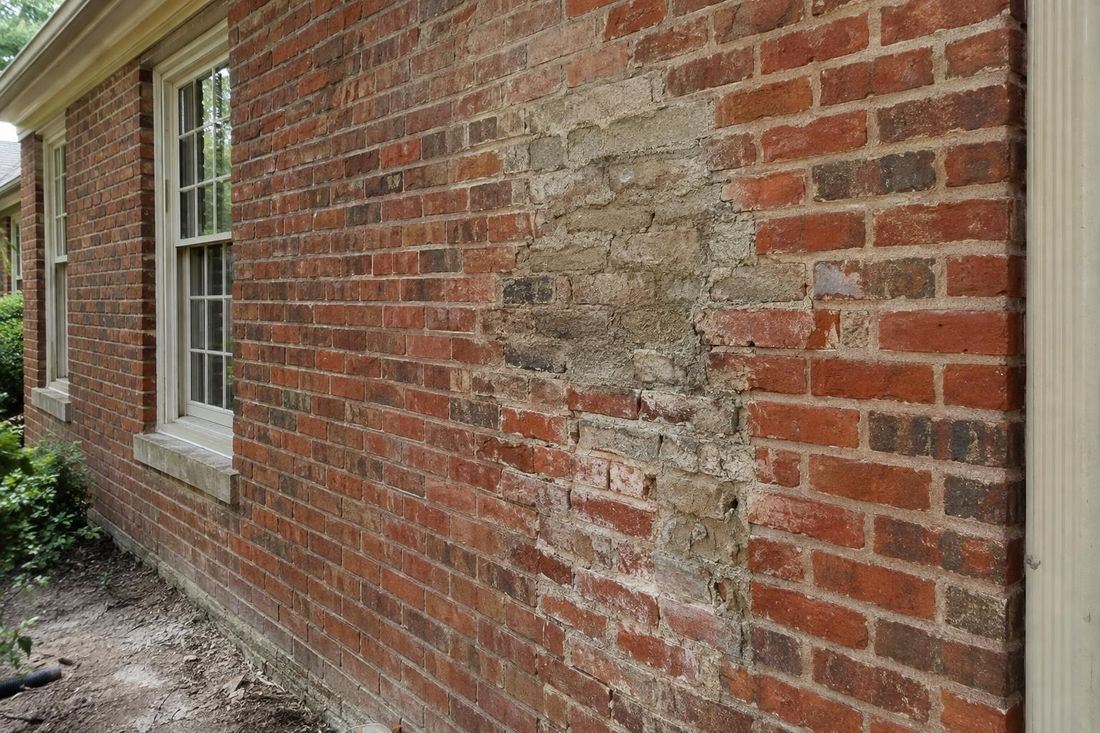
Deteriorated brick wall with damaged patch A red brick exterior wall beside a white double-hung window shows a large central area where the brick faces and mortar have worn away, exposing rough gray material underneath. The surrounding brick is intact, which shows the contrast between sound masonry and the damaged section that needs restoration.
What drives the cost
Price follows the labor and the surprises. The biggest swing is how much earlier bad repair we have to undo, since cutting out hard cement without chipping the brick goes slowly. Sourcing salvaged brick that matches your wall takes time too, and some sizes and colors are harder to find than others. Hand work is the rest of it, because raking joints with chisels takes longer than running a tool. And if your house is in a historic district, review of the plans can add steps. We see most of this at the free estimate, so you'll get the real picture before you decide.
How long it takes
Expect this to run slower than standard repointing, because we can't rush lime. Each joint is packed, tooled at the right moment, and then kept damp while it cures over days. Brick replacement adds time if we're waiting on salvage. Weather matters too, since lime doesn't like hard frost or a baking sun on a hot wall. We'll talk through a schedule at the estimate and tell you straight if the weather moves it.
Local expertise: residential historic brick restoration in Atlanta
Atlanta gets about 49.7 inches of rain a year. Late winter, early spring and July are the wettest stretches, and fall, especially October, is the driest.
What it means for your job
Mortar, stucco and sealers need dry time. Fall is the easiest season for repointing and sealing, and summer work is planned around afternoon storms.
Overnight freezes can be expected on about 40 days a year in Atlanta.
What it means for your job
Water that soaks into brick, stone and mortar and then freezes is what pops faces off brick and opens joints. Keeping water out matters more here than in places that rarely freeze, and winter mortar work has to be protected overnight.
Homes in a historic district may need approval before any exterior work, and that approval has to come first. We can work to what the review asks for, but the decision isn't ours. We won't repoint an old wall in hard cement, even if it's cheaper. If a wall is bowed or a chimney is leaning, it may need an engineer to look at it before we touch the joints. And not every mason does lime work, so say the house is historic when you request an estimate from anyone, us included.
Modern mortar is harder than old brick. The brick then takes the stress, and its face breaks off. Lime mortar is softer, so it gives first and the brick survives. Think of the mortar as the part you replace so you don't have to replace the brick.
Do I need approval for repairs?
In a designated historic district, exterior changes are usually reviewed. Ask the preservation office in Atlanta before we start.
Can't you just repoint over the old cement?
No. Hard cement left in place keeps pushing on the brick every time the wall moves with the weather. We cut it out first, then repoint in lime.
Will the new mortar look different?
A little at first. Lime lightens as it cures, so we judge color on cured samples, and over time the new joints weather in beside the old ones.
Should I seal the brick afterward?
We'd skip it. Water gets into a wall from the roof, the gutters and the ground, and old brick has to be able to let it back out. A sealer can trap it inside.