Commercial pavers do the hard work at a property: the entrance, the drop-off lane, the plaza, the crosswalk. We build them to carry box trucks and foot traffic, and to keep your doors open while we do it.
Qualified MasonsVerified ProfessionalsFree EstimatesOn Time
What paver driveways involves
Here's what this service is. We install pavers where your civil engineer's drawings call for them. That means vehicular pavers at entries and drop-offs, plaza and sidewalk pavers, crosswalk and accent bands, and permeable pavement that can count toward your stormwater requirements. We bid from the civil and landscape drawings. The pavement section is theirs and the craft is ours.
So when do you need one? Usually when you're a business, property manager or general contractor with a new site, a renovation, or a stormwater requirement that plain asphalt won't meet. Or when an entrance has to look like the rest of the building and still hold up to delivery trucks. Want a number? Call us for a free estimate in Atlanta.
Signs you need paver driveways
Ruts at the drop-offWheel paths dipping where trucks turn usually mean the base was too thin or never compacted well. Patching the surface won't fix what's underneath.
Water standing at the entrancePonding by the door is a slope problem or a clogged joint. Either way it's a slip hazard on your property.
A stormwater review that came back shortIf the reviewing agency wants more infiltration than your hard surface gives, permeable pavers are one way to get there.
Lipped edges on an accessible routeA raised paver or a cross slope past what the rules allow can catch a wheelchair. An inspector will notice it before your tenants do.
What we handle
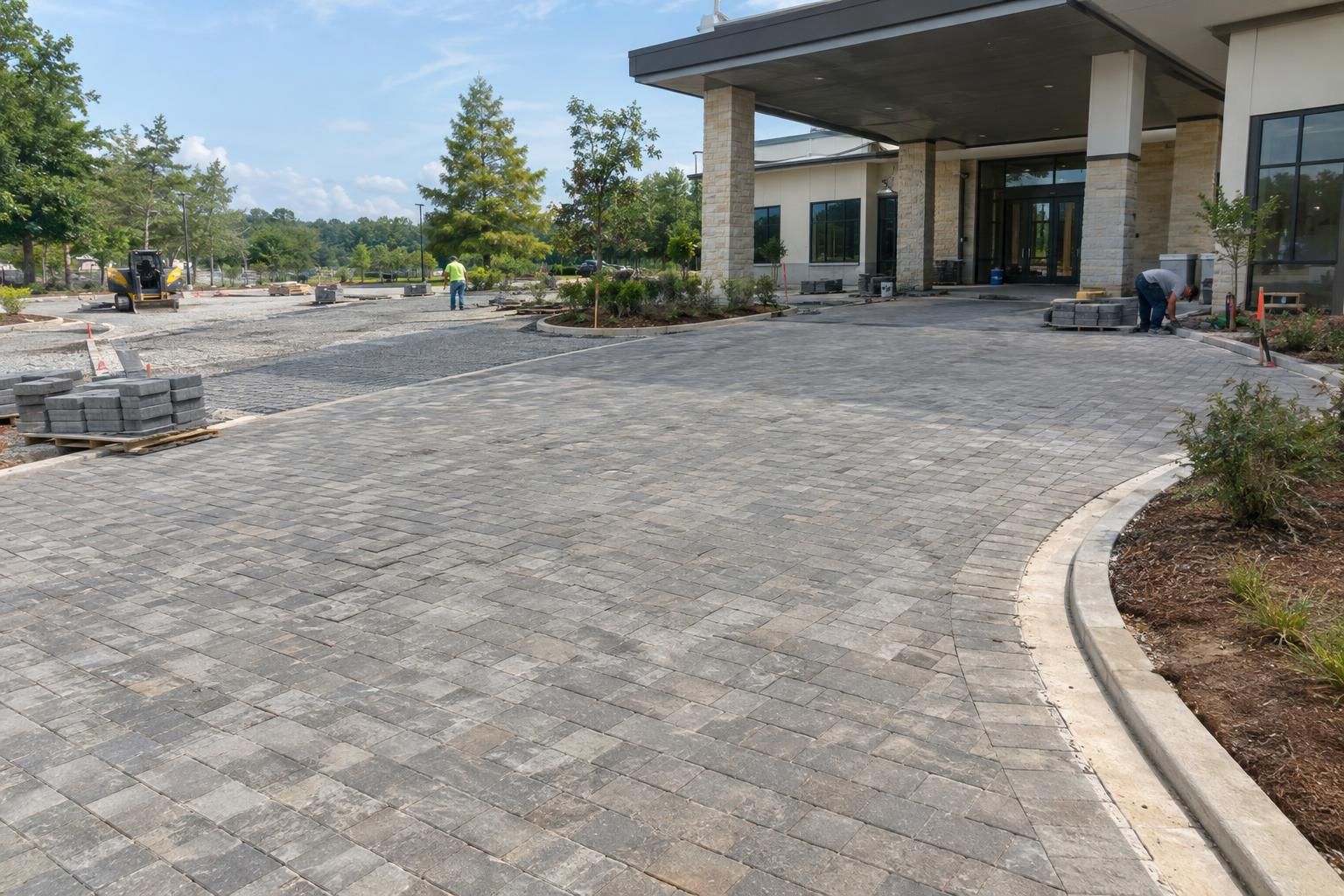
Vehicular pavers at entries and drop-offsThick pavers over a heavier base, usually laid in a herringbone pattern that resists the twist of turning tires. We build these in halves or phases so one lane stays open.
Plaza and sidewalk paversLighter sections for foot traffic, laid to the slopes accessibility rules require. If a delivery truck might cross the edge, we'll say so before the section gets locked in.
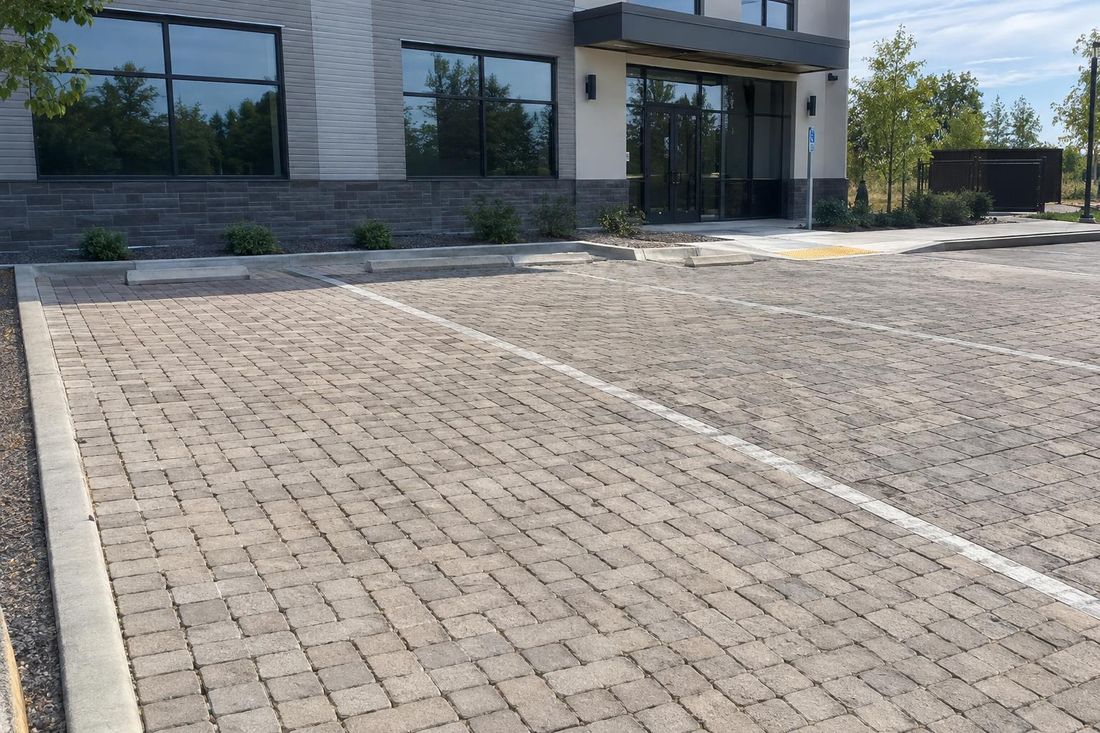
Permeable paver parkingOpen-jointed pavers over open-graded stone that stores water and lets it soak down. It can count toward stormwater requirements, and your civil engineer confirms that with the reviewing agency.
Crosswalk and accent bandsContrasting pavers set in a line to mark a crossing or frame an entrance. We cut them tight so the lines stay straight.
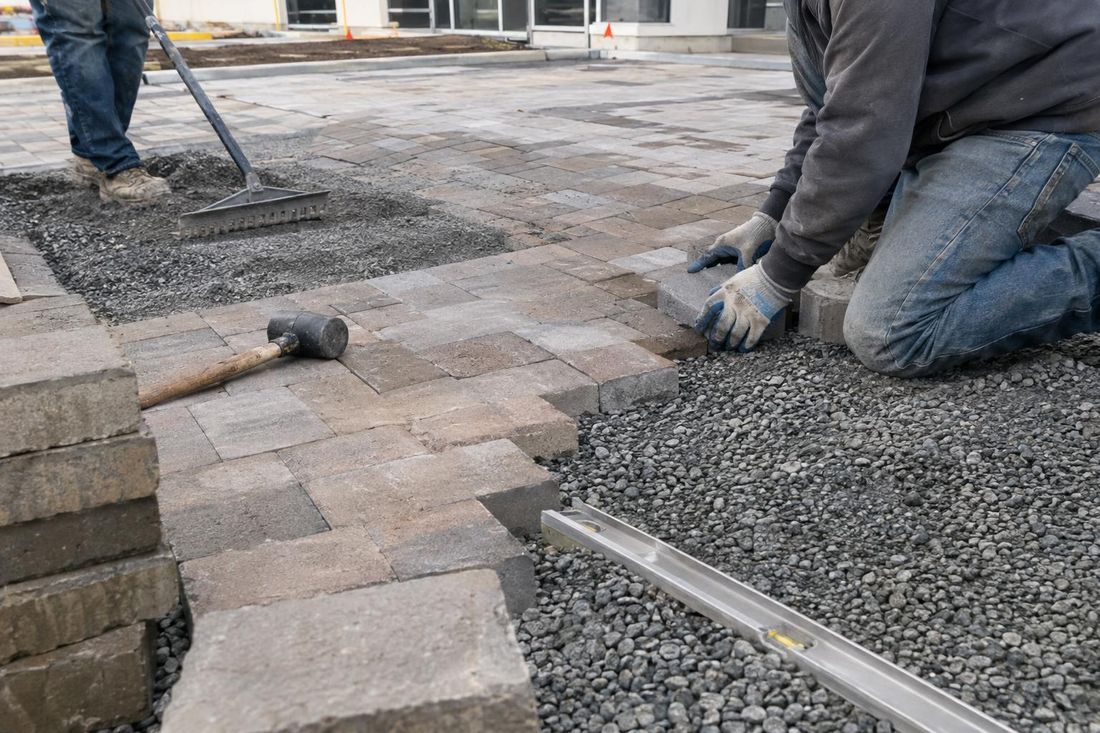
Workers installing interlocking concrete pavers Two workers lay interlocking concrete pavers over a bed of gray crushed gravel, with one kneeling to set a paver by hand. A rubber mallet, a metal level and a landscape rake sit nearby, and a commercial building is in the background.
How we do it
The pavement section is designed by your civil engineer for the traffic, and we build what's on the drawings. That means the stone gradation, base thickness and paver thickness they specify. We compact the base in lifts with a plate compactor or roller, screed the bedding layer to an even depth, and run the plate compactor over the pavers before sweeping the joints full.
Permeable systems are a different animal. They use open-graded stone layers that store water, with no fines to clog them, and the joints get clean angular stone instead of sand. Accessible routes are laid to the slopes accessibility rules require, and we check them with a level as we go, not after the last paver is down. Big open fields can be set mechanically with a clamp on a machine. Cuts, curves and tight corners we set by hand.
How a job with us goes
Bid from civil and landscape drawings
We read the civil and landscape sheets, take off the area, and note the base spec, paver type and edge restraint. If something doesn't add up, we ask before we price it.
Submittals and mock-up
We send paver samples and product data for approval, then build a mock-up panel. Owner and engineer can see color, pattern and joint width up close. It's easier to move a mock-up than a finished lot.
Base with compaction testing
We excavate, place the stone in lifts and compact each one. Testing happens before any paver goes down, because the base is the one part you can't fix later without pulling everything up.
Pavers installed mechanically or by hand
Machines set the big open fields and our masons hand-set the cuts, edges and curves. We keep the string lines pulled and check slopes as we go.
Inspection
We walk the finished work with the inspector or your representative and fix whatever they flag. Then we look over the joints and edges one more time.
Commercial paver parking area at building entrance A parking area is paved with interlocking concrete pavers in gray and tan tones, with painted white stall lines and concrete curbs along the edges. Behind it is a modern commercial building with large windows, glass entry doors, landscaped beds, and a handicap parking sign.
What drives the cost
Area comes first, since every square foot needs stone, bedding and pavers. Next is the paver and base specification. Thicker pavers and deeper stone cost more to buy and haul. A permeable system adds stone volume and cleaner, more specific materials. Phasing to keep access open takes more moves and slower progress than closing the whole lot. And testing adds its own fees and waiting time. Staying open costs more than shutting down, but a blocked entrance can cost you more than either. Send us the drawings and we'll break these pieces out so you can see where the price comes from.
How long it takes
Most commercial paver jobs run days to weeks, phased around site access. A small entrance can go in fast. Big plazas and permeable lots take longer, and so does any job we build in halves so traffic keeps moving. Submittal approval, testing results and rain can all move the start or stretch the middle. Tell us when your busy days are and we'll plan the work around them.
Local expertise: commercial paver driveways in Atlanta
The red clay of the Georgia Piedmont is typified by the Cecil soil series: very deep, well drained soil on ridges and side slopes, with a red subsoil that averages 35 to 60 percent clay.
What it means for your job
Clay holds water against a wall and does not recover well once it is compacted, so drainage behind a retaining wall and a properly built base under pavers and footings matter more here than the surface material.
Atlanta gets about 49.7 inches of rain a year. Late winter, early spring and July are the wettest stretches, and fall, especially October, is the driest.
What it means for your job
Mortar, stucco and sealers need dry time. Fall is the easiest season for repointing and sealing, and summer work is planned around afternoon storms.
Overnight freezes can be expected on about 40 days a year in Atlanta.
What it means for your job
Water that soaks into brick, stone and mortar and then freezes is what pops faces off brick and opens joints. Keeping water out matters more here than in places that rarely freeze, and winter mortar work has to be protected overnight.
We need the pavement design. We build to your civil engineer's section and we don't guess at traffic loads. Permeable pavers need periodic vacuum sweeping to keep draining, and once the joints clog with fines the water stops soaking in. Pavers can't make up for a bad subgrade either. If the base fails testing or the soil is soft, that gets fixed first, and we'll tell you what we find. Drainage design and utility work belong to other trades, and we coordinate around them.