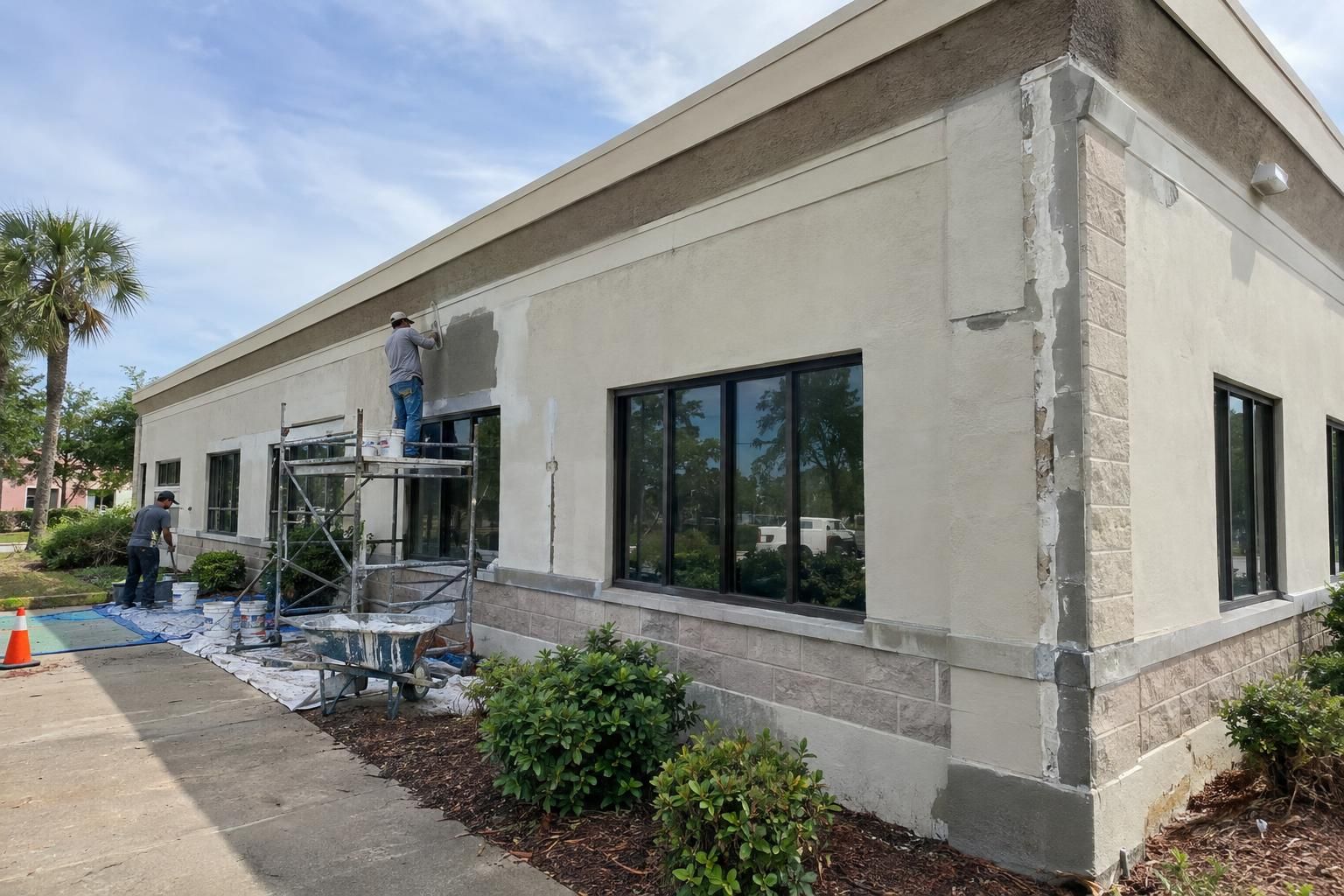
Before we touch a commercial wall, we find out what's on it. Cement stucco and foam-backed synthetic systems fail differently, so we repair them differently.
Qualified MasonsVerified ProfessionalsFree EstimatesOn Time
What stucco repair involves
Commercial stucco repair means fixing cracks, hollow areas, failed sealant and impact damage on storefronts, columns and full elevations. Traditional stucco is cement troweled over lath or block, and it's hard and heavy. The synthetic kind, usually called EIFS, is a thin coating over foam board, and it's much softer. A repair that suits one can wreck the other. And a wrong guess lets water in behind the finish, where nobody sees it for years.
You need us when a tenant complains about a stain, when a general contractor inherits a wall that sounds hollow, or when a delivery truck meets a column. We start with a free estimate and a walk around the building. Businesses, property managers and general contractors in Atlanta call us for all of it.
Signs you need stucco repair
Cracks running from window and door cornersStress gathers at those corners, so cracks start there first. On a commercial wall they also let water into the sheathing, so don't wait on them.
A hollow sound when you tapStucco that has let go of its backing sounds drummy under a knuckle or a mallet. That's delamination, and it only spreads.
A soft or spongy spot on a foam-backed wallPress it with your thumb. If it gives, water has probably gotten behind the finish and into the foam.
Sealant that's split, pulled away or stainedJoints at control lines and window perimeters are the wall's first defense. Dark streaks below them tell us water is getting past.
What we handle
Crack and delamination repairWe open cracks and cut hollow areas back to sound material, then rebuild. On EIFS we open the damaged section and check the foam and base coat before we patch anything.
Impact damage at storefronts and columnsCarts, trucks and bumpers chip corners and punch through foam-backed walls. We rebuild the profile and set new corner bead where the old one is bent.
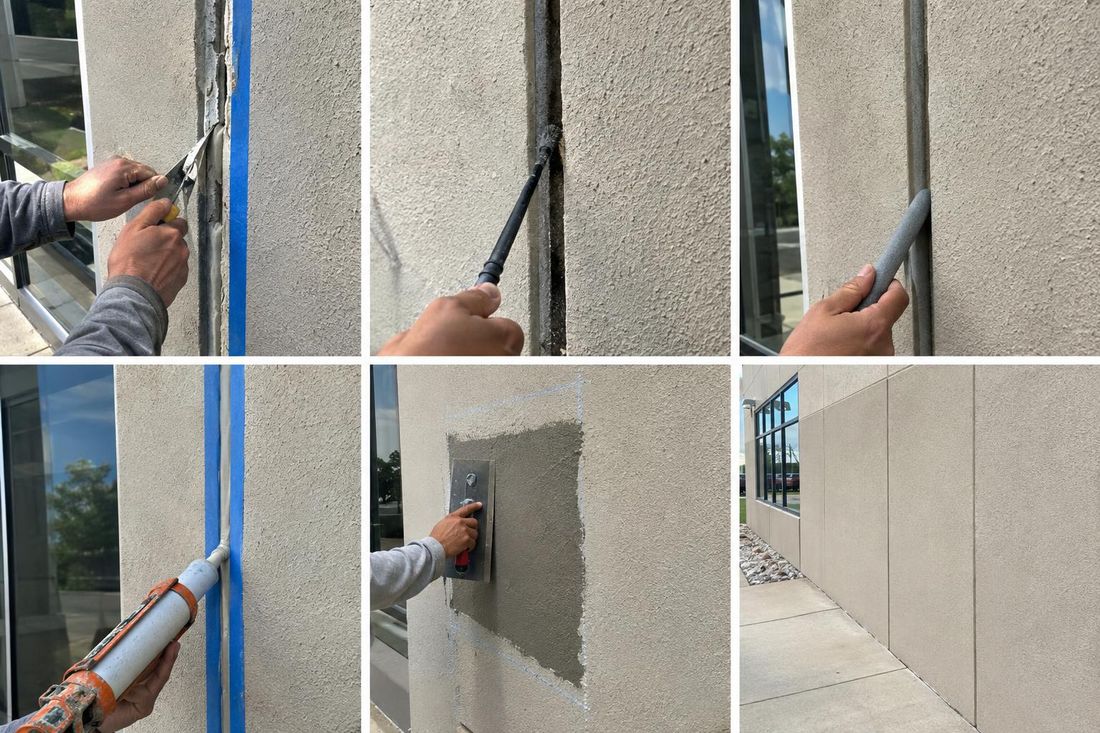
Sealant and control joint replacementWe cut out the old sealant, clean the joint, set backer rod and tool in new sealant so it can stretch with the building.
Re-coating and elastomeric finishingWhen a wall is more patch than original, we coat the whole elevation. Elastomeric finish can bridge hairline movement and gives the building one even color.
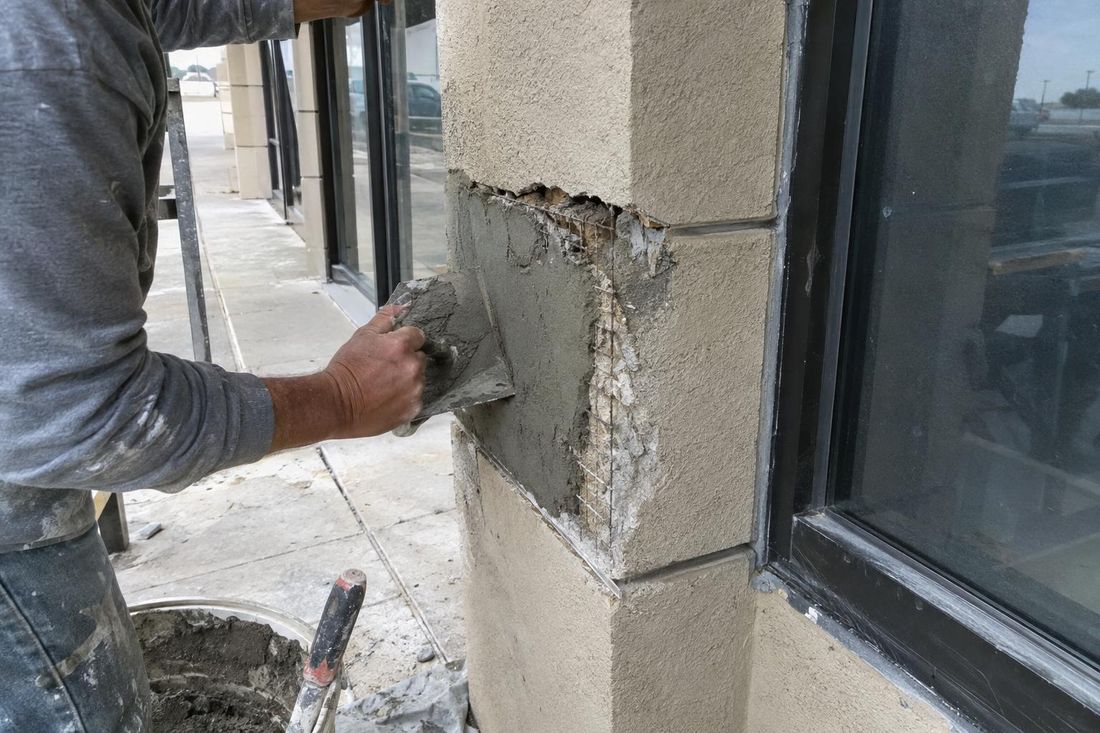
Plastering a damaged stucco column A worker in a gray long-sleeve shirt uses a metal trowel to press fresh gray stucco mortar onto a broken area of a beige column beside a storefront window. The exposed wire mesh and chipped edges are visible around the patch, and a bucket of mortar sits on the sidewalk below.
How we do it
On cement stucco, we sound the wall with a mallet and mark every hollow area in chalk. Delaminated areas are removed to sound material and rebuilt in coats, scratch then brown then finish. Each coat firms up before the next goes on, because rushing is how patches crack at their edges. Wherever we cut back, we check the lath and the water barrier before we close it up.
Control joints and window perimeters are resealed with backer rod and a sealant that suits the surface. Then the elevation is finished with a matching texture and coating so repairs do not telegraph. A patch can look fine at noon and show like a scar in low afternoon light. On EIFS we use compatible foam, mesh and base coat in place of cement, since the two systems don't mix.
How a job with us goes
Wall survey and system identification
We walk every elevation, tap the wall and probe suspect spots. We confirm whether it's stucco or EIFS first, because that answer decides every material we bring.
Scope by elevation
We write up each side of the building on its own, with the access it needs. That lets a manager or GC compare, schedule and approve it piece by piece.
Repairs and sealant work
We cut out the failed areas and rebuild them in coats. Then we replace sealant at control joints and window perimeters, so everything underneath is sound before we coat.
Finish coat across the elevation
We texture and coat the full face, corner to corner. There's no edge where a patch stops and the old wall starts.
Walk-through
We walk the finished elevations with you in daylight and look at them from where customers will. Anything we wouldn't want to see, we fix.
Commercial stucco joint and patch repair A six-panel collage shows a worker cutting out old sealant from a vertical joint in a stucco wall, cleaning the joint, and pressing in a gray foam backer rod. Next, blue tape lines the joint while caulk is applied with a caulking gun, a trowel smooths a fresh stucco patch, and the last frame shows a finished wall with thin vertical control joints.
What drives the cost
Price follows wall area first, then system type, since EIFS and cement stucco take different materials and labor. Height and access matter a lot. A second-story wall that needs a lift or scaffold costs more than one we can reach from the ground. Sealant replacement is figured by the linear foot, and coating adds to the job because we coat whole elevations. Tenant phasing changes the number too, since moving crews between storefronts takes time. We give a free estimate once we've seen the wall, and we'll show you which items are driving the total.
How long it takes
Plan on days per elevation for most buildings. Cement stucco needs time between coats, and weather can stretch that. A shopping center is usually phased over weeks, one storefront or section at a time, so tenants keep their doors open. Tell us early about delivery hours, holidays and tenant move-ins. And if a general contractor is holding a schedule, we'll fit our work around the other trades as best we can.
Local expertise: commercial stucco repair in Atlanta
Atlanta gets about 49.7 inches of rain a year. Late winter, early spring and July are the wettest stretches, and fall, especially October, is the driest.
What it means for your job
Mortar, stucco and sealers need dry time. Fall is the easiest season for repointing and sealing, and summer work is planned around afternoon storms.
Overnight freezes can be expected on about 40 days a year in Atlanta.
What it means for your job
Water that soaks into brick, stone and mortar and then freezes is what pops faces off brick and opens joints. Keeping water out matters more here than in places that rarely freeze, and winter mortar work has to be protected overnight.
We can't price what we can't see. Water damage to sheathing or studs behind the stucco is priced once exposed, because nobody knows how far it runs until the wall is open. If we find rot, we'll show you, explain it and give you a number before we go on. Our estimate covers the scope we walked. Structural movement is a different job, and a wall that keeps moving will crack again no matter how well we patch it. Weather matters too, since stucco and sealant both need dry conditions to cure.