Commercial Masonry demolition and removal in Atlanta
We cut into commercial buildings without making the rest of the building pay for it. Openings, tenant walls and site walls come out clean and on a schedule that works around you.
Qualified MasonsVerified ProfessionalsFree EstimatesOn Time
What masonry demolition and removal involves
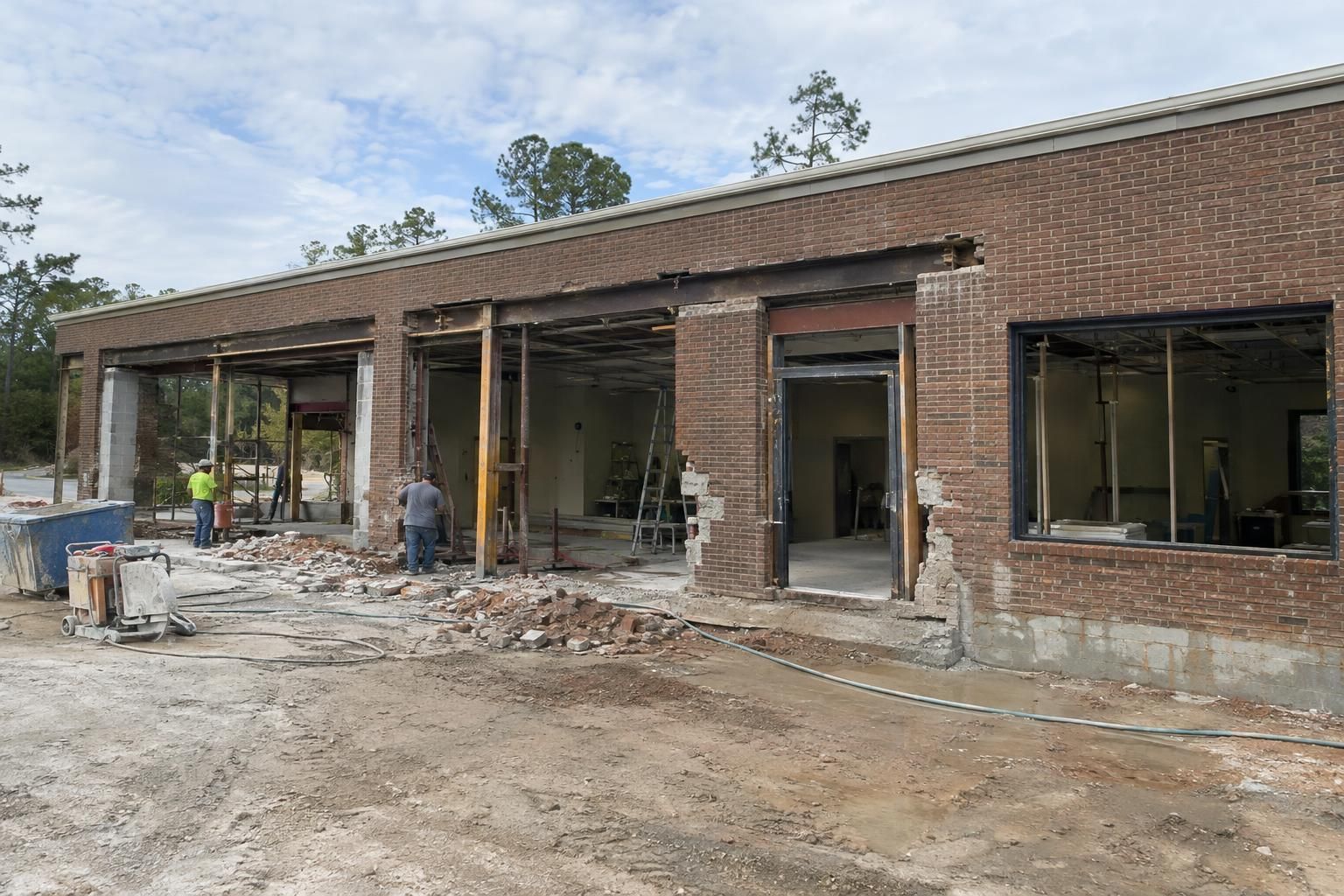
Commercial masonry demolition is selective work. We cut openings for doors, storefronts and ductwork, take out interior block walls for a tenant, and bring down site walls. The rest of the building keeps standing and the neighbors keep working. We start with the drawings and the engineer's notes, not a sledgehammer.
You need us when a new tenant's floor plan doesn't match the walls, when a storefront needs a wider door, or when the mechanical contractor needs a hole through a foot of block. Property managers and general contractors call us because the wall is in the way and the trades behind us are waiting on it. Got a wall that's holding up your schedule? We'll come look at it in Atlanta and give you a free estimate.
Signs you need masonry demolition and removal
Your tenant's plan doesn't fit the wallsThe layout wants one open space and a block partition runs right through it. Our first job is finding out if that wall is only a partition or if it's carrying load.
The drawings show an opening that isn't there yetA door, storefront or duct penetration is drawn into solid masonry. That's a saw-cut with a lintel behind it, and it needs a sequence.
Another trade is stuck waitingDuctwork, conduit or piping can't go in until somebody cuts through the wall. Their schedule hangs on ours.
A site wall or enclosure is in the wayAn old dumpster enclosure or freestanding screen wall blocks new paving, a dock or a utility run.
What we handle
New door, window and storefront openingsWe saw-cut to the size on the drawings and set a new lintel overhead. Brick, block and poured concrete each cut a little differently, and we plan the edges around the finish that's going in.
Interior block wall removal for tenant build-outsWe take partitions down in controlled sections so debris stays put. Before we cut, we check the cells for rebar, grout, conduit and pipe.
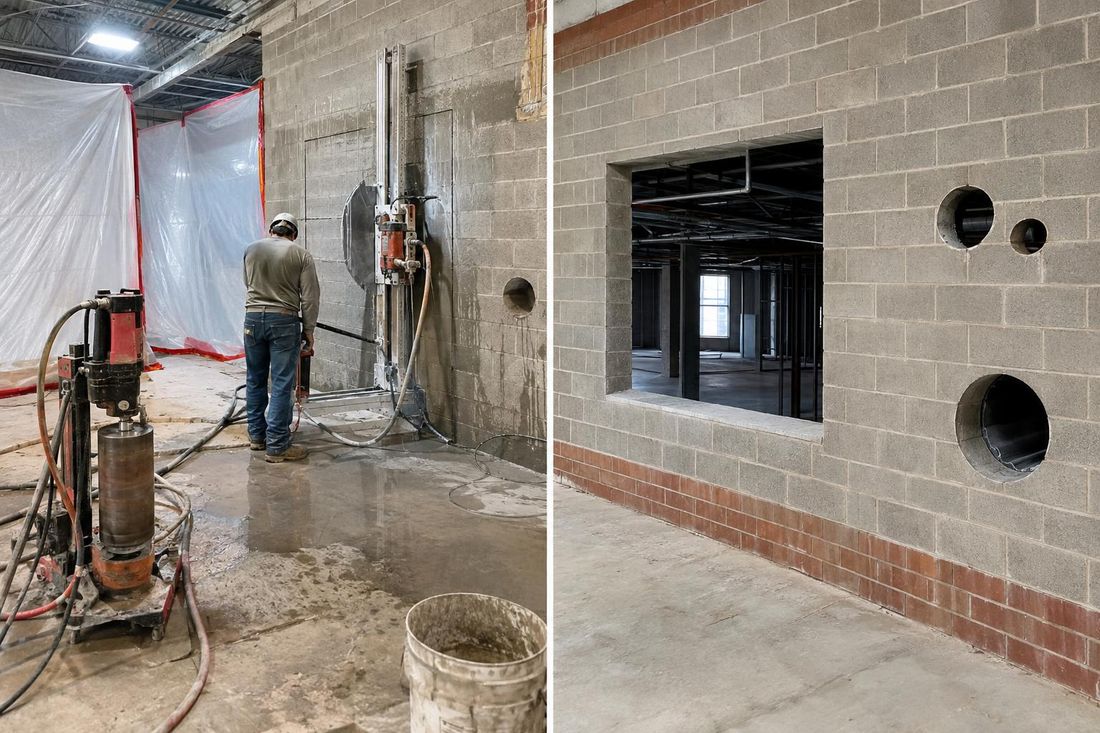
Openings for mechanical and electrical workCore drilling handles the round penetrations, and the wall saw handles the big rectangular ones for ducts and panels.
Site wall and enclosure removalFreestanding block or brick walls, dumpster enclosures and screen walls come down and get hauled off. We tell you what's left of the footing so the next trade isn't surprised.
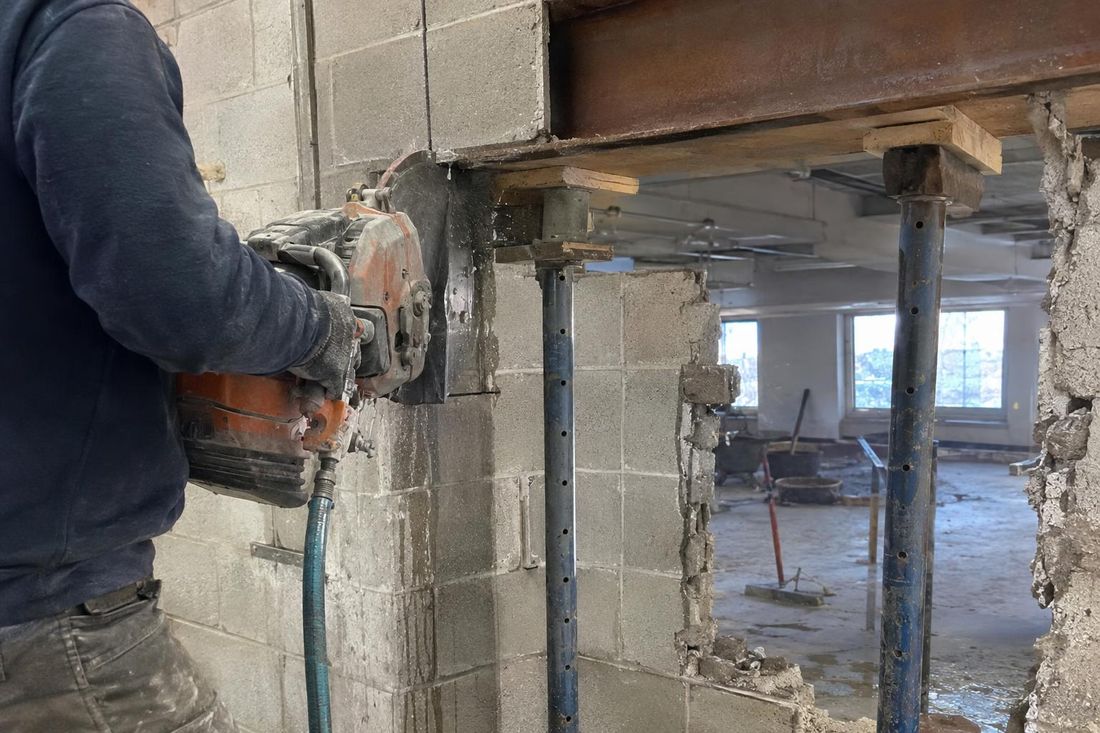
Wall saw cutting concrete block wall A worker in a dark sweatshirt operates an orange hydraulic wall saw with a water hose to cut an opening in a concrete block wall. Steel adjustable shoring posts support the rusty steel beam above, and the opening shows a gutted commercial interior beyond.
How we do it
Openings are saw-cut for clean edges, with dust and water controlled. A wall saw on a track makes the long straight cuts, and a hand saw finishes the corners. Wet cutting keeps dust down and plastic barriers keep what's left out of your tenant's space. Small penetrations get a core drill. We don't swing a hammer at an opening that has to take a door frame.
Shoring and new lintels go in before bearing walls are opened, following the engineer's sequence. Adjustable steel posts and needle beams carry the load while the wall is cut, and the steel lintel goes in on a solid bearing before we let the shoring go. That order matters. If you open first and support second, the wall tells you about it right away.
How a job with us goes
Site walk and scope
We read the drawings, then walk the wall. We look for what the drawings don't show, like conduit in the cells, a patched earlier opening, or a wall that's really bearing.
Shoring and protection
Bearing walls get supported first, to the engineer's sequence. We also cover floors, hang dust barriers and protect what stays, because a clean job site is part of the job.
Saw-cutting and removal
We cut the opening to size and take the masonry out in pieces we can carry. This is often after hours, so tenants aren't listening to a saw all day.
Lintels and jamb finishing
The lintel goes in to the engineer's size and bearing. Then we square up the jambs so the frame installer has a true opening.
Haul-off and cleanup
We load out the debris and vacuum the area. Then we walk it with you before we leave.
Core drilling and wall sawing concrete block A worker in a hard hat operates a track-mounted wall saw and a core drill rig on a concrete block wall inside a commercial building, with plastic sheeting hanging as a dust barrier. The right side shows the result: a rectangular opening and several round holes cut through the block wall.
What drives the cost
Price follows the work, so we look at the number and size of openings first. A bearing wall adds shoring and steel, and that changes the job more than anything else. Thick or reinforced walls take longer to cut. Dust and noise controls matter in an occupied building, and after-hours work costs more than daytime. Disposal counts too, because masonry is heavy and the haul adds up. Access plays a part as well. A cut on the ground floor with a dumpster at the door is a different job from a third-floor partition with a long carry. Send us the drawings and we'll price what's actually there.
How long it takes
Plan on days per opening, not weeks. A simple partition might come out in a night or two. A bearing opening takes longer because shoring goes in first and the lintel goes in after. We schedule around your tenants and your general contractor, and we'd rather hit a quiet weekend than a busy Tuesday. Tell us when the next trade needs the space and we'll work backward from there.
Local expertise: commercial masonry demolition and removal in Atlanta
Atlanta gets about 49.7 inches of rain a year. Late winter, early spring and July are the wettest stretches, and fall, especially October, is the driest.
What it means for your job
Mortar, stucco and sealers need dry time. Fall is the easiest season for repointing and sealing, and summer work is planned around afternoon storms.
Overnight freezes can be expected on about 40 days a year in Atlanta.
What it means for your job
Water that soaks into brick, stone and mortar and then freezes is what pops faces off brick and opens joints. Keeping water out matters more here than in places that rarely freeze, and winter mortar work has to be protected overnight.
Bearing walls need engineered shoring and lintels, and we follow the engineer's drawings. We don't guess at load. Hazardous materials found in old walls stop work until they're tested, and that can hold the schedule, so tell us if the building is old. We cut and remove masonry, so electrical, plumbing and finish trades are separate unless we've agreed otherwise. Permits and engineering are for you and your team to sort out.