Qualified MasonsVerified ProfessionalsFree EstimatesOn Time
What masonry crack repair involves
Crack repair means finding out why the masonry split, then fixing the crack and the cause where we can. Some cracks are cosmetic. Some come from the house settling. Some come from steel inside the wall rusting and swelling. The fix depends on which one you've got, and a caulk gun can't tell the difference.
You need us when you spot a crack in the brick, block, chimney or steps at your home and wonder if it matters. Maybe a door started sticking. Maybe you can slip a dime into the gap. Call us in Atlanta and we'll come look. The estimate is free, and if the wall isn't the real problem, we'll say so. We'd rather you call early than after a winter of water getting in.
Signs you need masonry crack repair
A gap you can slide a coin intoThat's usually wider than about a quarter inch, and a crack that wide needs a look from us soon. Water gets in easily, and the wall may be moving.
A crack that's grownMark each end with a pencil and write the date beside it. If the crack passes your mark, the wall is still moving and patching alone won't hold.
One side sits proud of the otherWhen the brick faces on either side of a crack don't line up, something has shifted. That points to settling or a failing support.
Sticking doors and windows nearbyFrames get squeezed when a wall moves. A crack with a stuck sash beside it is the combination we take most seriously.
What we handle
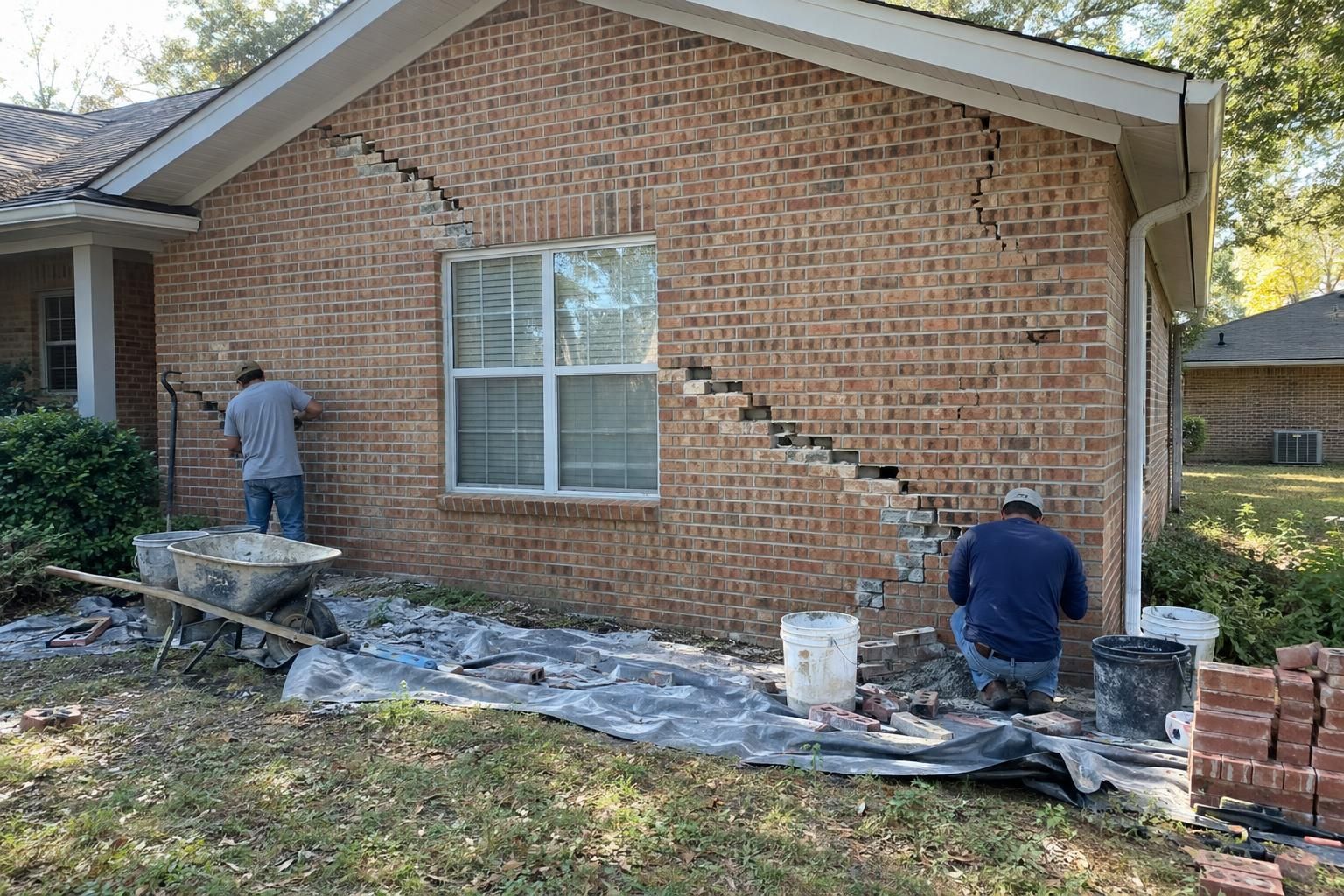
Stair-step cracks in brick or blockThese climb along the mortar joints in a diagonal. They often come from settling at one end of the wall, so we look at the ground and downspouts before we look at the mortar.
Vertical cracks at corners and openingsCorners and window edges take the most stress. We check whether it's a simple joint failure or a sign the wall is pulling away.
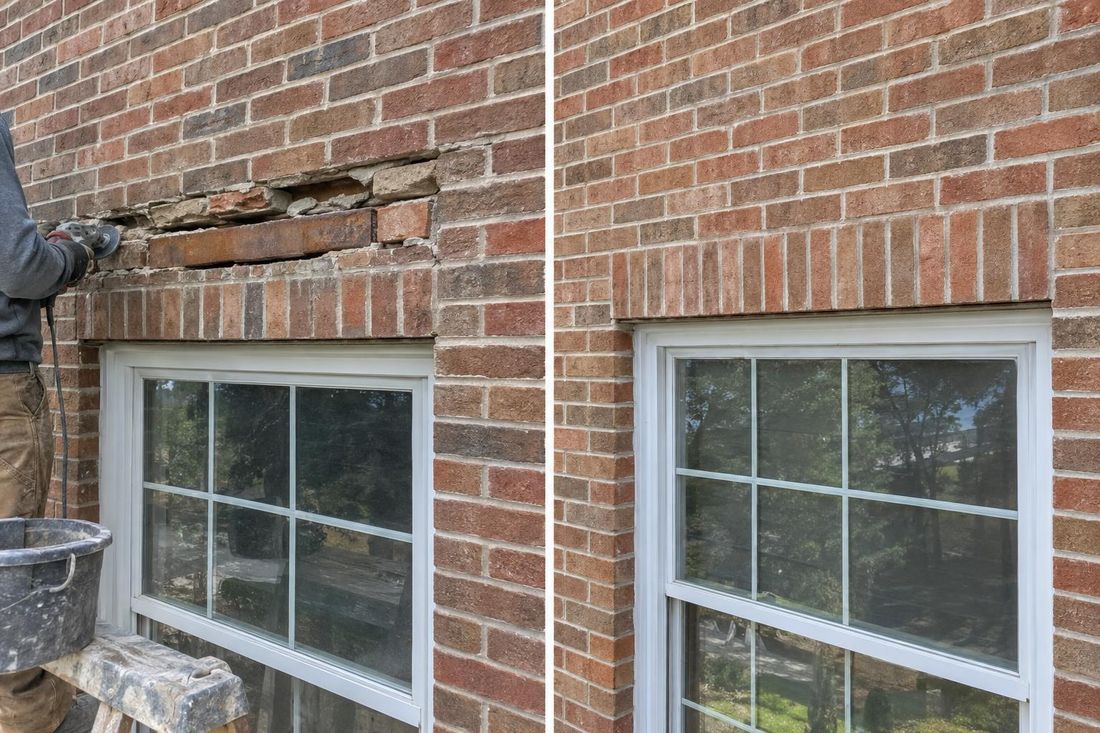
Horizontal cracks above windows and doorsThink rusting steel lintel. The rust swells and pushes the brick up, so the steel needs attention, not just the joint.
Cracks through the bricks themselvesWhen the brick splits and the mortar doesn't, a lot of force is at work. We replace the broken units and hunt for the reason.
Chimney and porch step cracksExposed masonry takes the worst of water and freezing. We repoint and rebuild loose sections before the weather does more damage.
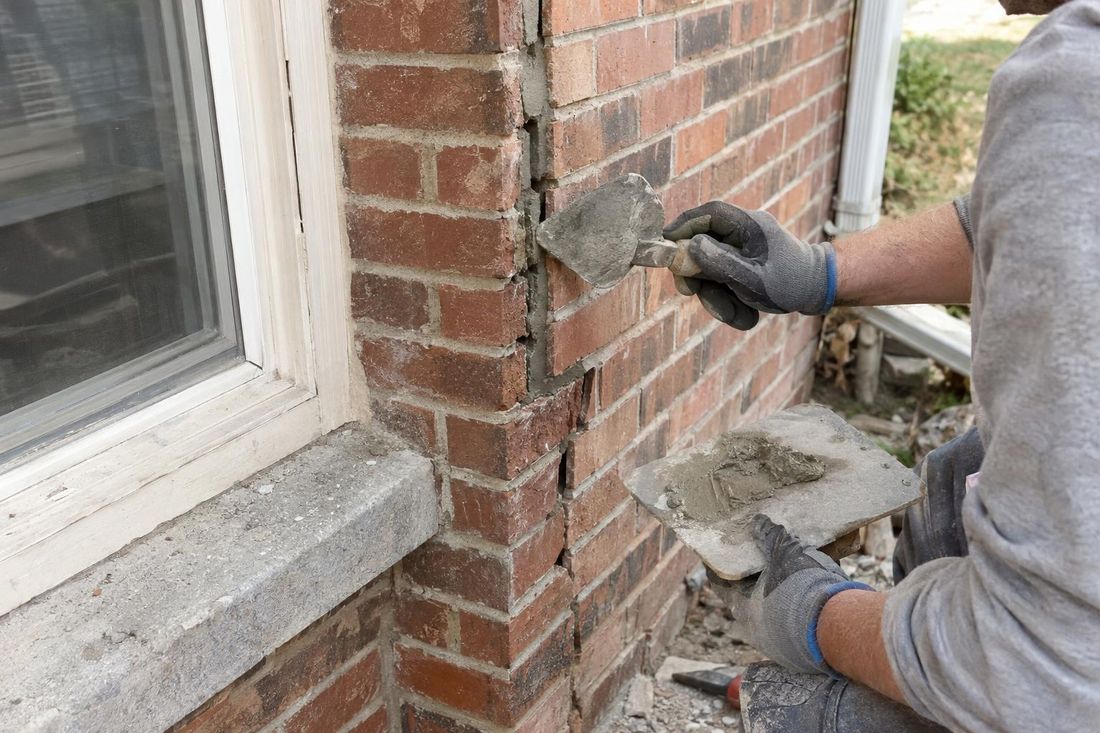
Tuckpointing a vertical brick wall crack A gloved worker holds a pointing trowel against a vertical crack in a red brick wall beside a window. In the other hand he holds a hawk with mortar, and part of the crack already looks filled with gray mortar.
How we do it
Stable cracks are cut out and repointed, and broken units get replaced. We cut the old mortar out with a grinder or hand chisel, at least twice as deep as the joint is wide, then brush it clean and pack in new mortar in layers. We match the mix to your wall. On older brick that usually means mortar softer than the brick, so the joint wears before the brick does.
Cracks that keep moving need more. We can stitch them with stainless steel bars set into the joints across the crack, which ties the two sides back together. Or we can cut a movement joint, fill it with backer rod and flexible sealant, and let the wall move without cracking. Which one we pick depends on whether the wall needs holding or needs room. And if steel is rusting inside, we deal with it before we close anything up.
How a job with us goes
Free estimate and crack assessment
We walk the wall and note the crack's direction, width and location. We also check the ground, gutters and nearby doors and windows, because that's where the cause usually shows itself.
Cause addressed where possible
A crack fixed without fixing why it opened will open again. If it's a downspout dumping at the footing or a rusted lintel, we deal with it or tell you who should.
Crack cut out, stitched or rebuilt
We pick the repair that matches what the wall is doing. Stable cracks get cut out and repointed, and moving ones get stitched or a movement joint.
Joints finished to match
We tool the new joints to the same profile and color as the old ones. A flat joint next to a concave one shows from the street.
Cleanup and walk-through
We sweep up, brush down the wall and walk it with you. You'll know what we did and what to watch for.
Brick above window before and after The left side shows a worker using a grinder on a damaged, open section of red brick above a white-framed window, with a mortar bucket nearby. The right side shows the same area with the brickwork above the window intact and evenly mortared.
What drives the cost
Price follows the work, so we look at how long the cracks are and how many there are. Replacing broken units costs more than repointing, and matching old brick can take time. Stitching adds bars and labor to each crack. Height matters because high walls mean ladders or scaffold. Access matters too, since a wall behind shrubs or a deck takes longer to reach. And the cause counts most. A crack from a simple joint failure is a smaller job than one that needs a lintel dealt with first. We price it after we've seen the wall, and the estimate is free.
How long it takes
Most crack repairs take a day or two. A few cracks in one wall can be done in a day, while stitching or replacing brick adds time. Mortar needs time to set, and we don't work it in hard freezing weather or driving rain, so the season can push a job back. If matching brick has to be tracked down, that can add a wait. We'll give you a realistic picture when we've looked at the wall.
Local expertise: residential masonry crack repair in Atlanta
The red clay of the Georgia Piedmont is typified by the Cecil soil series: very deep, well drained soil on ridges and side slopes, with a red subsoil that averages 35 to 60 percent clay.
What it means for your job
Clay holds water against a wall and does not recover well once it is compacted, so drainage behind a retaining wall and a properly built base under pavers and footings matter more here than the surface material.
Atlanta gets about 49.7 inches of rain a year. Late winter, early spring and July are the wettest stretches, and fall, especially October, is the driest.
What it means for your job
Mortar, stucco and sealers need dry time. Fall is the easiest season for repointing and sealing, and summer work is planned around afternoon storms.
Overnight freezes can be expected on about 40 days a year in Atlanta.
What it means for your job
Water that soaks into brick, stone and mortar and then freezes is what pops faces off brick and opens joints. Keeping water out matters more here than in places that rarely freeze, and winter mortar work has to be protected overnight.
If the foundation is still moving, we'll recommend an engineer or foundation contractor before we repair the wall. Patching brick on a foundation that's still shifting just means the crack comes back. We aren't engineers, so we don't diagnose structural failure or design foundation fixes. We can't promise a new joint will match old mortar exactly, since weathering changes color, though we get as close as we can. And repairs hold only as long as the cause stays fixed, so a leaking gutter or wet soil can undo good work.