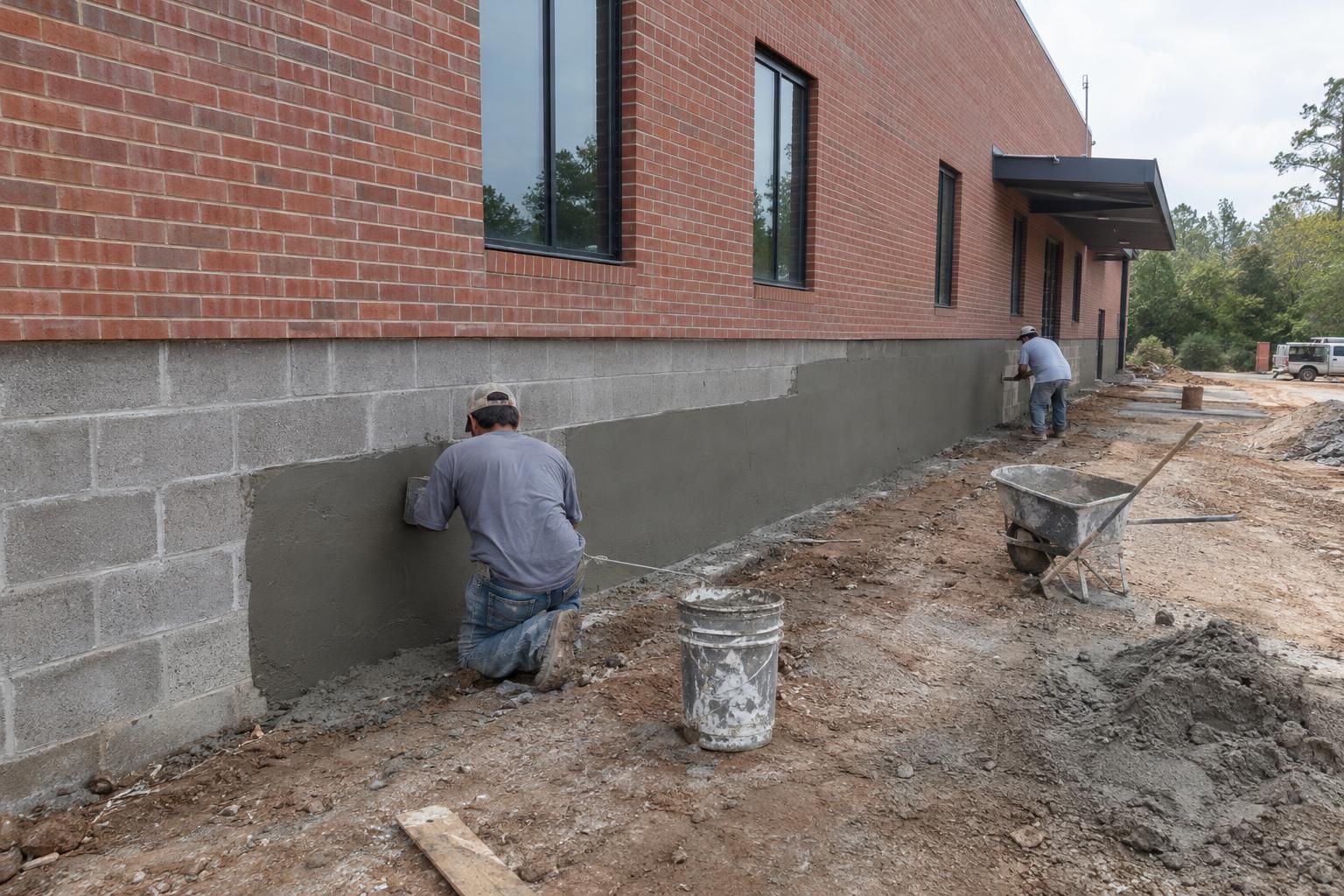
On a commercial building, parging is the smooth skin the waterproofing crew and the painters both count on. We put it on block so the next trade has a surface they can work with.
Qualified MasonsVerified ProfessionalsFree EstimatesOn Time
What parging involves
Here's what it does on a commercial job. Below grade, it fills the pitted face and open voids of block so a membrane has something smooth to stick to. Above grade, it gives exposed block a uniform face in service areas, docks and mechanical rooms, where raw block collects grime and takes a beating.
You need us when the drawings call for a parge coat ahead of waterproofing, when an old cement coating is letting go, or when a coating manufacturer won't stand behind their product on rough block. Property managers call us when a dock wall looks tired. General contractors call us when backfill is a few days out. We'll look at it and give you a free estimate in Atlanta.
Signs you need parging
Membrane peeling off blockWaterproofing that bubbles or lifts usually had no parge coat under it. The block face was full of voids, so the membrane had nothing smooth to bond to.
White crust at the base of a wallThat powdery efflorescence means water is moving through the block. Parging won't cure that alone, so we want to see where the water comes from before we cover anything.
A hollow sound when tappedKnock on the old coating with a hammer handle. If it sounds hollow or comes off in sheets, it's lost its bond and has to come back to sound block.
Chewed-up dock and service wallsCarts, pallets and bumpers wear raw block fast. Patchy, scuffed walls next to cleaner ones usually want a uniform face again.
What we handle
Parge coat below grade before waterproofingThis is the bread and butter of the service. We cover the block face so the membrane crew gets the smooth, even surface their product calls for.
Smoothing block in service and dock areasMechanical rooms, trash enclosures and loading docks get a uniform face that's easier to clean and to paint. We pay attention to corners and the zone where traffic hits.
Repairing failed cement coatingsWe sound the old coating, cut back everything that's loose and parge back to a solid edge. Patching over a coating that's already letting go just hides the problem for a season.
Surface preparation for elastomeric coatingsElastomerics show every flaw in the wall underneath. We parge the block so the coating goes on over a surface that's even and tight.
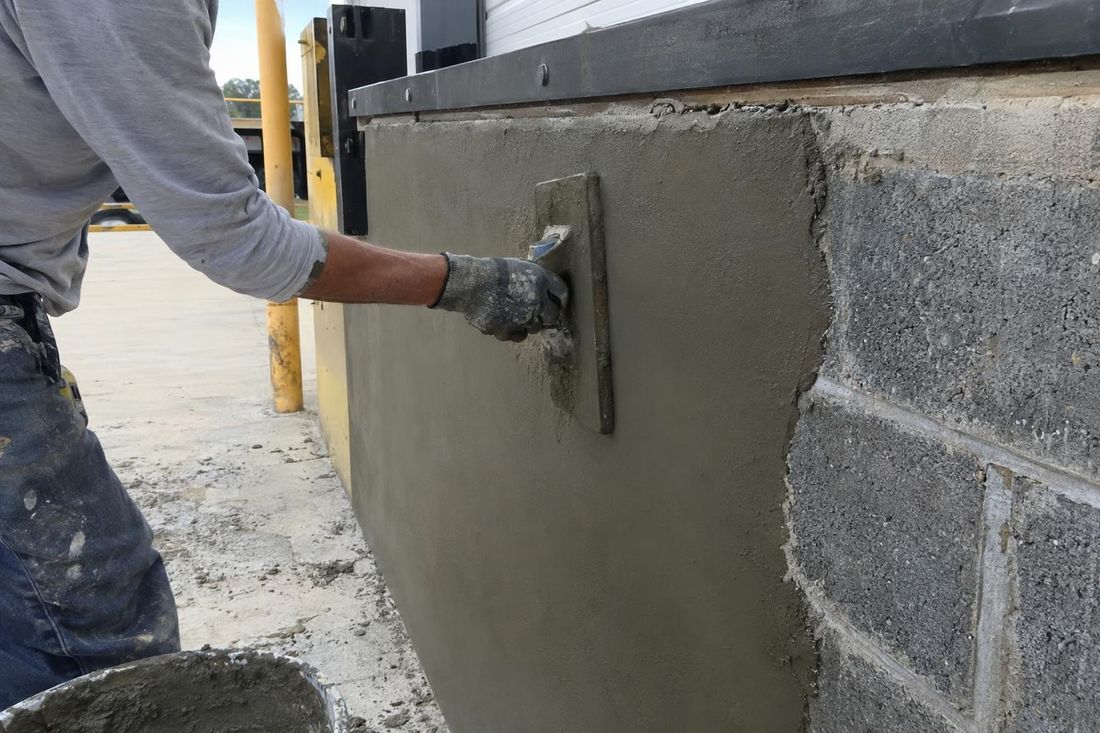
Troweling cement parge onto block wall A gloved hand holds a hawk or float against a concrete block wall that is partly covered with a smooth gray cementitious coat. The uncoated block and mortar joints are still visible on the right, next to a loading dock bumper and a yellow post.
How we do it
We use a cement mortar mix and apply it with a hawk and trowel to clean, sound block. Thickness is whatever the waterproofing or coating manufacturer requires, not whatever's easiest for us. That matters, because the parge coat becomes the surface their warranty depends on.
Before any mortar goes on, we scrape and wire-brush the face, knock off mortar fins and dampen the block so it doesn't suck the water out of the mix. Where we build thicker, we lay it on in coats and scratch the first one so the next coat grips. Then we finish it with a wood float or a steel trowel, depending on what the next trade wants to see.
How a job with us goes
Scope from drawings or site visit
We read the drawings or walk the wall with you and look at the block first. We note the waterproofing or coating spec, because it decides the thickness and the finish.
Surface preparation
We clean the block, cut out loose material and remove paint or old coating that won't hold a bond. Mortar only sticks as well as the face under it.
Parge application
Our masons apply the mortar in the thickness the manufacturer calls for. We keep the wall plumb and even, because a membrane shows every ridge.
Cure
We let the parge set and cure before anyone coats it. Rushing this is how a good coat ends up with problems.
Handoff to the next trade
We tell the waterproofing or coating crew what's ready and what isn't. Then the membrane goes on or the backfill starts.
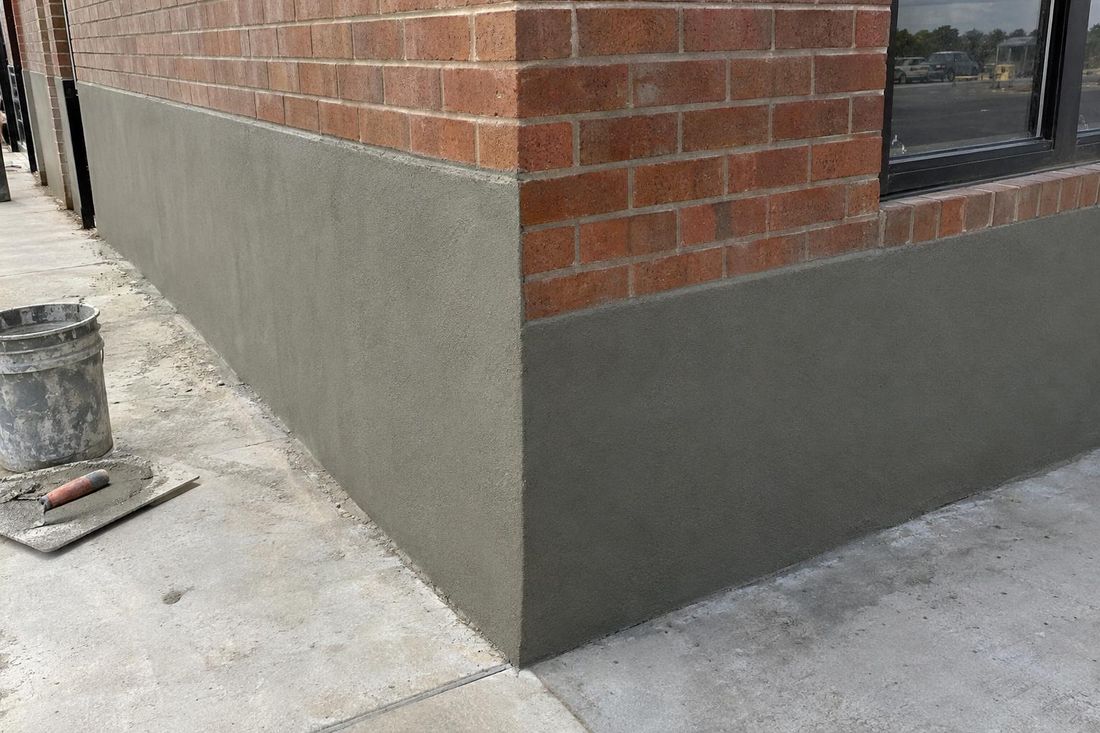
Parged concrete base on brick building The lower part of a red brick commercial building's walls is covered with a smooth, gray, cement-based coating, which is parging. A mortar board with a trowel and a bucket sit on the concrete walkway beside the wall.
What drives the cost
Mostly it's wall area and how we get to it. A long straight foundation wall with open access goes faster than a wall tucked behind equipment or down in a tight trench. Surface preparation is the next big one. Clean, sound block takes less time than block with old coatings, paint or loose material we have to remove first. Manufacturer requirements count too, because a thicker coat or multiple coats means more mortar and more labor. Scheduling matters when we're working around other trades. We can price it from drawings, but a site visit is better, and the estimate is free.
How long it takes
Most jobs take days, not weeks. We schedule parging just ahead of waterproofing or backfill, so the membrane crew isn't waiting on us and the excavator isn't waiting on either of us. Cure time before coating comes from the manufacturer, and we plan around it with you. Larger walls or phased work take longer, and we'll tell you that up front.
Local expertise: commercial parging in Atlanta
Atlanta gets about 49.7 inches of rain a year. Late winter, early spring and July are the wettest stretches, and fall, especially October, is the driest.
What it means for your job
Mortar, stucco and sealers need dry time. Fall is the easiest season for repointing and sealing, and summer work is planned around afternoon storms.
Overnight freezes can be expected on about 40 days a year in Atlanta.
What it means for your job
Water that soaks into brick, stone and mortar and then freezes is what pops faces off brick and opens joints. Keeping water out matters more here than in places that rarely freeze, and winter mortar work has to be protected overnight.
Parging is not a waterproofing membrane. On below-grade walls it prepares the surface for one, but it won't hold back water on its own. We won't parge over block that's soft, crumbling or wet from an active leak, because the coat won't last. If the wall has structural cracks or a drainage problem, that needs fixing first. Painted block has to be stripped or treated with a bonding system. And weather matters. We can't put mortar on in conditions that would keep it from curing right.