Qualified MasonsVerified ProfessionalsFree EstimatesOn Time
What brick and masonry sealing involves
On commercial buildings, sealing is part of the waterproofing plan, not an extra. Single-layer block walls in particular have no cavity and no second line of defense, so they rely on a water repellent or coating to stay dry inside. We apply that protection to brick, block and stucco, and we match it to what the wall actually is.
You need it when a block building leaks in wind-driven rain, when a facade has just been repointed or cleaned, or when an old coat has worn out. We also work for property managers and general contractors who need a wall handled on a schedule with paperwork behind it. Got a building in Atlanta with a damp wall and no clear reason why? Call us and we'll go look.
Signs you need brick and masonry sealing
Damp patches inside after wind-driven rainSingle-layer block has nothing behind it to stop water, so it shows up on the inside face. We check the joints and the top of the wall before we blame the block.
Water no longer beads on the surfaceSplash a little water on the wall. If it darkens and soaks in, the old repellent has worn out.
White powder on brick or blockThat's efflorescence, salts carried out by moisture moving through the wall. It tells us where water is getting in.
Coating that's chalking, peeling or crackedAn elastomeric coat past its life lets water in behind it and then holds it there. We want to see how much is still bonded.
What we handle
Clear water repellent on brick and blockWe spray a breathable repellent that soaks in and leaves the wall looking the way it did. It suits face brick and architectural block that you don't want painted.
Elastomeric coating on block and stuccoThis is a thick, flexible film, sprayed or rolled on and then back-rolled into the surface. It covers rough block and hairline cracks, but it does change the look of the wall.
Re-application on a maintenance cycleWe put your buildings on the manufacturer's schedule and come back to test and reapply before the wall starts soaking again. Property managers like one less surprise.
Sealing after repointing or cleaningFresh mortar and a cleaned face drink up water, so we seal once everything has cured and dried. We coordinate with the general contractor so the sequence doesn't get flipped.
Parapet and wall-top workThe top of a wall takes more water than any other part. We repair copings and sealant there first, then treat the face below.
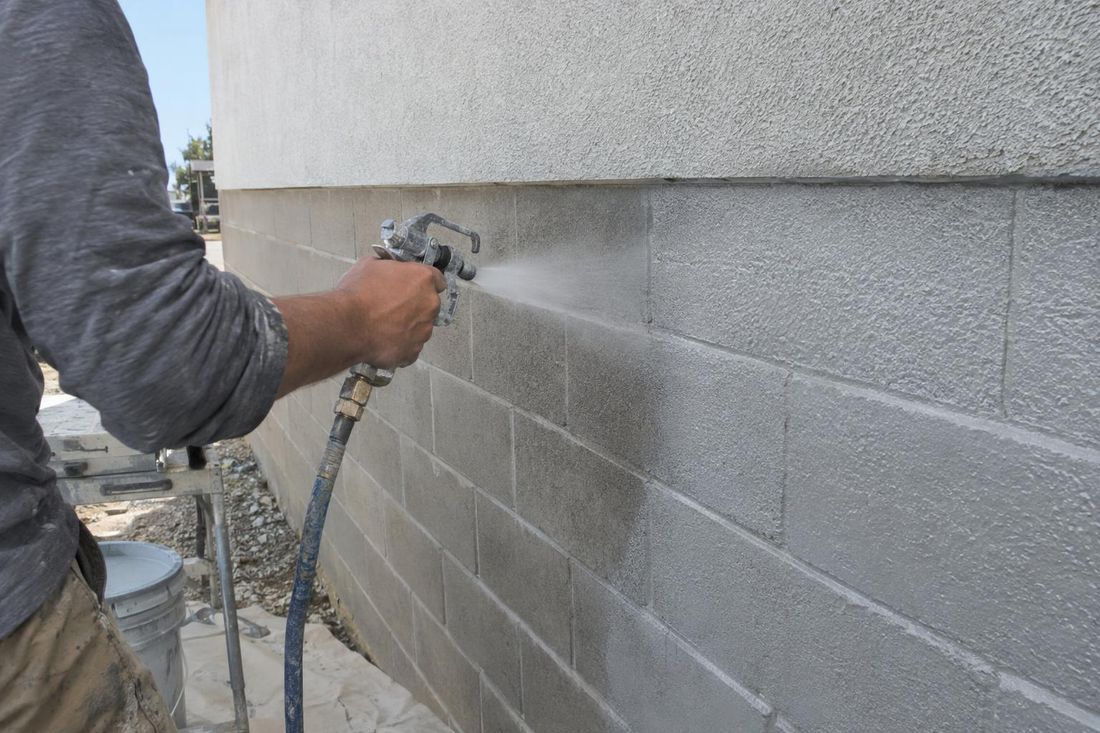
Spraying sealer on concrete block wall A worker's hand holds an airless spray gun connected to a blue hose and sprays a fine mist onto a gray concrete block wall. The darker, dampened blocks show the freshly coated area, while the stucco-finished section above and the drop cloth below are also visible.
How we do it
The manufacturer sets the product and coverage rate for the specific wall, and we don't guess. Porous split-face block can take far more material than dense face brick, so we confirm the rate on a test area before we open a drum. Then we apply it by low-pressure spray, working from the bottom up so the product soaks in evenly instead of just running off.
Sealant joints and cracks get repaired first so the repellent isn't asked to bridge gaps. We cut out failed sealant at control joints and window perimeters, and we repoint open mortar joints. The wall has to be clean and dry, so we check it with a moisture meter. Glass, metal and cars get masked or moved, because overspray is a pain to remove.
How a job with us goes
Wall survey and water test
We walk every elevation and look at joints, sealant, copings and the top of the wall. Where leaks are reported, we run a water test so we know where it's getting in and we fix the cause, not the symptom.
Repairs, sealant replacement and cleaning
We repoint, replace failed sealant and clean off dirt and old coatings. Sealer locks in whatever is on the wall, so the wall has to be clean first.
Test area and coverage rate confirmed
We treat a small area, let it dry and check the look and the beading. That's where we confirm the coverage rate against the manufacturer's rules.
Application by elevation
We work one side of the building at a time so you can plan entrances and parking. We spray at low pressure and watch the wind, since overspray travels.
Documentation for warranty
We record the product, coverage and dates for each elevation, with photos. The warranty depends on the manufacturer's application rules, so the record matters.
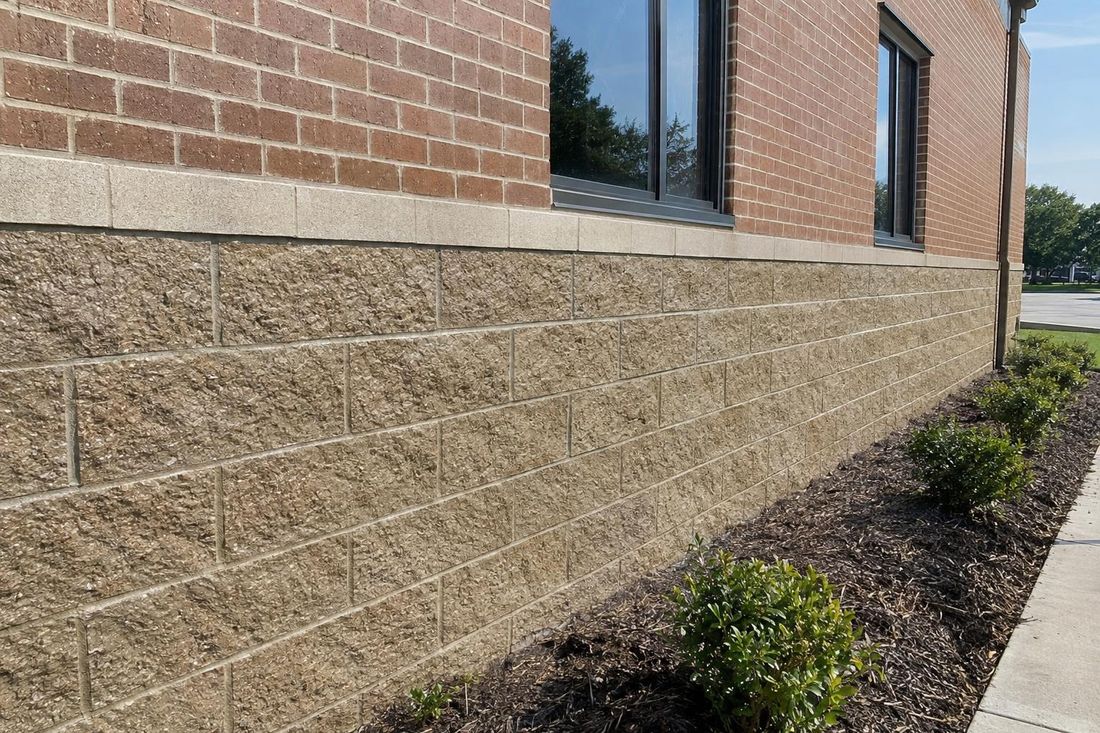
Commercial brick and split-face block wall The photo shows the exterior wall of a commercial building. Red brick with dark-framed windows sits above a band of tan split-face concrete block, and a mulched landscape bed with shrubs runs along the base. The masonry looks clean and uniform, with even mortar joints and no visible damage.
What drives the cost
Several things move the price. Wall area comes first, then how porous the surface is, because thirsty block drinks more product and the coverage rate goes up. Repairs required first can matter as much as the sealing itself, so a wall with failed joints costs more than a sound one. Height and access count too, since a lift or swing stage takes more time than a ladder. And manufacturer warranty requirements can dictate the product, the number of coats and the paperwork. We price after we see the wall, which is why the estimate is free.
How long it takes
Most jobs run days to weeks, depending on size. Rain is the biggest control on the schedule, since the wall has to be dry before we spray and stay dry while the product sets. Overspray on cars and glass is the other one, so we pick calm days and sort out parking with you ahead of time. If repairs come first, we add that time up front instead of surprising you later.
Local expertise: commercial brick and masonry sealing in Atlanta
Atlanta gets about 49.7 inches of rain a year. Late winter, early spring and July are the wettest stretches, and fall, especially October, is the driest.
What it means for your job
Mortar, stucco and sealers need dry time. Fall is the easiest season for repointing and sealing, and summer work is planned around afternoon storms.
Overnight freezes can be expected on about 40 days a year in Atlanta.
What it means for your job
Water that soaks into brick, stone and mortar and then freezes is what pops faces off brick and opens joints. Keeping water out matters more here than in places that rarely freeze, and winter mortar work has to be protected overnight.
Repellents don't bridge cracks or failed joints. That's why repairs come first, and a wall with movement cracks needs a different fix. Sealing won't cure a leak that comes from a roof, flashing or window. Any product warranty is the manufacturer's and depends on their application rules, so we follow them closely. We won't spray a wet wall or into a rain forecast. A clear repellent also won't hide stains or efflorescence that are already there, and it does wear out over time.
Our block building leaks in heavy rain. Will sealing fix it?
Often, once cracks, joints and the top of the wall are repaired. A water test finds where it is getting in, and we'd rather learn that first than coat over a leak.
How often is it reapplied?
Follow the manufacturer's cycle. Many are in the five to ten year range. A splash test on the wall tells us when it's time.
Will a clear repellent change how the brick looks?
Not much. Some products deepen the color a little, which is why we do a test area first. An elastomeric coating is a different story, because it's a film and you'll see it.
Can the building stay open while you work?
Usually, yes. We work one elevation at a time and stay clear of doors. We'll talk through air intakes and windows before we start.
Can we seal right after repointing or cleaning?
Not right away. New mortar and a freshly washed wall need time to cure and dry, and the product label tells us how long