Brick steps show wear before anything else on a house does. We reset loose treads and rebuild worn steps in Atlanta, and we always start by checking what's under the brick.
Qualified MasonsVerified ProfessionalsFree EstimatesOn Time
What brick steps and stoops involves
Brick steps take more wear and water than any other brickwork on your house. Feet hit them every day, rain sits on them, and winter freezes whatever water got in. So the job comes down to one of two things. Either we reset loose treads, or we rebuild the steps on a base that's still sound.
You need us when a brick rocks under your foot, when mortar crumbles out of the joints, or when the whole stoop leans away from the door. Sometimes it's a quick fix. Sometimes the base has given up and the steps have to come apart. We'll tell you which one you've got, and we'll show you why, before anyone picks up a hammer. The estimate is free, and we'll stand right there on your steps while we look.
Signs you need brick steps and stoops
Brick that rocks underfootA brick that moves when you step on it has lost its mortar bed. One is a small fix. Several in a row usually mean water got under them.
Crumbling or sandy jointsMortar that rubs away like sand lets water into the core of the steps. Push a screwdriver into a joint, and if it sinks in easily, that joint is done.
A gap where the steps meet the houseIf you can slide a finger between the stoop and the wall, or a crack runs through the steps, the base has settled. Brick on top can't fix that.
Puddles and flaking facesWater that sits on a tread after rain, or brick faces peeling off in flakes, tells us the pitch is wrong or the brick was never meant for treads.
What we handle
Resetting loose tread bricksWe lift the loose ones, clean out the old mortar, and set them back in a fresh full bed. It's the right call when the base underneath is solid.
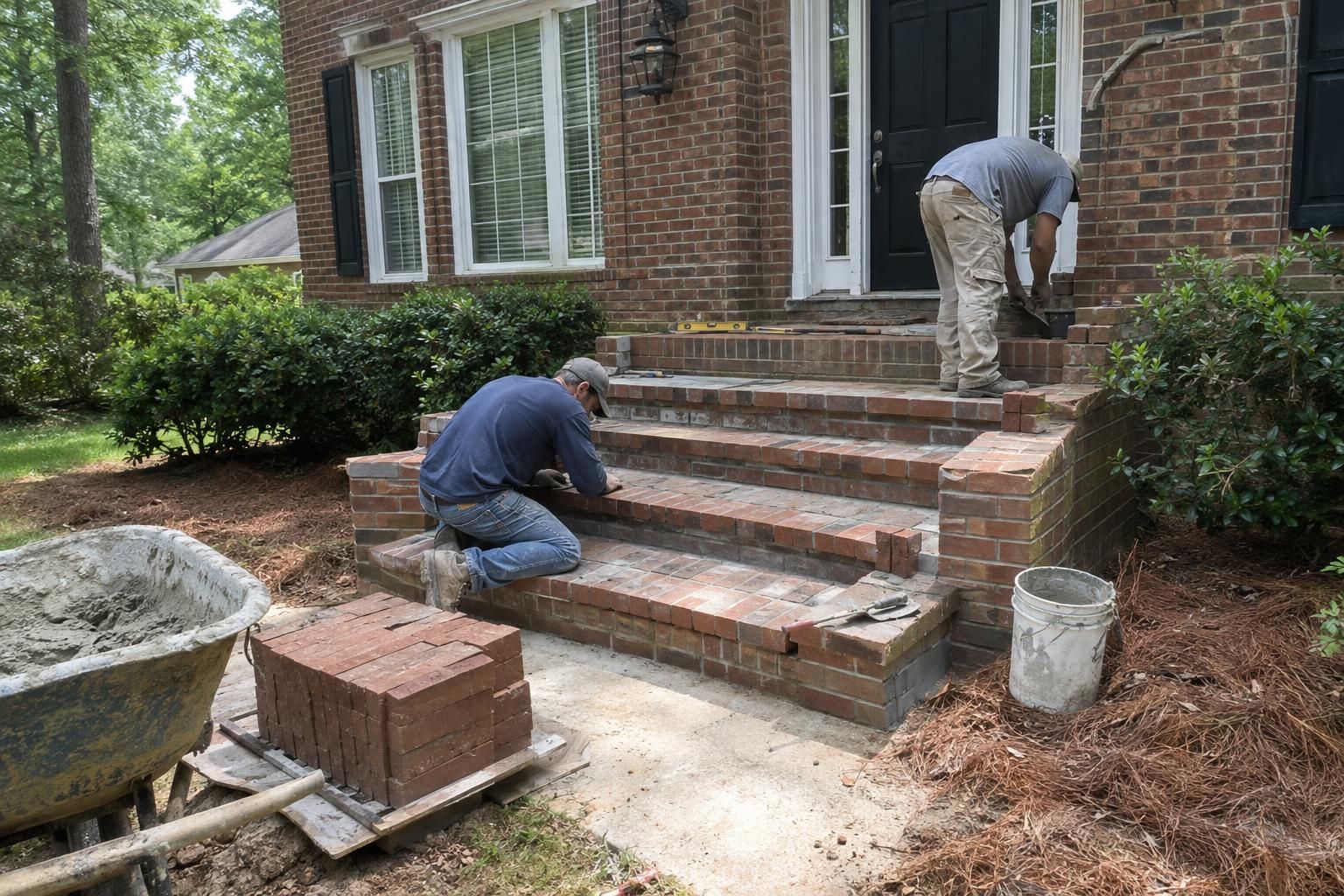
Rebuilding front or back stepsWe take the brick off, check the core, and lay it back up. This is the job when several treads are loose or the joints have failed across the board.
New stoop or landingWe build the base, the core, and the brick surface for a platform at your door. We pitch it so water leaves instead of lingering.
Adding or widening stepsWe tie the new work into what's there and match the brick as closely as we can find it. Matching old brick is the hard part, and we'll be straight with you about how close we get.
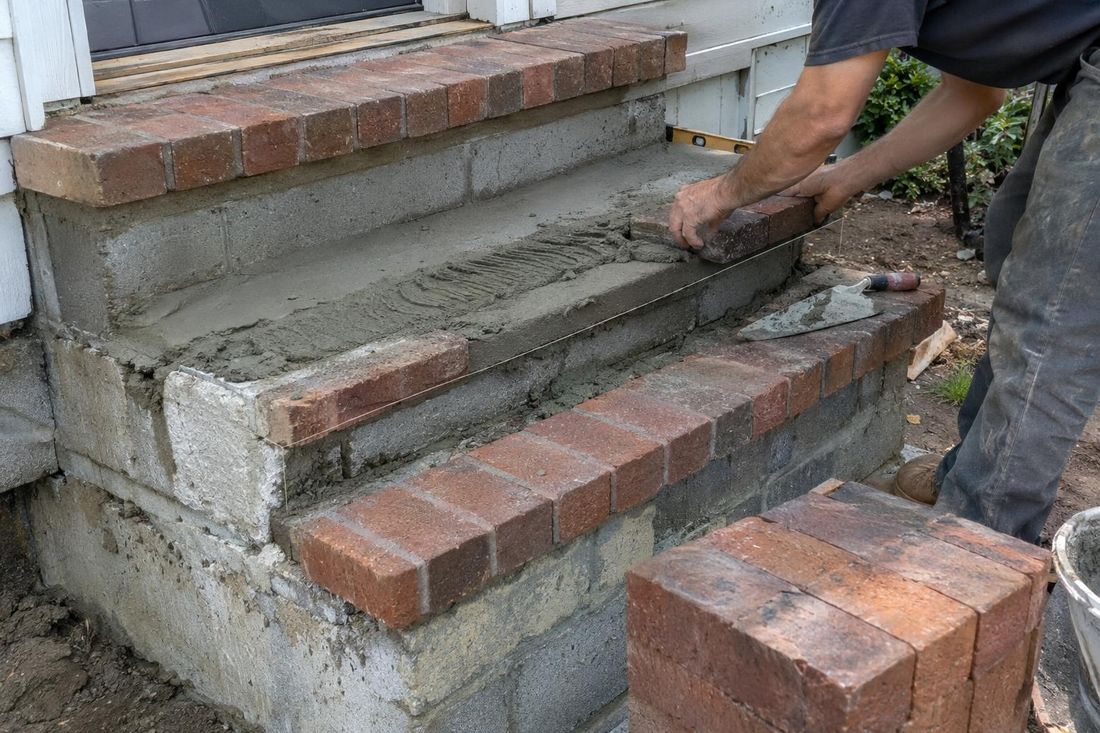
Bricklayer laying brick on concrete steps A mason sets a brick into a bed of fresh mortar on a concrete block step, using a string line as a guide. The lower step is already finished with brick, a trowel rests on the side, and a stack of bricks sits in the foreground.
How we do it
Treads go down in a full mortar bed, not dabs of mortar at the corners. Dabs leave hollow spots, and hollow spots are where water collects, freezes, and pops a brick loose. Under that bed sits a concrete or block core. We set the treads with a slight slope so water runs off the front instead of sitting on top.
We use paving-grade brick on treads. Ordinary face brick is made for walls, so it wears down under feet and holds water, which is why you see it flaking on old steps. Paving brick takes the abuse. We tool the joints with a jointer so they shed water too. And if we're reusing your old brick, we sort out the ones with spalled faces and swap those.
How a job with us goes
Free estimate
We come out, press on the treads, and look at the joints and the line where the steps meet the house. Then we tell you whether a reset will hold or the steps need a rebuild. You get a straight answer, and it costs you nothing.
Old brick removed, base checked
We pull the loose or failed brick and chip off the old mortar with a hammer and chisel. Then we look at the core underneath for cracks and sunken spots, because that decides whether the repair lasts.
Base repaired or re-poured
Cracked block gets replaced and a failed concrete core gets re-poured. We won't lay new brick over a base we don't trust.
Brick laid with pitch for drainage
We set each tread in a full mortar bed and check it with a level so it falls slightly away from the house. Water should leave the step, not park on it.
Joints finished, steps stay closed
We tool the joints and clean the brick faces. Then we close the steps off while the mortar cures, because footprints in fresh mortar make a bad repair.
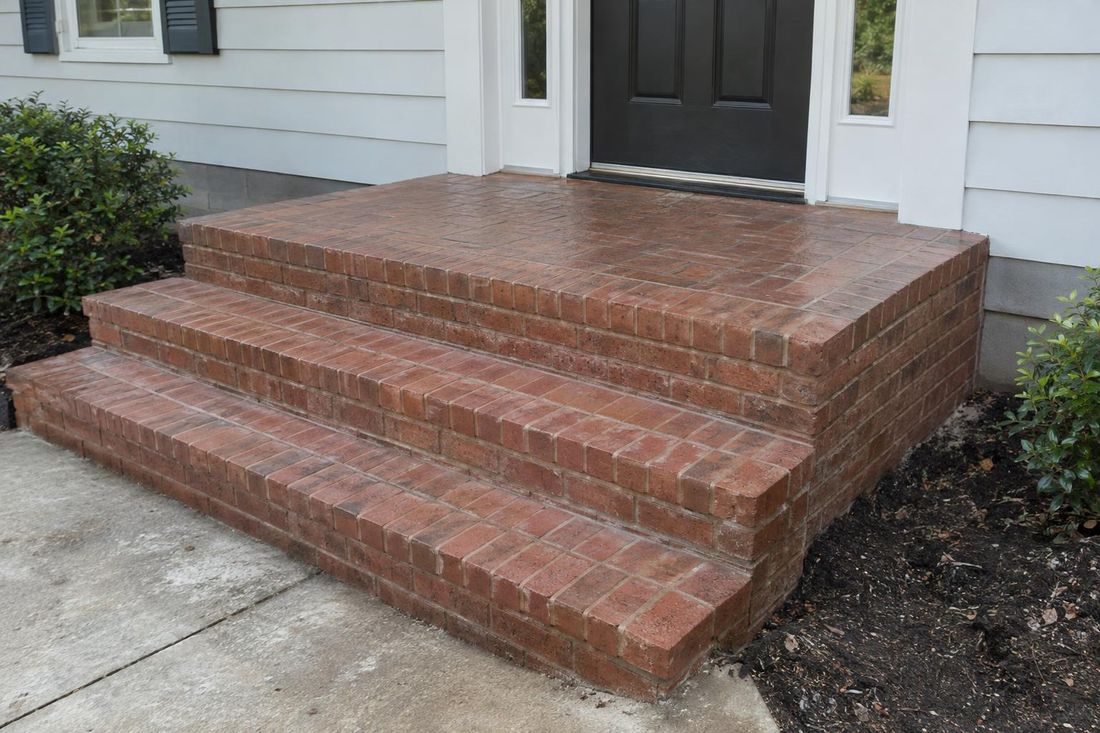
Red brick steps and entry stoop A three-step red brick staircase leads up to a brick landing at a dark front door with white side panels. Mulch beds with green shrubs border the steps, and a concrete walkway runs along the bottom.
What drives the cost
Price follows the work under the brick as much as the brick itself. The number of steps and their width set how much brick and mortar we need. The condition of the base is the big swing, since a sound core means a reset and a failed one means demolition and new concrete or block. If you have railings, we have to take them off and set them back, and that adds time. Brick choice matters too, because matching old brick can take some hunting. We'll walk through each of these at the free estimate so you can see exactly what's driving the number.
How long it takes
Resetting a few bricks is a half day. A rebuild usually takes us two to four days, depending on how many steps you have and how much of the base needs work. Then comes the part nobody likes, which is waiting. Stay off the steps for a day or two so the mortar can cure. Cold or damp weather can stretch that, so we'll tell you when they're ready instead of guessing.
Local expertise: residential brick steps and stoops in Atlanta
The red clay of the Georgia Piedmont is typified by the Cecil soil series: very deep, well drained soil on ridges and side slopes, with a red subsoil that averages 35 to 60 percent clay.
What it means for your job
Clay holds water against a wall and does not recover well once it is compacted, so drainage behind a retaining wall and a properly built base under pavers and footings matter more here than the surface material.
Atlanta gets about 49.7 inches of rain a year. Late winter, early spring and July are the wettest stretches, and fall, especially October, is the driest.
What it means for your job
Mortar, stucco and sealers need dry time. Fall is the easiest season for repointing and sealing, and summer work is planned around afternoon storms.
Overnight freezes can be expected on about 40 days a year in Atlanta.
What it means for your job
Water that soaks into brick, stone and mortar and then freezes is what pops faces off brick and opens joints. Keeping water out matters more here than in places that rarely freeze, and winter mortar work has to be protected overnight.
If the base has sunk or cracked, resetting brick on top won't last, and we won't pretend it will. In that case the fix is a rebuild, and we'll say so at the estimate. We reset your railings when we have to take them off, but new railings are a separate trade and not something we make or install. We also can't promise old brick will match perfectly, because weathered brick and new brick never look quite alike. And if the weather turns bad mid-job, we may stop and close the steps until it's fit to lay brick.
Brick steps and stoops questions
Can you just fix the loose bricks?
Yes, if the base is solid. If several are loose, the base is usually the problem, and we'll show you what we find.
How long before we can use the steps?
Typically 24 to 48 hours, depending on weather. Cold or damp days slow the cure.
Why do you use paving brick on the treads?
Ordinary face brick wears down underfoot and holds water. Paving-grade brick is made for that kind of traffic.
Will you take off my railing?
Yes. We remove it to do the work and reset it when the brick is done. A new railing is a different trade, so that part isn't ours.
How do I know if I need a reset or a rebuild?
Push on each tread and look at the joints and the line where the steps meet the wall. One or two loose bricks is usually a reset. A crack through the steps or a gap at the wall points to the base. Either way, call us and we'll look for free.