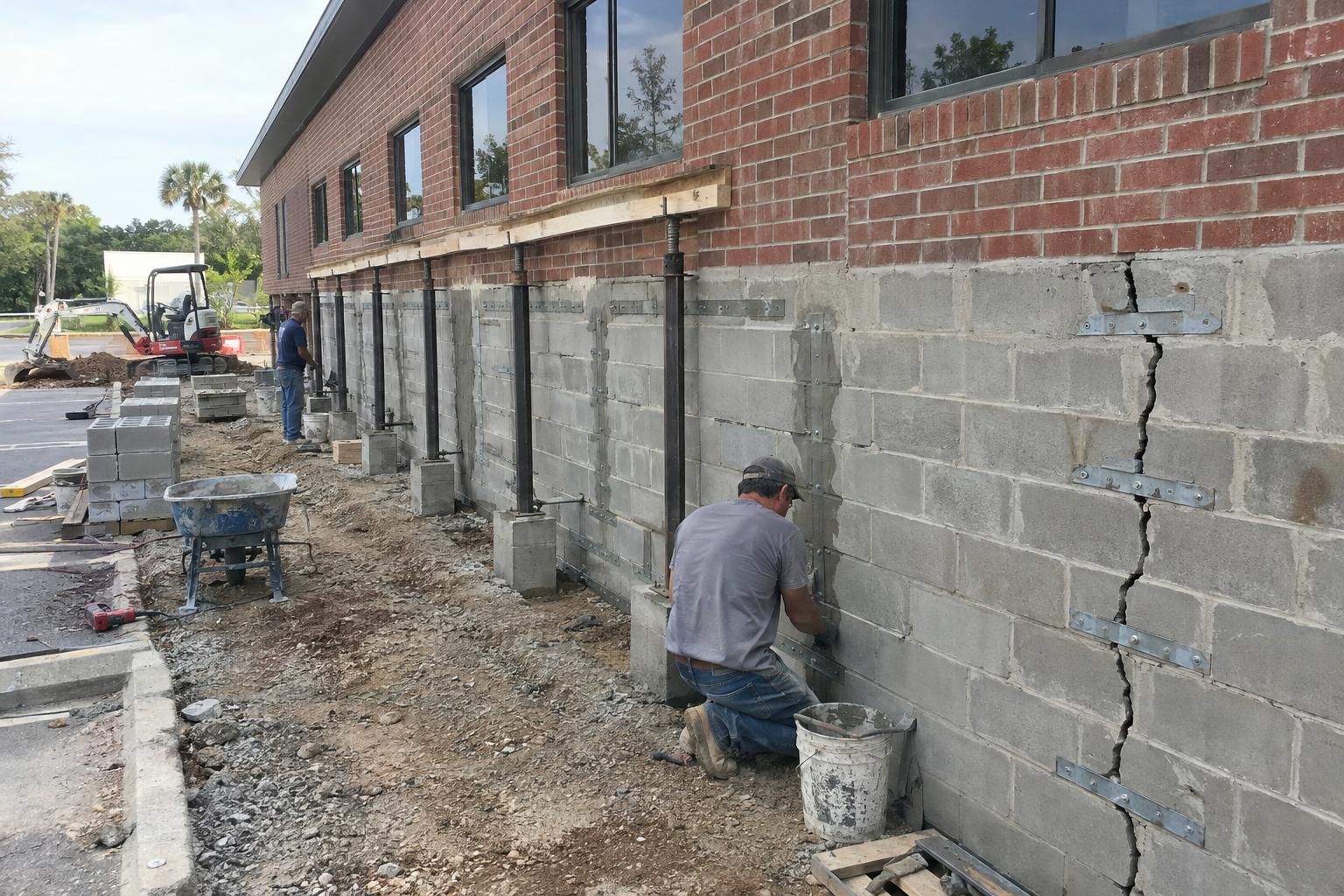
When block in a bearing wall cracks or gets knocked out of place, we repair it to your engineer's detail. The structure is shored, and your building is usually still open for business.
Qualified MasonsVerified ProfessionalsFree EstimatesOn Time
What block foundation repair involves
Commercial block repair means fixing the masonry that carries your roof, your upper floor, or the steel bearing on it. We stitch cracks, rebuild sections a truck or forklift has wrecked, and add reinforcing and grout to walls that never had enough. Our masons build what the drawing says, the way it's drawn.
You need us when a crack runs through the block and the wall above it has started to drop. You need us when a dock jamb won't hold an anchor, or when something big has hit the wall. Property managers call us after a tenant spots a crack. General contractors call us when a renovation opens a wall and shows block nobody trusted. In Atlanta, we plan the work around your hours, not ours.
Signs you need block foundation repair
Horizontal crack along a mortar jointA crack running level across the wall, often near mid-height, usually means the wall is bending under soil or roof load. Don't caulk it. Get an engineer out first.
Stair-step cracks that keep growingMark the ends with a pencil and write the date beside them. If they've moved in a few months, something under or behind the wall is still moving.
Rust stains bleeding from the jointsThe steel inside the wall is corroding, and rust swells until it pops the face off the block. It's much easier to fix before that happens.
Broken corners at docks and door jambsForklifts and trucks hit the same spots again and again. A jamb that has lost its face shell won't hold an anchor or a door track.
What we handle
Crack repair and stitching in bearing wallsWe cut steel stitching bars into the bed joints across the crack, bond them in, and repoint. The two sides of the wall work as one again.
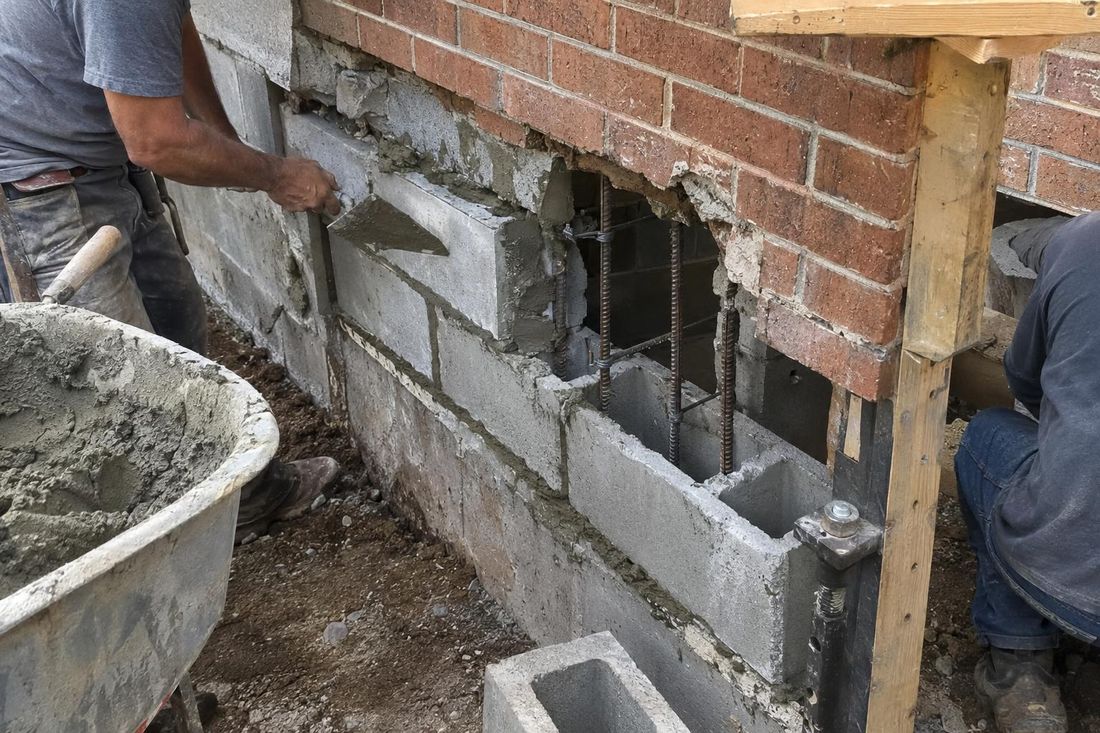
Rebuilding impact-damaged wall sectionsAfter a truck hit, we shore the load above and take the broken block out back to sound wall. Then we lay it up again with reinforcing and grout.
Adding reinforcing and grout to existing wallsPlenty of older block walls are hollow and light on steel. We open the cells where the engineer calls for it, set rebar, and fill them solid.
Repair at loading docks and overhead door jambsThese corners take a beating. We rebuild the jamb and add filled cells and steel where the detail allows, so it holds up to the next bump.
Masons rebuilding concrete block foundation wall A worker uses a trowel to lay mortar on concrete blocks in a foundation wall, with vertical steel rebar exposed in an open section beneath a brick wall. A wheelbarrow of mortar and a spare hollow block sit in the foreground, and wooden bracing supports the brick above.
How we do it
Every repair follows an engineered detail, and which one we use depends on what the wall is doing. Cracks get steel stitching across the joint. Walls that need more strength get grouted reinforcing added to the existing cells. Walls that are too damaged to save get a section rebuild, with shoring carrying the load above while we work. Often one job uses two or three of these.
We cut out the damaged block with a diamond blade and grind out joints before anything goes back in. Replacement block matches the existing wall in size and face, and mortar is mixed to the engineer's spec. Rebar goes in before grout, and we pour grout in lifts and rod it so it fills the cell without voids. Then we ask the inspector to look before we cover anything.
How a job with us goes
Walkthrough and masonry scope
We walk the wall with you or your property manager, then measure and photograph the damage. We also note what's in the way, like utilities, tenants, and delivery doors. That gives your engineer a clear starting point and gives us a scope to price.
Engineer's assessment and repair detail
The engineer works out why the wall moved and draws what fixes it. We don't guess at structure. If you already have a drawing, we build from it.
Shoring and area protection
We set shoring that carries the load above the repair, and we wall off the work area. Dust and falling debris stay away from your staff and customers.
Repair or rebuild with inspections
We do the masonry as detailed and stop for inspections at the points the engineer names. Rebar placement before grout is the big one, because nobody can check it afterward.
Finish restoration
We match the block and joints, patch what we opened, and pull the shoring. Then we clean up so the wall looks like part of the building again.
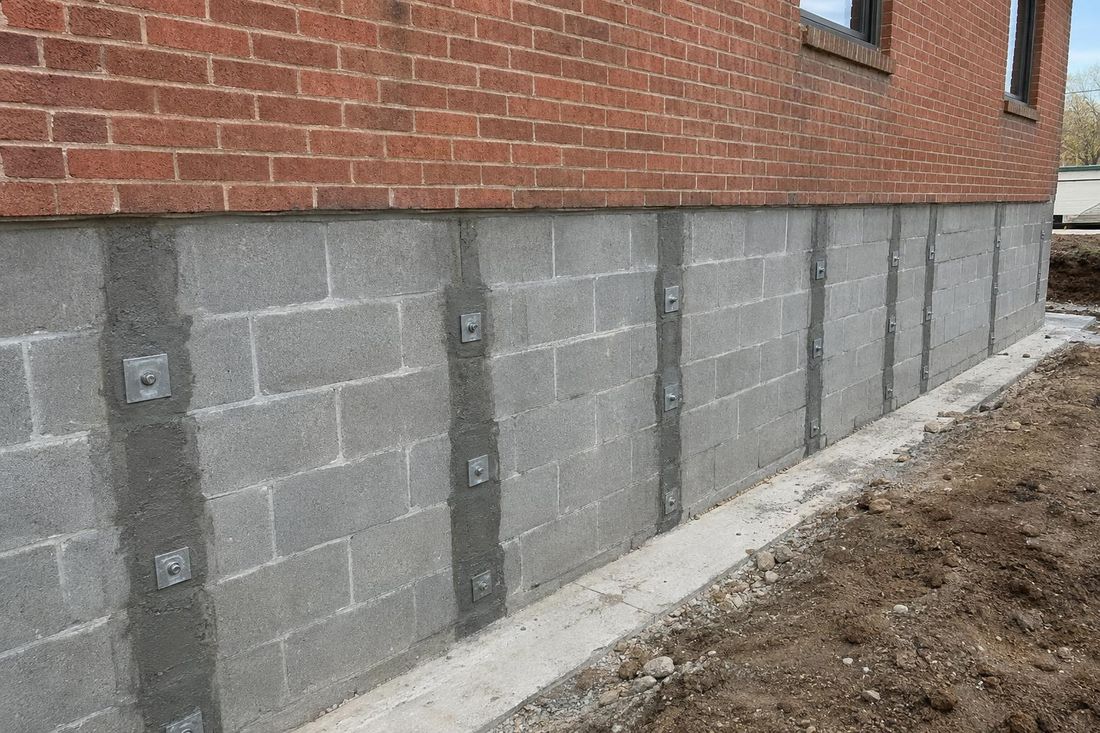
Concrete block wall with anchor plates A gray concrete block foundation wall below a red brick facade has vertical strips of mortar or grout, each holding square metal plates with bolts at intervals. These plates and bolts are wall anchors that stabilize the block wall, and a concrete strip and bare soil run along its base.
What drives the cost
Engineering comes first, since a structural repair can't start without a drawn detail. Shoring is next, and it can be a real part of the job on tall walls or heavy roof loads. Then comes the extent of damage. A single stitched crack and a rebuilt dock corner are very different jobs. Working in an occupied building changes the price too, because phasing, protection, and off-hours work take time. Finishes matter as well. Matching old block, paint, or a coating on a wall customers see costs more than patching a back wall. The estimate is free, and we'll show you where the money goes.
How long it takes
The repair itself is often quicker than people expect. Waiting is the slow part. Engineering and permit time usually set the schedule more than the masonry does, so the sooner your engineer sees the wall, the sooner we can set a start date. Once shoring is up and we're cleared to work, we'll tell you what a realistic schedule looks like for your building. We'll also tell you where weather or inspections might move it.
Local expertise: commercial block foundation repair in Atlanta
The red clay of the Georgia Piedmont is typified by the Cecil soil series: very deep, well drained soil on ridges and side slopes, with a red subsoil that averages 35 to 60 percent clay.
What it means for your job
Clay holds water against a wall and does not recover well once it is compacted, so drainage behind a retaining wall and a properly built base under pavers and footings matter more here than the surface material.
Atlanta gets about 49.7 inches of rain a year. Late winter, early spring and July are the wettest stretches, and fall, especially October, is the driest.
What it means for your job
Mortar, stucco and sealers need dry time. Fall is the easiest season for repointing and sealing, and summer work is planned around afternoon storms.
Overnight freezes can be expected on about 40 days a year in Atlanta.
What it means for your job
Water that soaks into brick, stone and mortar and then freezes is what pops faces off brick and opens joints. Keeping water out matters more here than in places that rarely freeze, and winter mortar work has to be protected overnight.
Structural repairs need an engineer's design. Our estimate covers the masonry scope, not the engineering, and we can't give a firm price on a bearing wall until there's a detail to price from. Once we open a wall, we sometimes find damage that wasn't visible, and that can change the scope. We fix masonry. If a wall moved because of a failed footing, a leaking roof, or bad drainage, we'll tell you plainly. That cause has to be dealt with by someone else, or the repair is only temporary. And we don't take on any wall the engineer hasn't cleared for work.
Yes. We shore the wall, rebuild the damaged section with reinforcing, and restore the finish. Keep people away from any bulged area until we've looked.
Do we need an engineer?
For bearing walls, yes. We can work from your engineer's detail, or tell you what to ask for if you don't have one.
Can we stay open while you work?
Usually, yes. Tell us your hours and where customers and deliveries go, and we'll plan the barriers and schedule around that.
We're a GC and opened a wall that has cracked block behind it. What now?
Stop loading it and call us. We'll look, and your engineer can decide what the wall needs.
Will the repair match the rest of the wall?
We match the block, mortar joints, and finish as closely as we can. A new section can look different at first, but we'll show you what to expect before we start.