Qualified MasonsVerified ProfessionalsFree EstimatesOn Time
What masonry restoration involves
Masonry restoration is the planned renewal of a building's entire exterior. We repoint the joints, replace failed brick or stone, repair rusted steel and flashing, replace sealants, and clean the wall. We do it together and in order, because each repair leans on the others. New mortar over a leaking flashing just fails again.
You need it when spot repairs stop holding. Maybe you're patching the same parapet every spring, or water keeps showing up inside at the window heads. Property managers often call us after a facade inspection report, and general contractors call when an envelope scope lands on their desk. Either way, we walk the building, find where the water is getting in, and build a plan that fixes the cause and not just the symptom.
Signs you need masonry restoration
Mortar sanded away in the jointsIf we can rake it out with a key or you see sand piled at the base of the wall, the joints have quit. Water goes straight into the wall from there.
Rust stains or cracks at window headsThat's usually a steel lintel swelling as it rusts and pushing the brick apart. It gets worse every winter.
Spalled faces and loose unitsBrick faces popping off, or stone that sounds hollow when we tap it, means water has been freezing inside. Falling pieces are also a danger at the sidewalk.
Interior leaks, white powder or failed sealantEfflorescence on the wall, stained plaster inside, and caulk that's cracked or pulled away from its edges all say water is getting through the envelope.
What we handle
Full-building repointing and repairWe grind out failed mortar, repoint with mortar matched to the old wall, and replace broken units, elevation by elevation. This is the core of most restoration jobs.
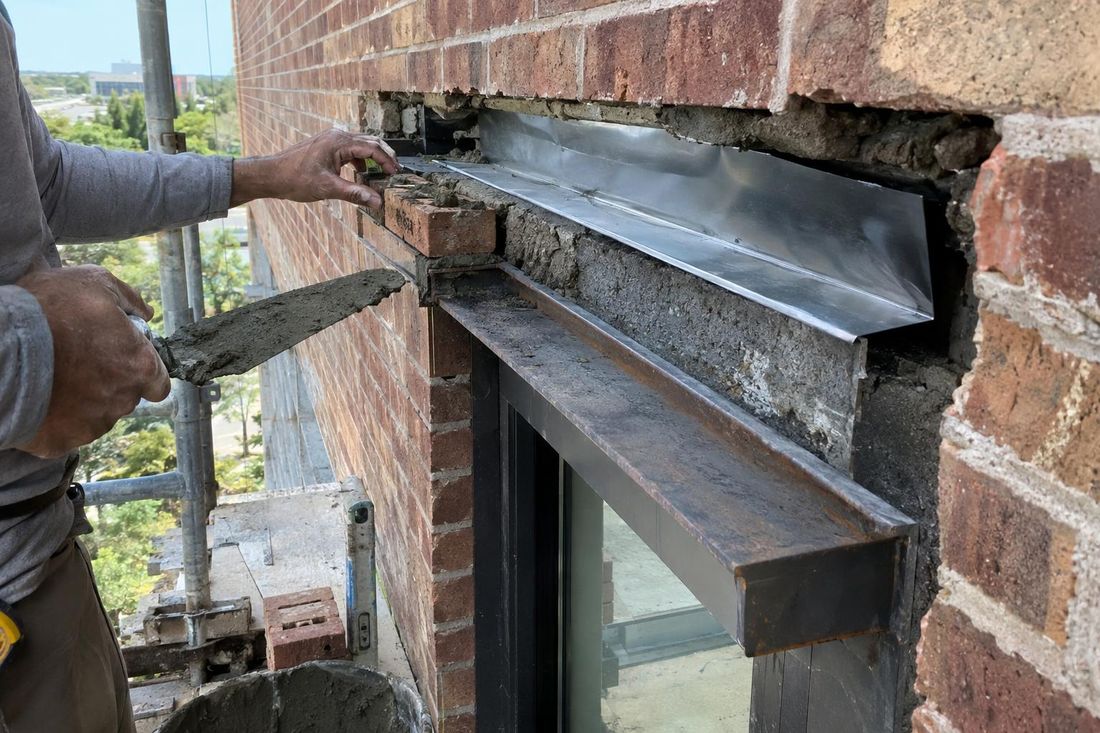
Flashing, lintel and shelf angle programsWe open the wall at the steel, cut out the rust, and install new flashing and weeps so water has a way out. On taller buildings, the shelf angles that carry the brick get the same treatment.
Sealant replacementWe cut out old sealant at windows, control joints and copings, clean the joint, set backer rod, and tool in new sealant. Sealant only works if the joint is the right depth.
Cleaning and water repellentWe test small patches to find the gentlest method that works, then wash the wall. Where it suits the masonry, a breathable water repellent goes on last.
Mason relaying brick above window lintel A worker in a gray long-sleeve shirt holds a trowel with mortar and sets a brick into an opening in a brick wall, above a rusty steel angle lintel and a window. Metal flashing is visible in the exposed joint, and the worker stands on scaffolding.
How we do it
A condition survey sets our quantities for each repair type. We sound the wall by tapping it, probe the joints, and open a few suspect spots to see what's behind the face. Then we count: feet of repointing, units to replace, lintels and angles to repair.
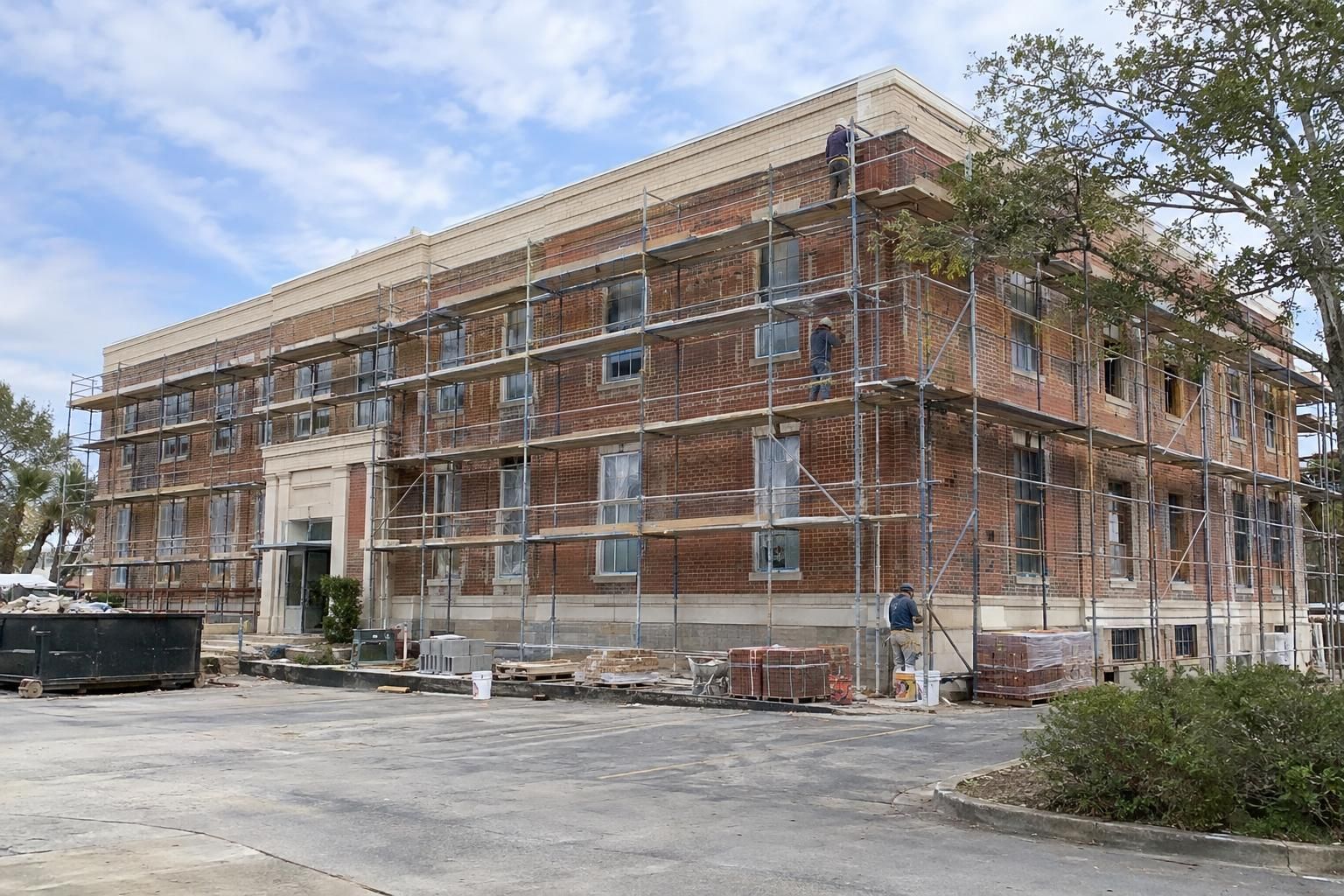
Work goes elevation by elevation, from scaffolding or swing stages depending on the building. Before production starts, we build mock-ups for mortar color, joint tooling, brick match and cleaning, and you approve them. Everything after that gets matched to the approved sample. Hidden conditions get unit prices, so when we open a wall and find more rusted steel than we expected, you already know what each extra repair costs. And the mortar is matched to the existing masonry, never harder than the brick it sits against.
How a job with us goes
Condition survey
We walk every elevation, sound the masonry, and write down each defect. We do this first because every price after it depends on what's really there.
Scope, unit prices and phasing
We write the scope by repair type and put unit prices on the conditions we can't see yet. We also lay out the phasing so the work fits your budget and your tenants.
Mock-ups
We build sample panels on the wall with the mortar, brick and cleaning you'll actually get. You approve them before production, so the finished wall holds no surprises.
Restoration by elevation
We set up scaffolding or swing stages and finish one elevation before moving to the next. Steel and flashing come first, then units, then pointing and sealants, with cleaning last so we don't dirty the wall twice.
Closeout and maintenance recommendations
We walk the job with you, clear the punch list, and hand over recommendations for upkeep, like when to check sealants and keep drains clear. A restored wall lasts longest when somebody keeps an eye on it.
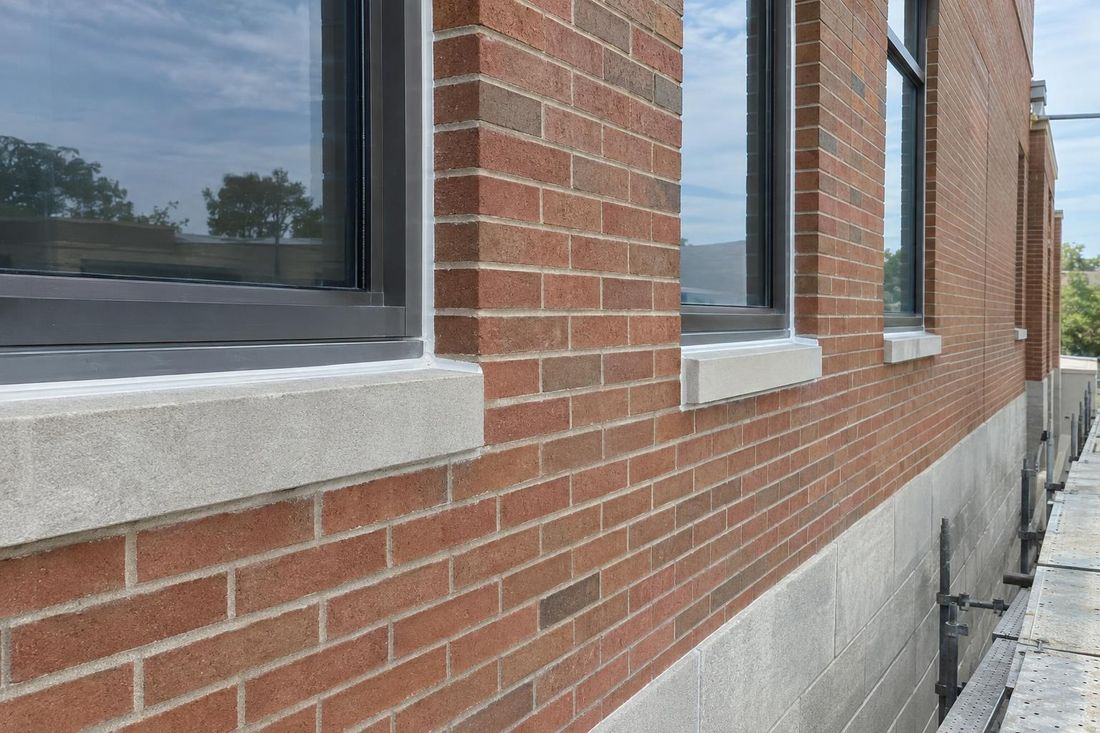
Red brick wall with stone sills A red brick building wall with neatly pointed mortar joints, dark-framed windows and light gray stone window sills, above a base of gray stone blocks. Scaffolding is visible at the right edge along the wall.
What drives the cost
Size and height set the baseline, because more wall means more hours and taller wall means harder access. The access system matters a lot, since scaffolding, swing stages and lifts each carry their own setup and rental cost. Repair quantities come next. A wall that needs light repointing costs far less than one with failing lintels and hundreds of cracked units. Phasing changes the number too, because splitting a job over several years means more moves on and off the building. And if the building is occupied, we may need overhead protection, protected entrances and set work hours. We give free estimates, and we'll show you which of these is driving yours.
How long it takes
For a mid-size building, plan on months, not weeks. Weather matters, because mortar and sealant need decent temperatures to cure right. Many owners phase the work over budget years, taking the worst elevation first and coming back for the rest. We'd rather plan that out at the start than discover it halfway up the scaffold. Tell us how your budget cycle runs and we'll lay the phases against it.
Local expertise: commercial masonry restoration in Atlanta
Atlanta gets about 49.7 inches of rain a year. Late winter, early spring and July are the wettest stretches, and fall, especially October, is the driest.
What it means for your job
Mortar, stucco and sealers need dry time. Fall is the easiest season for repointing and sealing, and summer work is planned around afternoon storms.
Overnight freezes can be expected on about 40 days a year in Atlanta.
What it means for your job
Water that soaks into brick, stone and mortar and then freezes is what pops faces off brick and opens joints. Keeping water out matters more here than in places that rarely freeze, and winter mortar work has to be protected overnight.
Quantities are estimates until the wall is opened. We can sound and probe all day, but we can't see rusted steel behind brick until the brick comes out. That's why our contracts carry unit prices for the difference, whether the count runs over or under. We don't cover problems that start outside the masonry, like a failed roof membrane, bad drainage at grade, or structural movement. If we find one, we'll tell you and point you toward an engineer. The work also depends on weather and safe access, and we won't set mortar or sealant in conditions that would make it fail.
Masonry restoration questions
Can restoration be phased over several years?
Yes, by elevation, starting with the worst exposure. That's usually the side that takes the most rain and sun. We plan each phase so the finished elevation is fully sound and the scaffold doesn't have to come back to it. Then the next budget year picks up the next wall.
Do you need an engineer's report first?
It helps on larger buildings, since it gives everybody the same list of problems to price. But we can also survey and price directly if you don't have one. Just ask.
Can you work while the building is occupied?
Yes. We plan overhead protection, protected entrances, and noisy work at agreed hours. Tell us early about tenants, loading docks and air intakes, because those shape how we set up.