Qualified MasonsVerified ProfessionalsFree EstimatesOn Time
What chimney leaks and flashing involves
A chimney leak starts at the cap, the crown, the brick and mortar, or the flashing where the stack meets the roof. Each one fails differently. A cracked crown sheds rain straight down beside the flue. Worn flashing lets water run behind the stack and into your attic or down the wall. Guess wrong and you pay to fix the wrong thing.
That's what this service is. We trace the leak, repair the source, and tell you straight when a roofer needs to be on the job too. You need us when a stain shows up near the chimney, when the mortar is crumbling, or when somebody caulked the flashing once and the drip came back. We give free estimates in Atlanta, so you'll know what's going on before you spend a dime.
Signs you need chimney leaks and flashing
Brown stain on the ceiling or wall near the chimneyWater is getting in somewhere above it. If it shows up mostly after wind-driven rain, that points us toward the flashing or the brick.
A stain that dries out and comes backThe leak is still active, and it's only visible when the rain is heavy enough. Painting over it hides the problem and doesn't stop it.
White powder on the brickThat's efflorescence, salt left behind as water moves through the masonry. It tells us the stack is staying wet.
Crumbling mortar or a cracked crownIf we can scrape a joint out with a key, or see cracks in the concrete on top, rain has an open door.
What we handle
Flashing and counter-flashing replacementWe cut a groove into the mortar joints, set new counter-flashing, and lap it over the step flashing. It's the leak we trace most often.
Crown and cap repairHairline cracks in the crown get sealed with a flexible coating. A badly cracked crown gets rebuilt, and a rusted or missing cap gets replaced.
Repointing and brick repairWe grind out failed mortar, pack in new mortar, and replace bricks that have spalled or gone soft.
Water repellent on the stackOnce the repairs are done, we can treat the brick with a breathable repellent. It slows water down, but it won't close an open joint.
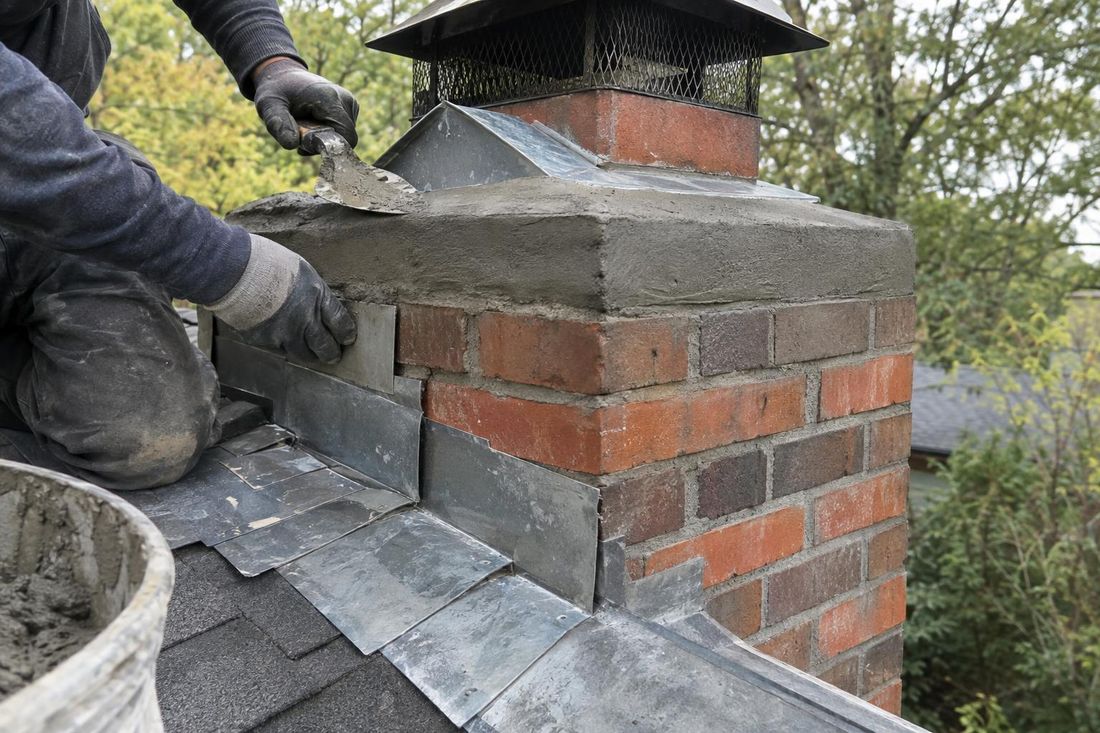
Mason applying mortar over chimney flashing A gloved worker kneels on a shingled roof and uses a trowel to spread cement-like mortar on the chimney crown beside a metal cap. Layered sheet-metal flashing is fitted along the base and side of the brick chimney, and a bucket of mortar sits in the foreground.
How we do it
Counter-flashing is cut into the mortar joints and lapped over the roofer's step flashing, not just caulked to the brick. We use an angle grinder with a diamond blade to cut a clean groove along the joint, bend the metal into it, and lock it in place. Sealant goes in last to fill the cut, but the metal does the work. Caulk alone is a patch, and we don't treat it as a repair.
Wider chimneys get a small peaked diverter (a cricket) on the uphill side. Without one, water and debris pile up against the back of the stack and test the flashing every storm. For repointing, we match the new mortar to the old, and it's always softer than the brick so the joint takes the wear instead of the brick face. And we brush out every joint before we pack it, because mortar won't hold to dust.
How a job with us goes
Free estimate and leak tracing
We come out, look at the chimney from the roof and the attic, and check the cap, crown, joints and flashing one at a time. We do this first because a leak that looks like flashing is sometimes the crown, and we won't quote a fix until we know.
Source repaired
We fix what's actually leaking, whether that's the crown, the cap, or failed mortar. Fixing the source first matters, because new flashing over wet, crumbling brick won't last.
Flashing cut in and sealed
We cut the groove, set the counter-flashing over the step flashing, and seal it. If the chimney is wide enough, this is also when the cricket goes in.
Water test where possible
We run water over the work and watch for trouble. Some roofs and some weather won't allow it, and we'll tell you when that's the case.
Cleanup and walkthrough
We sweep up the cut dust and mortar scraps, then show you what we did and what we'd keep an eye on.
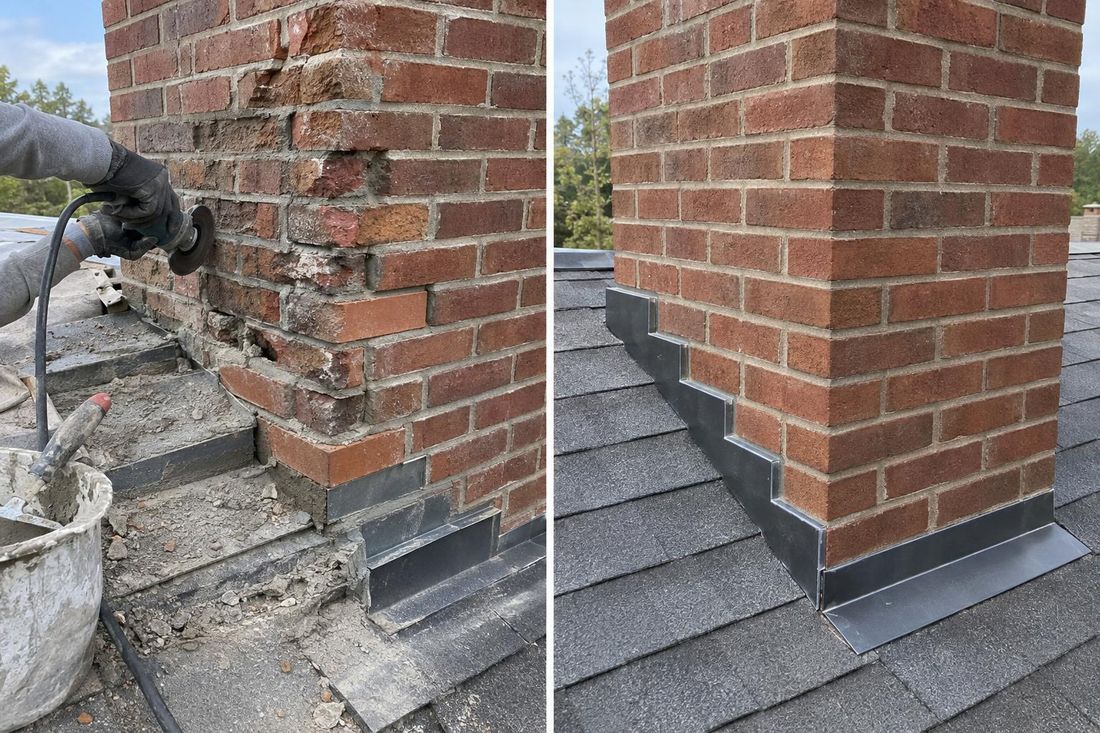
Chimney brick repointing and metal flashing The left side shows a worker using a grinder to cut out mortar on a deteriorated brick chimney base, with step flashing along the roof line. The right side shows a brick chimney with stepped metal flashing installed against it on a shingled roof.
What drives the cost
Price follows the source of the leak. A crown coating costs less labor than a rebuilt crown, and a few feet of repointing is a different job than a whole stack. For flashing, the length of metal matters, and so does the roof. A steep or high roof takes more time and more care than a low one, and roof type changes how we tie into the existing step flashing. Then there's the cricket. If your chimney is wide enough to need one, that adds material and labor, but it also protects the flashing behind it. We'll go through each of these with you at the free estimate, so nothing on the quote is a surprise.
How long it takes
Most leak repairs take a day. That covers a typical flashing job, a crown repair, or a modest stretch of repointing. A long run of flashing, a cricket, or a lot of bad brick can stretch it, and so can weather, since we don't want to set mortar or sealant in the rain. Mortar and coatings keep curing after we leave, and we'll tell you what to expect. If a roofer has to work on the roof around ours, the schedule depends on both of us.
Local expertise: residential chimney leaks and flashing in Atlanta
Atlanta gets about 49.7 inches of rain a year. Late winter, early spring and July are the wettest stretches, and fall, especially October, is the driest.
What it means for your job
Mortar, stucco and sealers need dry time. Fall is the easiest season for repointing and sealing, and summer work is planned around afternoon storms.
Overnight freezes can be expected on about 40 days a year in Atlanta.
What it means for your job
Water that soaks into brick, stone and mortar and then freezes is what pops faces off brick and opens joints. Keeping water out matters more here than in places that rarely freeze, and winter mortar work has to be protected overnight.
Roof shingles and decking damaged by the leak are a roofer's repair, and some jobs need both trades. We work on the chimney, and we'll point out roof damage when we see it. We also can't fix a leak that isn't coming from the chimney. A vent, a skylight or a bad roof valley can leave a stain that looks like a chimney problem, and we'll say so if that's what we find. And masonry work doesn't go well in freezing temperatures or a downpour, so we may need to wait for a better day.
Chimney leaks and flashing questions
Roofer or mason?
A mason for the crown, brick and counter-flashing. A roofer for shingles and step flashing. Often both, and we're happy to work alongside yours.
Will caulk fix it?
Briefly. Caulk on flashing fails within a few seasons, because brick and metal move at different rates and the bead pulls loose.
How do you know it's the flashing and not the brick?
We look at the stain, then check each part of the chimney one by one. Where the water shows up inside usually tells us where to start.
Will a water repellent stop my leak?
Not by itself. It helps sound brick shed water, but it can't bridge a cracked crown or an open joint. We repair first and treat after.
Do I need a cricket?
If your chimney is wide, probably. Water stacks up behind it on the uphill side, and a cricket sends it around. We'll tell you at the estimate.