Qualified MasonsVerified ProfessionalsFree EstimatesOn Time
What chimney repair involves
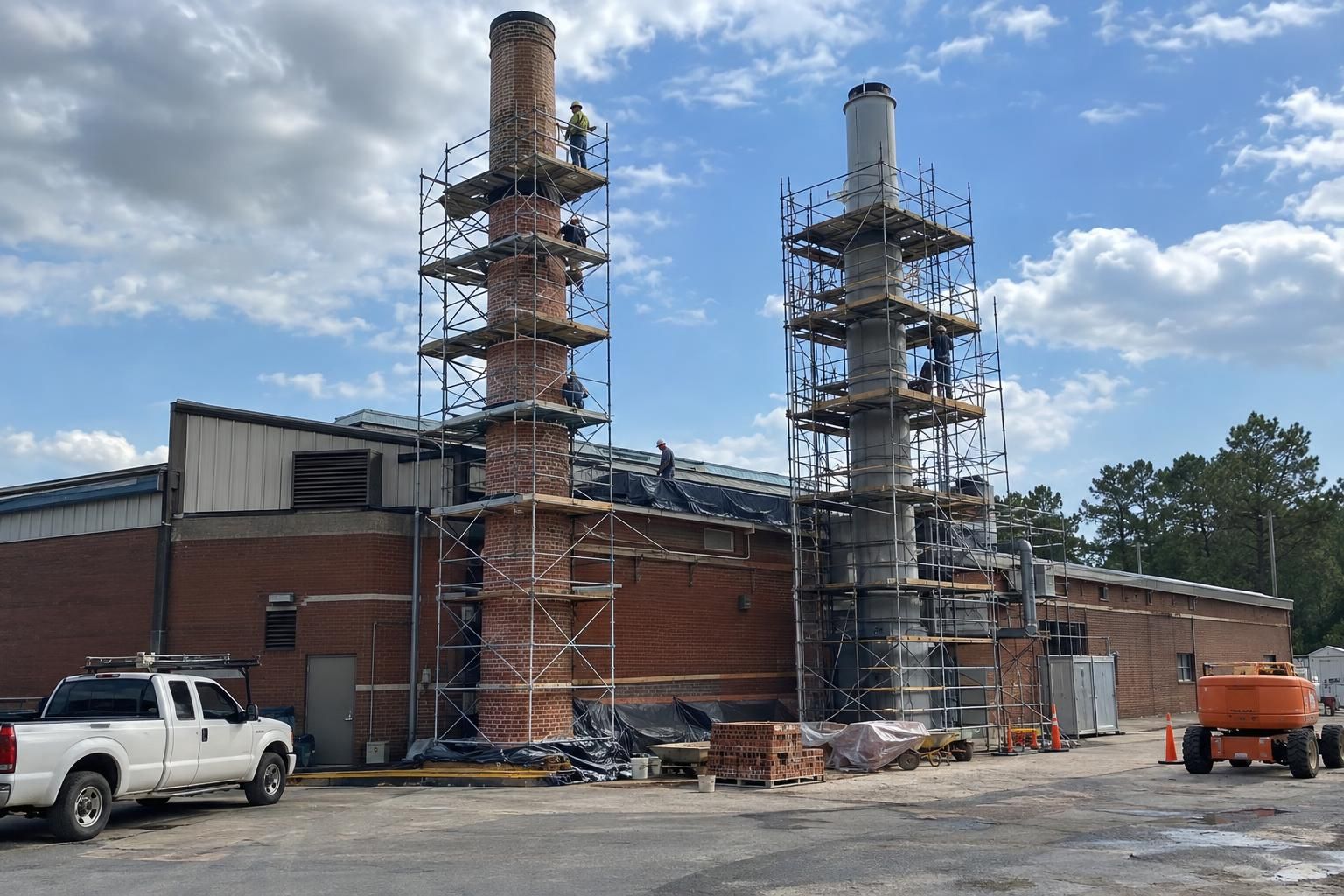
Commercial chimneys are boiler stacks, restaurant flues and the rows of chimneys on apartment buildings. They're tall, they sit on roofs other trades walk on, and they serve equipment somebody needs running. So we plan the repair around height, shared roofs and how the building operates before we pick up a trowel.
You need us when mortar is washing out of a stack, when brick is shedding onto a roof or a lot below, or when a crown has cracked and water is soaking the masonry. Property managers call us to survey every chimney on a site. General contractors call us when a renovation turns up a stack nobody budgeted for. Either way, we look first, write the scope chimney by chimney, and give you a free estimate in Atlanta.
Signs you need chimney repair
White crust on the brickThat's salt left behind by water moving through the masonry. It tells us moisture is getting in, usually at the crown or the top joints.
Debris on the roof or the groundChips of brick and sandy mortar mean the joints are going or the brick faces are spalling. On a tall stack that's a falling hazard.
Joints you can dig outIf a screwdriver tip sinks into the mortar with little push, the joint has lost its grip. Soot streaks running down from the joints tell the same story.
Stains below a chimneyA brown patch on a top-floor ceiling near a chimney often starts at the crown or the flashing, not out in the roof field. Have the stack checked before anyone patches the membrane again.
What we handle
Boiler and incinerator stack repointingWe cut out the failed joints and pack them with mortar matched to the brick. A stack that sees exhaust and weather all day needs joints that hold, and we work down from the top.
Multi-chimney repairs on apartment roofsWe number every chimney on the roof and work through them in one visit. That way the scaffold or lift goes up once instead of once per chimney.
Cap and crown replacementWe remove cracked or missing caps and crowns and set new ones with a slope and an overhang. Water then drips clear of the brick instead of running into it.
Partial or full rebuilds above the roof lineWhen the brick is too far gone to repoint, we take it down course by course, save the sound brick and lay it back up. Flashing gets tied in as we go.
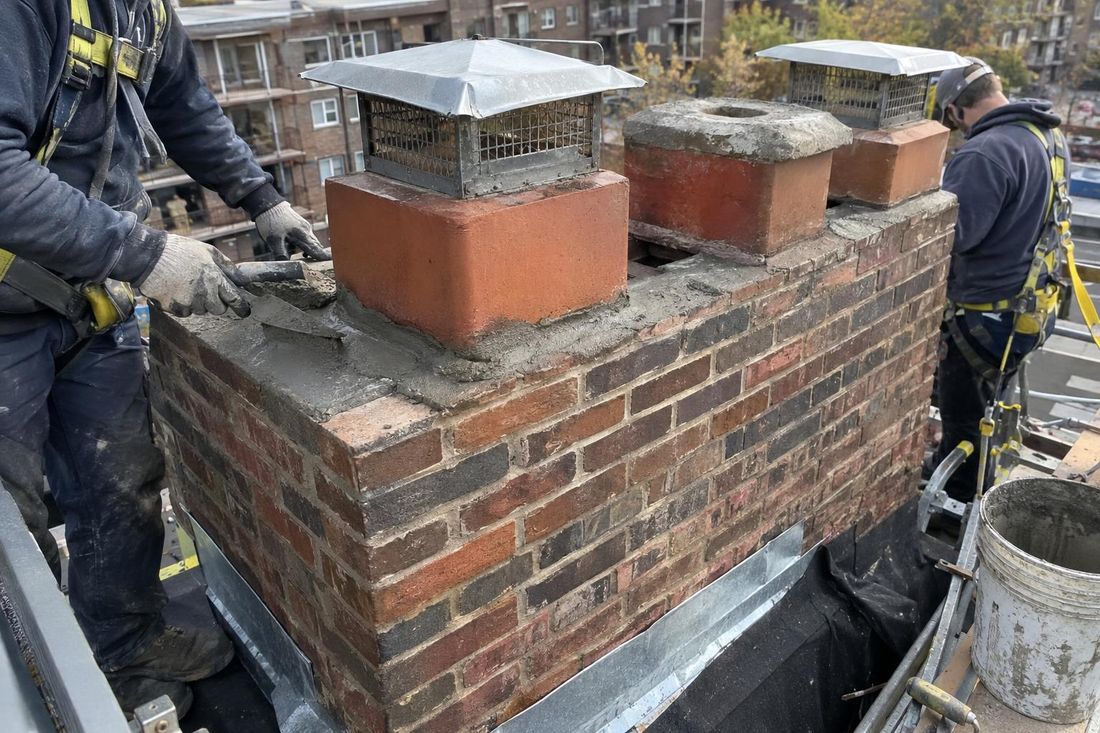
Workers applying mortar to chimney crown Two workers in safety harnesses stand beside a brick chimney, and one smooths wet mortar on the top with a trowel. Metal-capped flue covers sit on clay flue tiles, and metal flashing runs along the base of the chimney.
How we do it
Tall stacks are reached by scaffold or lift, and our masons stay tied off with fall protection whenever they're above the roof edge. We pick the access to suit the roof. A lift needs firm ground and room to swing, and scaffold on a roof needs its load spread so it doesn't crush the roofing underneath.
For repointing, we grind and chisel out the old joints, blow out the dust and pack in new mortar that's no harder than the brick. Hard mortar on old soft brick does more harm than good. We schedule around the shutdown of the equipment the flue serves, because nobody wants masons working over a firing boiler. Roofing gets covered with boards and tarps while we work, and once the brick is done we tie the flashing back in.
How a job with us goes
Roof survey and scope by chimney
We go up and look at every chimney, brick by brick where we can reach. Each one gets its own write-up, because the chimney on the north end is rarely in the same shape as the one on the south.
Access and safety plan
We decide how we'll reach each stack and where the fall protection ties off. We also mark out where tools and debris can't land, since people work and park below.
Shutdown schedule
We sit down with whoever runs the boiler, kitchen or incinerator and pick days the equipment can be off. That keeps our masons out of the exhaust and your building running on its own schedule.
Repairs
We rake out joints, replace loose brick, and repair or replace crowns and caps. Roofing is covered the whole time so nothing gets punctured or buried in mortar.
Flashing tie-in and documentation
We tie the flashing back into the new masonry so water has no easy way in. Then we hand you a written record of what we did on each chimney, which property files and contractor closeouts tend to want.
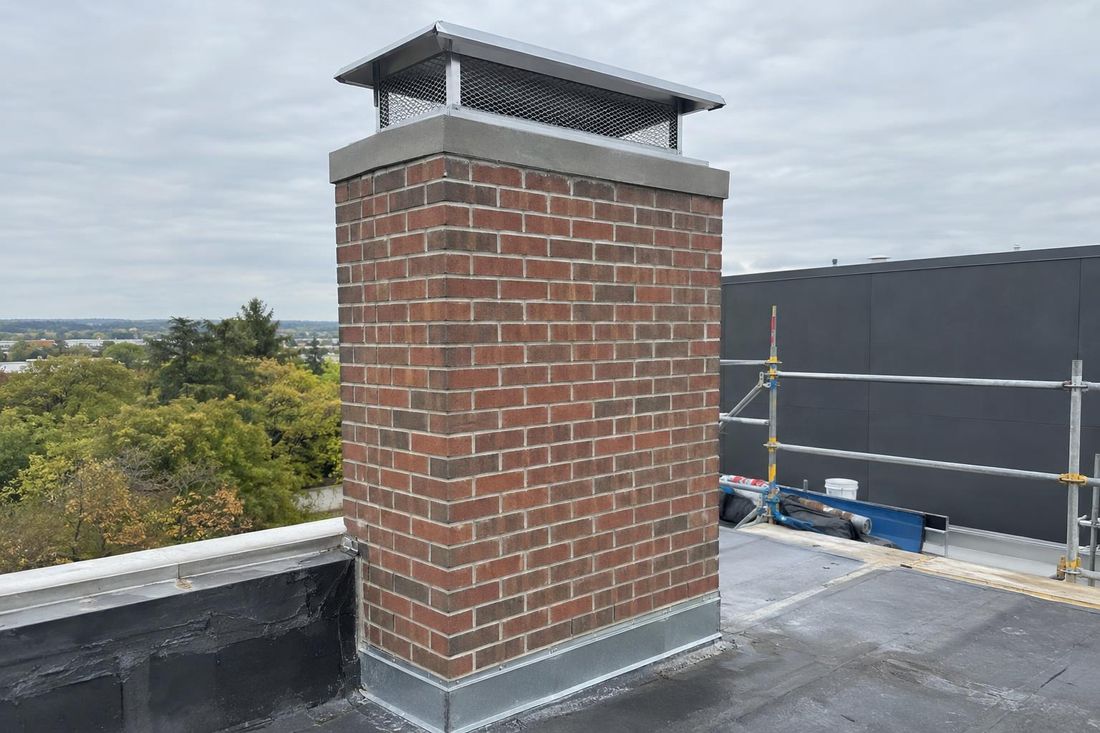
Brick chimney with metal cap on flat roof A red brick chimney stands on a flat commercial roof. It has a concrete crown, a stainless steel cap with mesh screening, and galvanized metal flashing at the base. Scaffolding rails and roofing materials are visible to the right.
What drives the cost
Height is the big one, because taller stacks take longer to reach and longer to work. The number of chimneys matters too, though doing several in one visit usually spreads out the setup. Access equipment is its own line, since a lift, a crane or scaffold each cost differently. Shutdown scheduling can add cost if we have to work odd days or come back in short windows. And roofing coordination counts, because protecting a delicate membrane or tying in flashing takes extra time. We price each chimney separately after the survey, so you can see where the money goes.
How long it takes
Most chimneys take days, not weeks, but that depends on height, condition and how much of the stack has to come down. A full property gets phased building by building, so we're never tearing up every roof at once. Equipment shutdowns usually set the calendar, so tell us early which days are open.
Local expertise: commercial chimney repair in Atlanta
Atlanta gets about 49.7 inches of rain a year. Late winter, early spring and July are the wettest stretches, and fall, especially October, is the driest.
What it means for your job
Mortar, stucco and sealers need dry time. Fall is the easiest season for repointing and sealing, and summer work is planned around afternoon storms.
Overnight freezes can be expected on about 40 days a year in Atlanta.
What it means for your job
Water that soaks into brick, stone and mortar and then freezes is what pops faces off brick and opens joints. Keeping water out matters more here than in places that rarely freeze, and winter mortar work has to be protected overnight.
Flue liner and appliance venting work is a mechanical trade, so we don't do it. We can repair the masonry around a liner, but sizing, relining and connecting a boiler or hood belong to the mechanical contractor. We also won't repair a chimney that's no longer worth saving. Abandoned chimneys can be capped or taken down instead, and sometimes that's the better call. And if the structure underneath the stack is failing, that has to be addressed before we can do lasting work on top of it.