Qualified MasonsVerified ProfessionalsFree EstimatesOn Time
What tuckpointing and repointing involves
Repointing means we grind out the failed mortar between the bricks or blocks and fill the joints with new mortar. The masonry stays and the joints get renewed. On a commercial building, that also means scaffold or lift access, dust control, and a plan that keeps customers and tenants safe on the sidewalk below.
You need it when joints have gone soft, open or recessed and water is finding its way in. Maybe a tenant called about a stain under a window. Maybe the parapet is shedding sand. Waiting rarely helps, because water in an open joint freezes, expands and pushes the damage deeper. We'll walk the building, write up what each facade needs, and give you a free estimate anywhere in Atlanta.
Signs you need tuckpointing and repointing
Stains below windows and rooflinesBrown or damp marks on interior walls usually mean water is coming in through open joints or failed sealant. Start looking there.
Mortar you can scratch outIf a house key sinks into the joint and sand comes out, the mortar has lost its bond and its strength.
Cracked or pulled-away sealantCheck window perimeters and expansion joints. Sealant that has split or let go of the masonry isn't shedding water anymore.
Open coping jointsGaps between coping stones let rain straight into the top of the wall. It's the hardest spot to see from the ground, so we check it up close.
What we handle
Full-elevation repointingWe cut and repoint every joint on a facade, top to bottom. It's the right call when the mortar is worn across the whole wall, and it leaves one consistent finish.
Parapet and coping joint repointingParapets take weather from the top and both faces. We repoint the wall joints and the coping joints together so the cap stops feeding water to the wall below.
Targeted repointing at leak locationsSometimes the trouble is one corner or one run of windows. We repoint that area and redo the sealant beside it, and we'll tell you honestly if the mortar next to it is due.
Block wall joint repairConcrete block joints on warehouses, service buildings and rear walls get cut out and refilled. Cracked block joints are where water gets in.
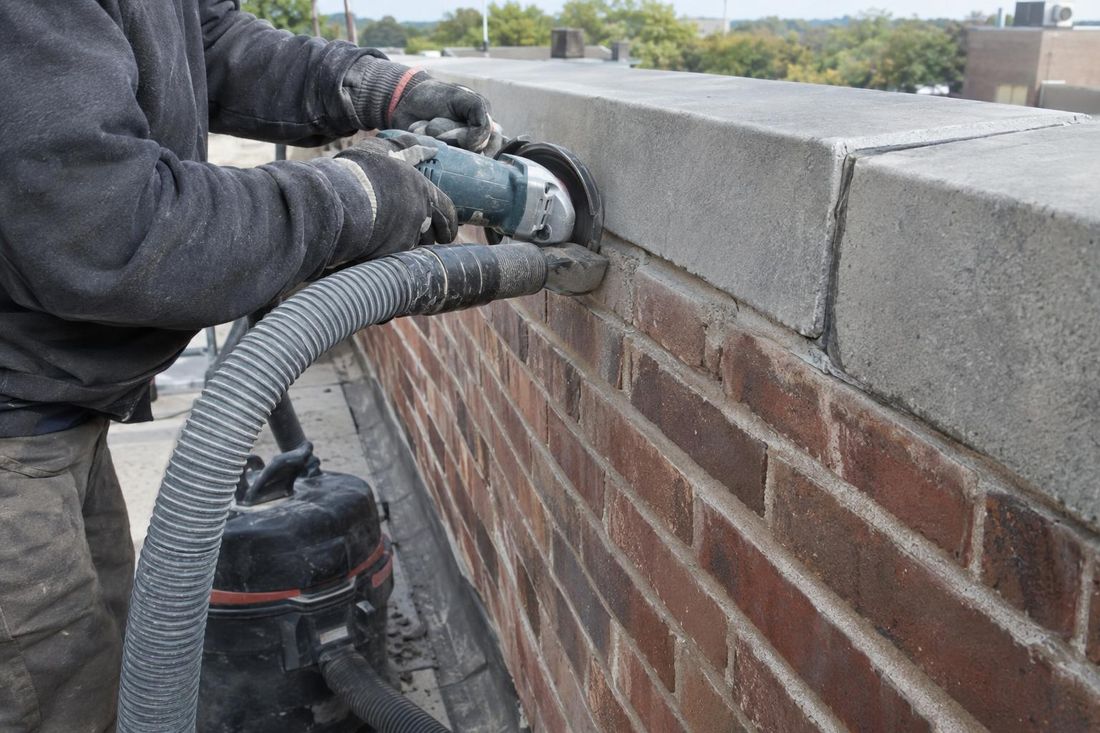
Grinding mortar joints with dust extraction A worker in gloves uses an angle grinder fitted with a dust shroud connected to a vacuum hose to cut into the mortar joints of a red brick wall below a concrete coping cap. A black shop vacuum sits on the rooftop beside the wall.
How we do it
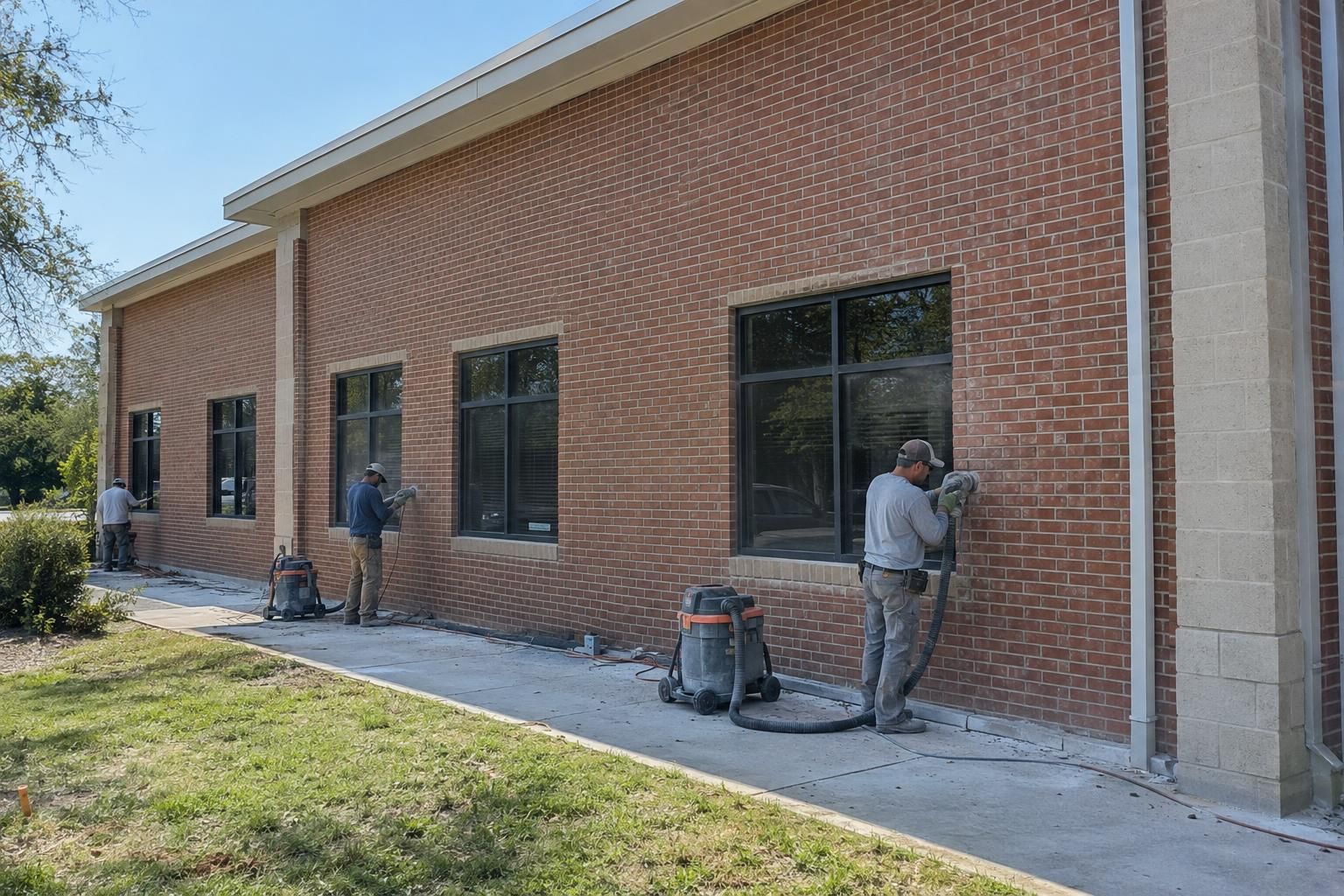
We cut joints out with grinders on dust shrouds, hooked to vacuums. We stop short of the brick edge and finish corners by hand with a chisel, so we don't chew up your masonry. Then we brush and vacuum the joints clean, because new mortar won't bond to dust.
We repoint with mortar matched to the original in color, tooling and strength. Harder isn't better, since mortar tougher than old brick makes the brick take the stress, and that's how faces spall. We pack it in thin layers and tool it to the profile you approved. Sealant joints at windows and expansion joints are usually replaced in the same mobilization. We cut out the old sealant, set new backer rod and tool fresh sealant, so we're not back with a lift next season.
How a job with us goes
Facade survey and written scope
We walk every elevation, sound the joints and look hard at the sealant and coping. You get a written scope by elevation, so you can budget and phase it.
Mock-up panel
We repoint a small panel to set mortar color and joint profile. You approve it before we touch the wall, and it stays as the standard for the whole job.
Access and public protection
We set up scaffold or lifts and screen entrances, walks and air intakes. People still need to get in the door, and the dust has to stay out of the building.
Cutting, repointing and sealant work by phase
We finish one elevation before starting the next. You never have the whole building torn open at once.
Final cleaning and inspection
We clean the walls and the ground, then take down protection. Then we walk each elevation with you and check the work against the mock-up and the scope.
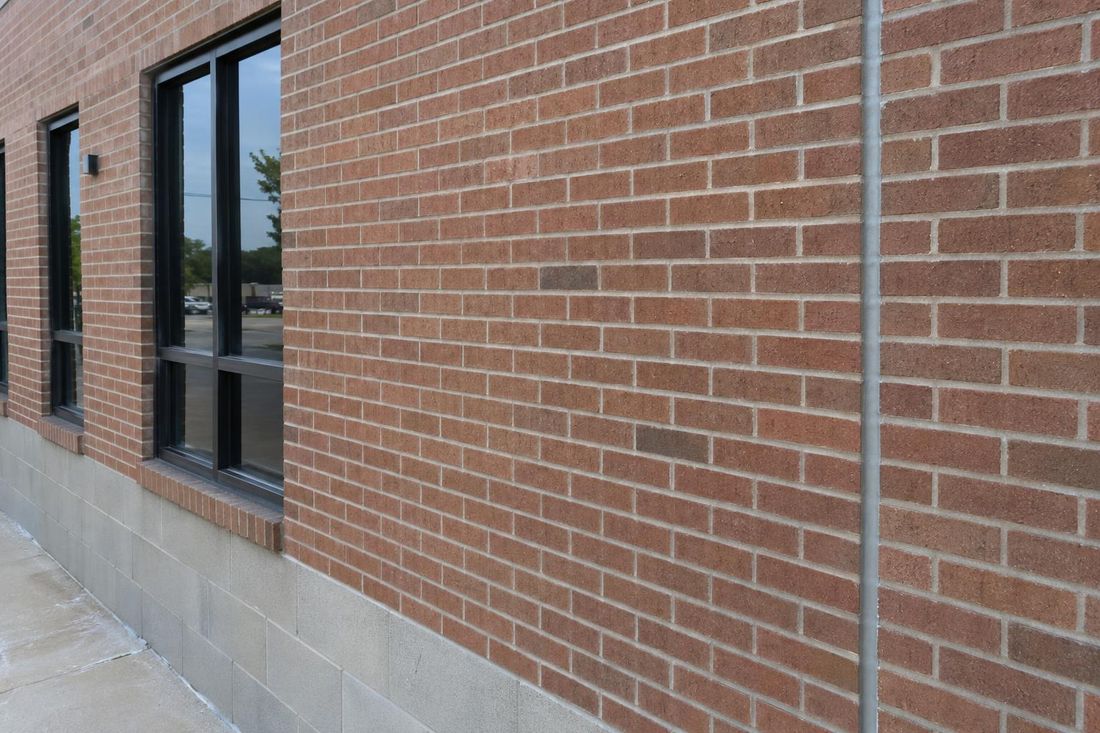
Brick wall with clean mortar joints A red-brown brick wall on a commercial building shows evenly finished light mortar joints, with dark-framed windows and a concrete block base alongside. A vertical metal downspout runs down the brick surface on the right.
What drives the cost
The biggest driver is total wall area, because every linear foot of joint gets cut and filled by hand. Building height matters next, along with how we reach the wall, whether that's a lift, swing stage or scaffold. Dust-control requirements add labor, especially near entrances and air intakes. Phasing around tenants stretches the schedule, and sealant replacement adds its own materials and time. Our written scope breaks the work out by elevation, so you can see where the money goes and decide what to do first.
How long it takes
A multi-story building is measured in weeks, not days. Access setup and the mock-up come first. Then we work through the facade one elevation at a time and finish each before starting the next. Weather, tenant schedules and how much sealant work is in the scope all move the dates. We'll give you a realistic schedule with the estimate.
Local expertise: commercial tuckpointing and repointing in Atlanta
Atlanta gets about 49.7 inches of rain a year. Late winter, early spring and July are the wettest stretches, and fall, especially October, is the driest.
What it means for your job
Mortar, stucco and sealers need dry time. Fall is the easiest season for repointing and sealing, and summer work is planned around afternoon storms.
Overnight freezes can be expected on about 40 days a year in Atlanta.
What it means for your job
Water that soaks into brick, stone and mortar and then freezes is what pops faces off brick and opens joints. Keeping water out matters more here than in places that rarely freeze, and winter mortar work has to be protected overnight.
Repointing won't cure a leak caused by failed flashing or a bad roof, and we won't pretend it will. If water is already inside, a leak investigation should come first, so we know where it's really coming from. We also can't make new mortar match brick that has weathered for decades down to the last shade. Cracks from building movement need to be understood before we fill them. Otherwise they'll just reopen.