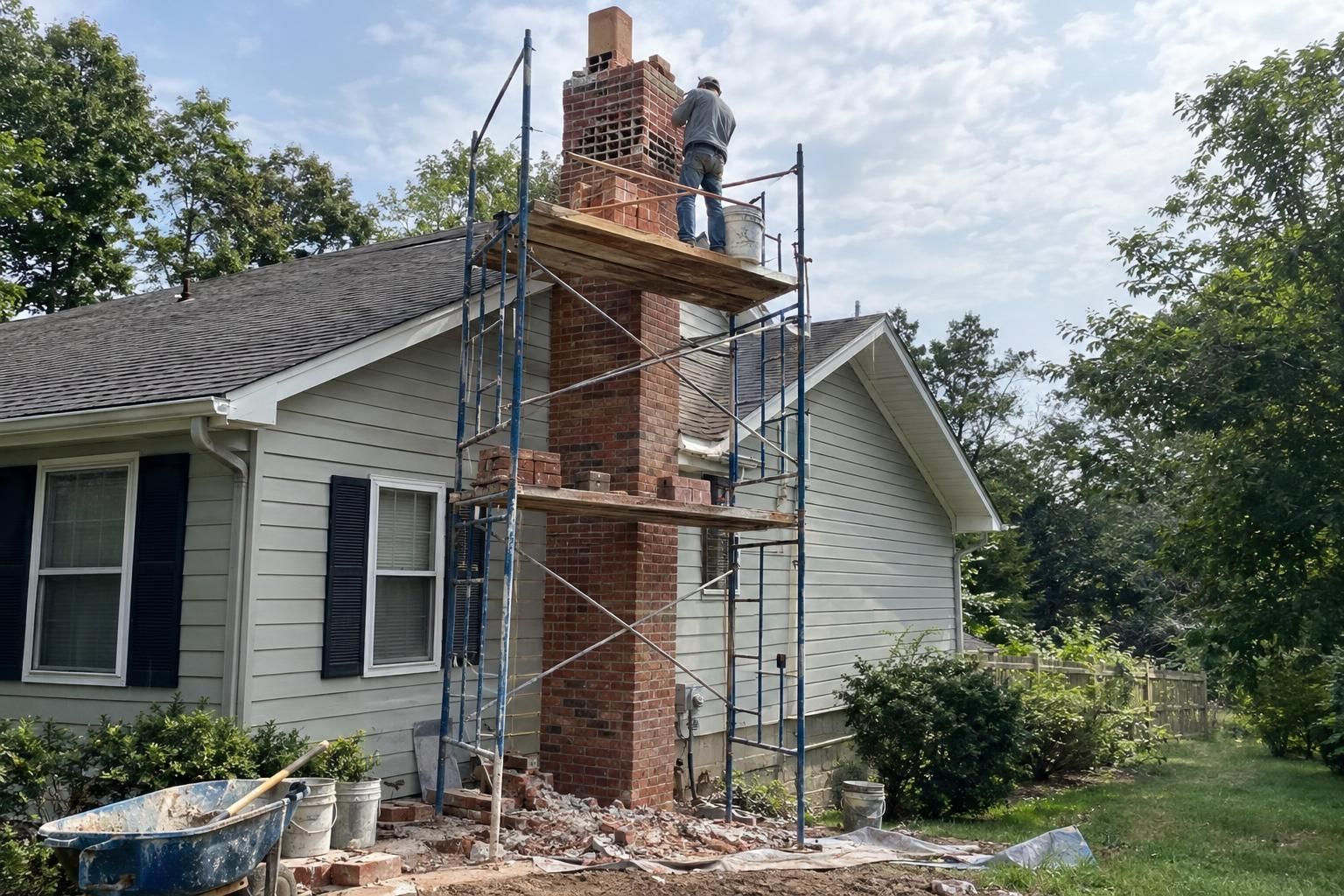
When the brick is loose or the stack leans, we take it down to sound masonry and build it back right. Most of our rebuilds start at the roof line and go up.
Qualified MasonsVerified ProfessionalsFree EstimatesOn Time
What chimney rebuilds involves
A chimney rebuild means we take the bad part of the chimney apart by hand, brick by brick, and lay it back up with new brick, new flue tile, and a new crown. We stop at the first course that's still solid. Everything above that line gets replaced, and everything below it stays put.
You need one when repair won't hold. Pointing works if the brick itself is good. But if bricks are crumbling, cracked through, or the whole stack has a lean to it, fresh mortar is just paint on a bad wall. Water gets in behind it, freezes, and pushes things further apart. We'd rather tell you that straight and show you what we see up there. The estimate is free.
Signs you need chimney rebuilds
Leaning stackSight along the chimney from the yard and compare it to a window edge or the ridge. If it tilts, the bond has let go somewhere below, and that's a rebuild, not a patch.
Loose or fallen brickIf you can wiggle a brick by hand, or pieces keep turning up in the gutter, the mortar behind the face is gone. Pointing the surface won't fix that.
Faces flaking off the brickThat's water working inside the brick and popping the face off. A few is a repair. Whole courses of it means the brick is finished.
Cracked or crumbling crownThe crown is the slab on top. If it's cracked through or has no overhang, rain runs straight down the flue tile and into the brick below.
What we handle
Rebuild from the roof line upThis is our most common job. We take the stack down to the roof line, then rebuild it with new brick, flue tile, and crown, and set new flashing.
Rebuild of the top courses and crownSometimes only the top few courses and the crown have failed. We take down just that, rebuild it, and cast a new crown, so you're not paying for more than you need.
Full rebuild from the groundWhen the damage runs through the whole chimney, we start at the base. It's more work, but a chimney that leans from the bottom can't be fixed from the top.
Taking down an unused chimneyIf you're not using it, we can take it down by hand, course by course, to the level we agree on. The roof and any opening below then need closing up, and we'll talk that through at the estimate.
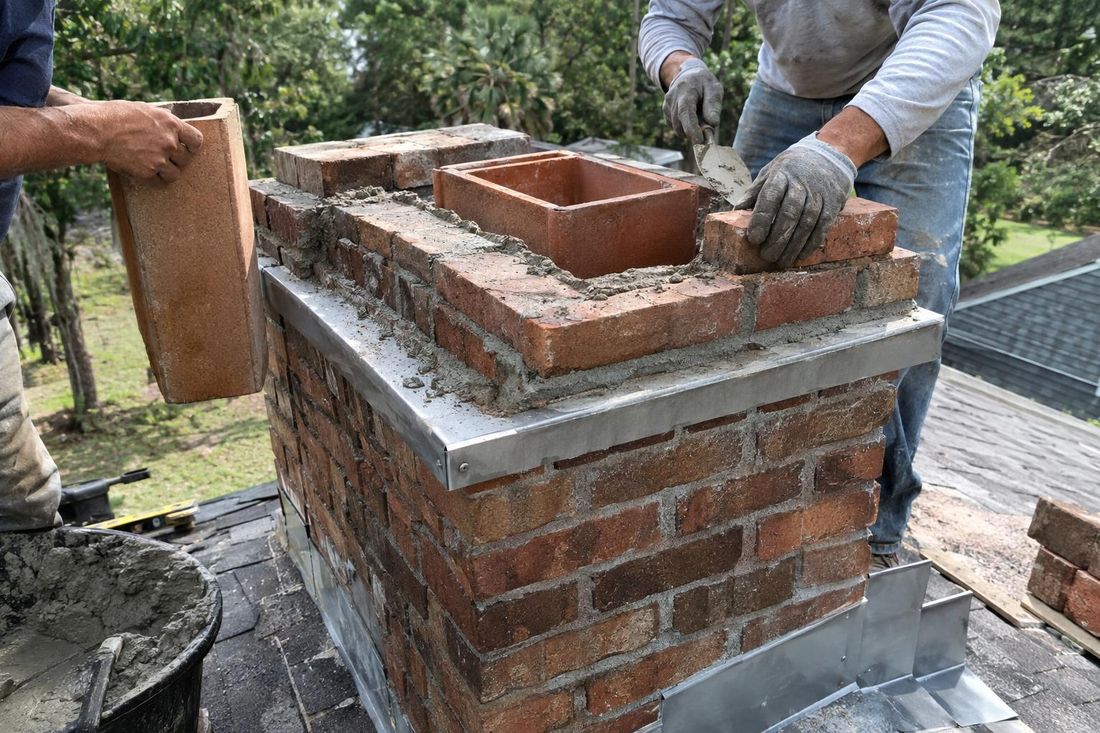
Bricklayers rebuilding a rooftop chimney Two workers wearing gloves lay red bricks with mortar around a clay flue tile on top of a chimney stack with a metal flashing ledge. One worker holds a trowel, the other holds another clay flue liner section, and a mortar tub sits on the roof nearby.
How we do it
We dismantle the stack by hand with a hammer and brick chisel, not a jackhammer, so we don't shake the sound brick below. We clean the bricks we're keeping and set the line with a level. As new brick goes up, we replace the flue tile too, stacking each clay section on the one below. We leave a little room around the tile so it can expand with heat instead of being locked tight to the brick. We mix mortar to suit the brick it's joining, because mortar harder than old brick will chew up the brick.
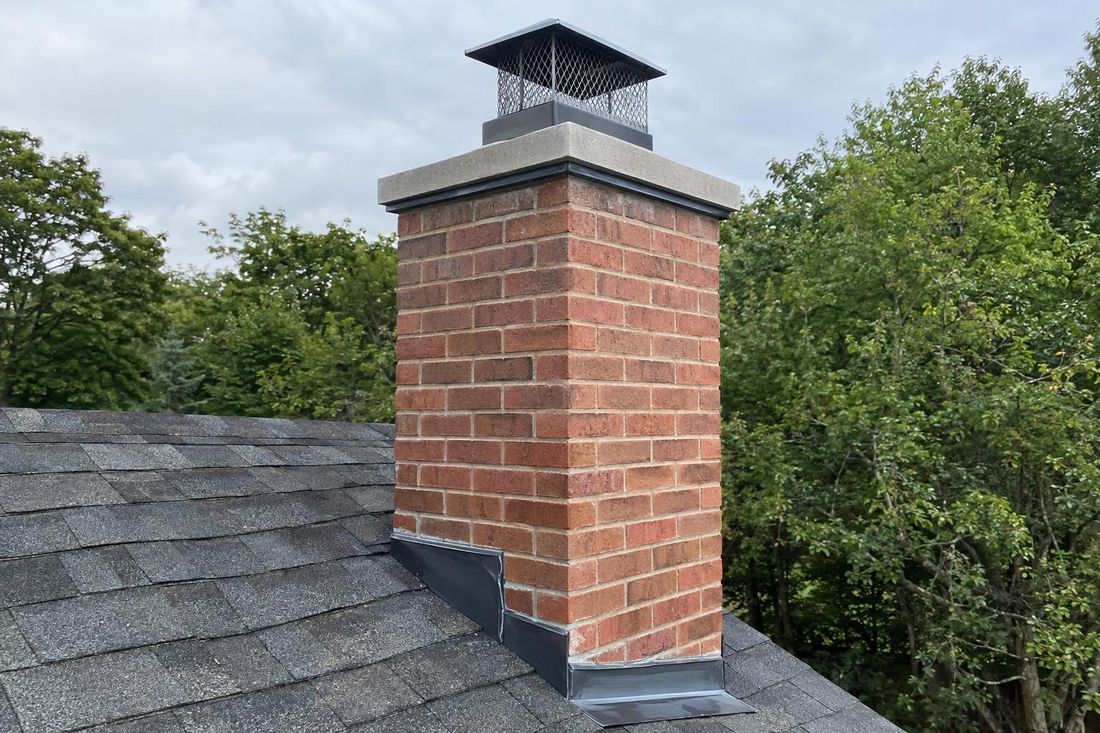
On top, we cast a new crown with an overhang past the brick and a drip edge underneath, so water falls free instead of running down the sides. Where the chimney meets the roof, we fit new flashing. The step flashing goes under the shingles and the counterflashing is tucked into a raked mortar joint. That joint is where old chimneys usually start to leak.
How a job with us goes
Free estimate and brick match
We look at the chimney from the roof and the ground, and we tap the brick to find where it stops being sound. We also hold sample brick up against your house, because color is the first thing you'll see.
Staging and roof protection
We set up staging and cover the roof so falling brick and mortar don't hurt your shingles. It's boring work, but a dented roof would be on us.
Teardown to sound brick
We take the stack down by hand until we hit brick and mortar that hold. That's where the rebuild starts, and we'll show you the line before we build on it.
Rebuild with new flue tile and crown
We lay brick course by course and set new flue tile as it rises. Then we cast the crown with its overhang and drip edge, so the top sheds water.
Flashing and cleanup
We fit the new flashing, then clear the roof, the yard, and the gutters. We check that what came down is gone, not just moved.
Red brick chimney with metal cap A red brick chimney rises from an asphalt shingle roof, finished with a concrete crown and a mesh-sided metal chimney cap on top. Dark metal flashing is fitted around the base where the chimney meets the roof.
What drives the cost
The biggest thing is how far down the rebuild goes. A few courses and a crown is a smaller job than a stack taken to the roof line, and that's smaller than a full rebuild from the ground. After that it's the size of the chimney, since more brick means more hours. Roof height and pitch matter too, because a steep, tall roof takes more staging and more care. Flue tile adds cost, particularly if you have several flues. And flashing depends on how much of the roof joint we need to redo. We can't know all of that from the street, so the free estimate happens with us up close.
How long it takes
A roof-line-up rebuild is typically two to four days. Teardown goes quicker than the build, since laying brick straight and level is the slow part. Rain can stop us, because we don't lay brick or cast a crown in a downpour. The crown also needs time to set before it takes weather. A full rebuild from the ground runs longer. We'll give you our best read after we've seen the chimney, and we'll tell you if anything changes along the way.
Local expertise: residential chimney rebuilds in Atlanta
Atlanta gets about 49.7 inches of rain a year. Late winter, early spring and July are the wettest stretches, and fall, especially October, is the driest.
What it means for your job
Mortar, stucco and sealers need dry time. Fall is the easiest season for repointing and sealing, and summer work is planned around afternoon storms.
Overnight freezes can be expected on about 40 days a year in Atlanta.
What it means for your job
Water that soaks into brick, stone and mortar and then freezes is what pops faces off brick and opens joints. Keeping water out matters more here than in places that rarely freeze, and winter mortar work has to be protected overnight.
A rebuilt chimney may need a permit, so check with your Atlanta building office before we start. We can tell you what we'll be doing, but the permit decision isn't ours. This page covers the chimney stack. Fireplace and firebox problems are a separate job. A rebuild won't fix a smoky fireplace or a cracked firebox. We find out how deep the damage goes only once the stack is coming apart. If it runs deeper than we saw from the roof, we'll stop and talk before we go on. And the brick match will be close, not exact.
Chimney rebuilds questions
Repair or rebuild?
If the brick is sound and only the joints have failed, repair. If bricks are loose, cracked through, or the stack leans, rebuild.
Will the new brick match the house?
We match as closely as we can, and we'll hold samples up to the wall with you first. The chimney top is rarely seen up close.
How do you know how far down to go?
We tap and pull until we reach brick and mortar that hold. That's the line. We can't see all of it from the roof, so if it's deeper than expected, we'll tell you.
Can I use the fireplace while you're working?
No. The flue is open or in pieces, and there's brick coming down. Wait until the work is done.
What if only the crown is cracked?
Then we may only need to replace the crown, and maybe a few courses. Cracks in the crown still let water in, so don't wait on it.