Residential Paver repair and releveling in Atlanta
Sunken pavers don't fix themselves, but they rarely need to be replaced either. We lift them, rebuild what's underneath, and set the same pavers back so you can't tell we were there.
Qualified MasonsVerified ProfessionalsFree EstimatesOn Time
What paver repair and releveling involves
Paver repair is simple to describe. We pull up the affected pavers, stack them in order, and fix the base beneath, because the pavers are almost never the real problem. Then we re-lay them in the same pattern. Since your pavers go back where they came from, the repair does not show.
You need it when your patio has a dip where water sits, a walkway border is drifting toward the lawn, or a paver rocks under your foot. Those are signs the base has moved. Is it a small spot right now? Good. Fix it then, before the low area grows and the pavers around it start to shift too. A dip just keeps collecting water and getting lower.
Signs you need paver repair and releveling
Puddles after rainWater sitting in one spot means that area has dropped below the pavers around it. Usually the base underneath has washed out or settled.
Pavers that rock or clack underfootThe bedding sand beneath them has shifted or drained away, so nothing is holding them level anymore.
Border pavers drifting and joints openingGaps along the edge and pavers creeping toward the lawn tell us the edge restraint has failed or was never anchored well.
A hump near a tree or shrubRoots lifting from below push pavers up into a ridge. It's a different fix than a sunken spot, and we'll tell you which one you've got.
What we handle
Releveling sunken areasWe lift the low pavers, rebuild the base under them, and set them back flush with the ones around them. It's the most common call we get for patios and walkways.
Fixing spreading edgesWe reset the border pavers, replace edge restraint that has failed, and refill the joints so the field stops creeping outward. Patio borders and driveway aprons are where we see it most.
Replacing cracked or stained paversWe pull the damaged ones and blend new pavers in among your old ones. Oil and rust stains that won't clean up are a common reason.
Re-sanding and sealingWhen joints have washed out, we refill them with polymeric sand. We can also seal the surface once it's clean and dry, which helps hold the sand in place.
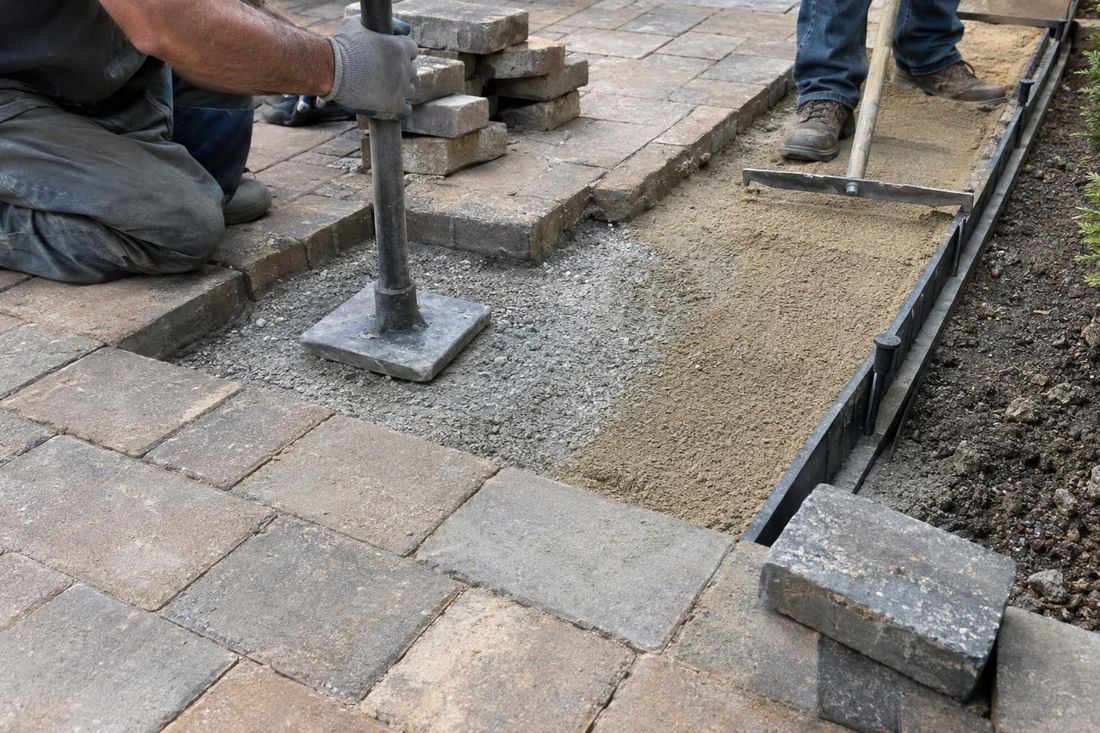
Compacting base and screeding paver bedding Workers prepare a paver area where existing interlocking pavers have been lifted, showing compacted gravel base being tamped with a hand tamper and a section of leveled bedding sand being screeded beside a plastic edge restraint. Stacks of removed pavers sit nearby, with intact pavers surrounding the open section.
How we do it
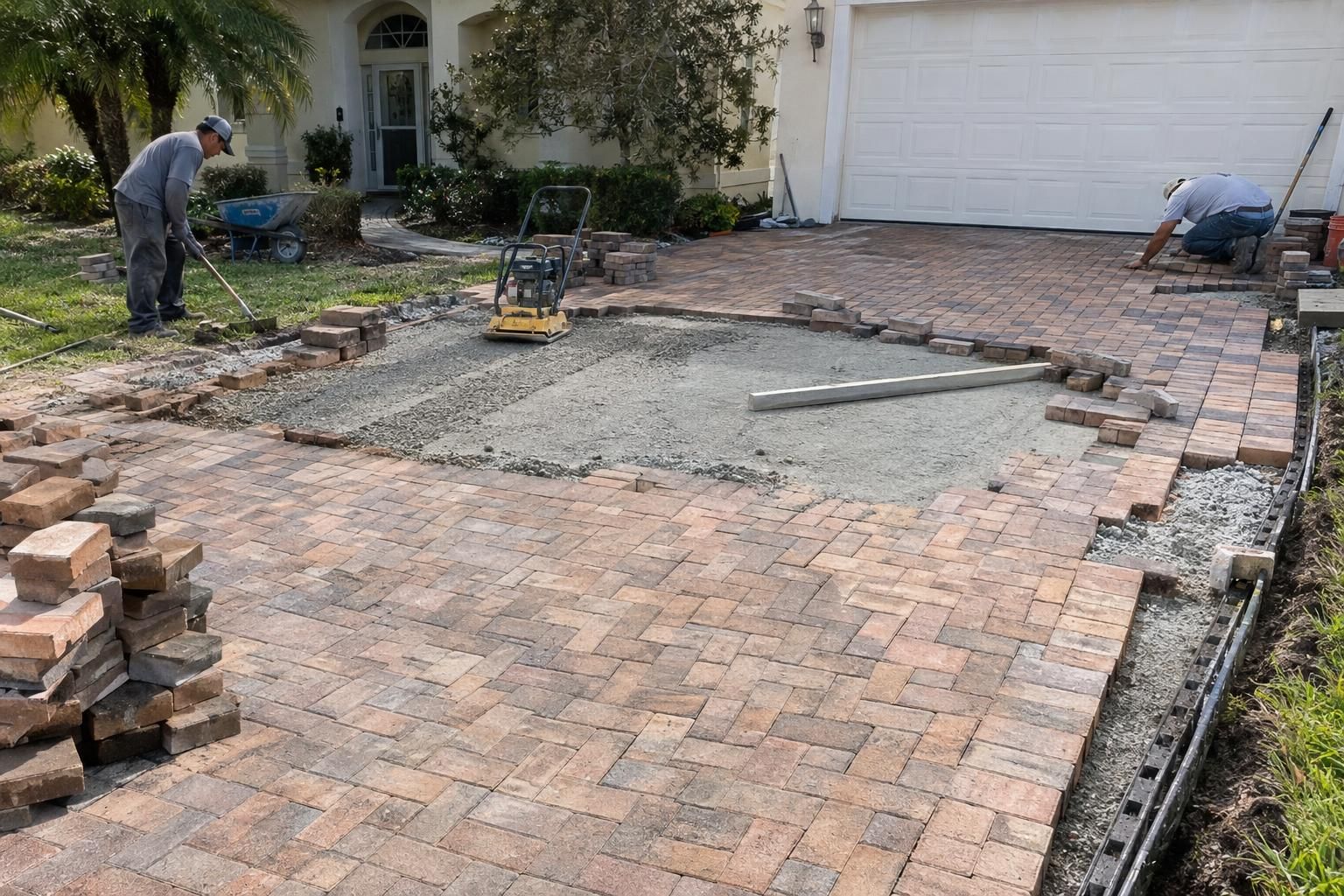
We start by pulling the pavers and stacking them in the order they came out. Then we dig into the base to see what went wrong. Whatever is low gets more base material, and we compact it in thin layers with a plate compactor so it doesn't settle again. Then we lay fresh bedding sand and screed it level against a straightedge.
The same pavers go back in the same pattern, so your lines and cuts match what you had. Failed edge restraint gets replaced, because a solid edge is what keeps the field tight. Last, we sweep polymeric sand into the joints, run the compactor over the surface, and mist it so the sand sets up.
How a job with us goes
Free estimate and cause check
We look at the damage, then we look for the reason. Downspouts, grade, roots and base depth all get checked, because fixing the dip without fixing the cause just brings it back.
Pavers lifted and stacked
We pull the affected pavers and stack them in the order they came out. That keeps your pattern and cuts intact.
Base corrected
We dig out the soft or washed-out spots, add base material, and compact it in layers. Then we screed fresh bedding sand to grade.
Pavers re-laid, edged and sanded
The pavers go back in the same pattern and we replace edge restraint where it failed. Then we sweep polymeric sand into the joints and wet it down so it sets.
Final walkthrough and cleanup
We sweep the surface, haul off the leftover material, and walk it with you. We check that nothing rocks and that water runs where it should.
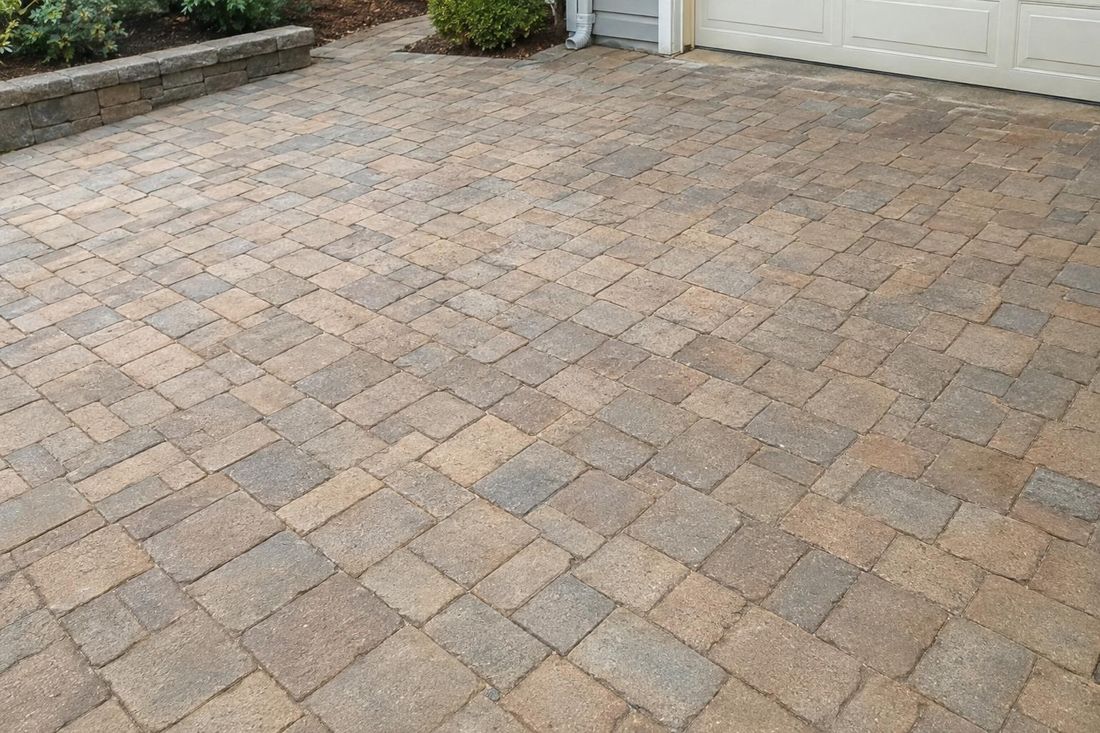
Residential paver driveway with even surface A multi-colored interlocking concrete paver driveway in tan, gray, and brown tones sits beside a garage door and a low stone retaining wall. The pavers form a flat, uniform surface with tight joints and no visible sinking, gaps, or uneven spots.
What drives the cost
Price follows how much we have to pull up and why it went down. A small dip takes less work than a patio corner that washed out. Cause matters too. A washout from a downspout is usually straightforward base work, while roots or a thin base from the start mean more digging and more material. Edge repair adds to the job when restraint has to be replaced along a long run. Replacement pavers only come into it if some are cracked or stained past saving. We'll walk the area with you and give a free estimate, so you know where you stand before we lift a single paver.
How long it takes
Most repairs take a day. A single sunken patch or a short stretch of edge is often finished well before dark. Bigger areas, a lot of replacement pavers, or roots that need dealing with can stretch it. Polymeric sand needs time to set, so we'll ask you to keep water off the joints for a while after we leave. We'll give you a realistic time when we do the estimate, and we'll tell you if the weather is likely to change the plan.
Local expertise: residential paver repair and releveling in Atlanta
The red clay of the Georgia Piedmont is typified by the Cecil soil series: very deep, well drained soil on ridges and side slopes, with a red subsoil that averages 35 to 60 percent clay.
What it means for your job
Clay holds water against a wall and does not recover well once it is compacted, so drainage behind a retaining wall and a properly built base under pavers and footings matter more here than the surface material.
Atlanta gets about 49.7 inches of rain a year. Late winter, early spring and July are the wettest stretches, and fall, especially October, is the driest.
What it means for your job
Mortar, stucco and sealers need dry time. Fall is the easiest season for repointing and sealing, and summer work is planned around afternoon storms.
Overnight freezes can be expected on about 40 days a year in Atlanta.
What it means for your job
Water that soaks into brick, stone and mortar and then freezes is what pops faces off brick and opens joints. Keeping water out matters more here than in places that rarely freeze, and winter mortar work has to be protected overnight.
We can fix the pavers, but we can't fix the water. If a downspout or drainage problem caused the washout, it has to be redirected or the dip returns, and we'll point it out when we see it. Replacement pavers may be a slightly different shade than the weathered ones around them. We blend them in, but we can't make new match old. Some stains won't come out of a paver no matter what we try. And if the whole base was built wrong from the start, patching one area won't hold, so we'll tell you honestly if a larger rebuild makes more sense.
Water washing out the base, a thin base, or roots. Often it's a downspout dumping at the edge of the patio. We can usually tell which one it is once we dig down.
Can you match my old pavers?
Your existing pavers are reused, so most of the surface is a perfect match. Any new ones are blended in among them.
Do you have to take up my whole patio?
No. We lift the affected pavers and a margin around them. If the base is bad across the whole area, we'll say so before we start.
Will the low spot come back?
If we fix what caused it, it's much less likely. But a washout that keeps running will win in the end, so the water has to go somewhere else.
When can I use the patio again?
Foot traffic is fine fairly soon. Give the polymeric sand time to set and keep water off it, and we'll tell you when the furniture can go back.